Dasatinib added to chemotherapy did not improve survival outcomes in CBF-AML patients
A phase 3 study of intensive chemotherapy with or without dasatinib in core-binding factor acute myeloid leukemia
Randomized, open-label, phase 3 trialNo clear difference
Does adding dasatinib to intensive chemotherapy improve event-free survival in CBF-AML patients?
Who
202
Adult patients with core-binding factor acute myeloid leukemia
Compared
Standard arm
Dasatinib arm
Main outcome
event-free survival
Result: hazard ratio 0.92 (95% confidence interval, 0.63-1.33)
Bottom line: Adding dasatinib to intensive chemotherapy failed to improve survival outcomes and increased serious adverse events.
Blood · 2026-01-06Download image
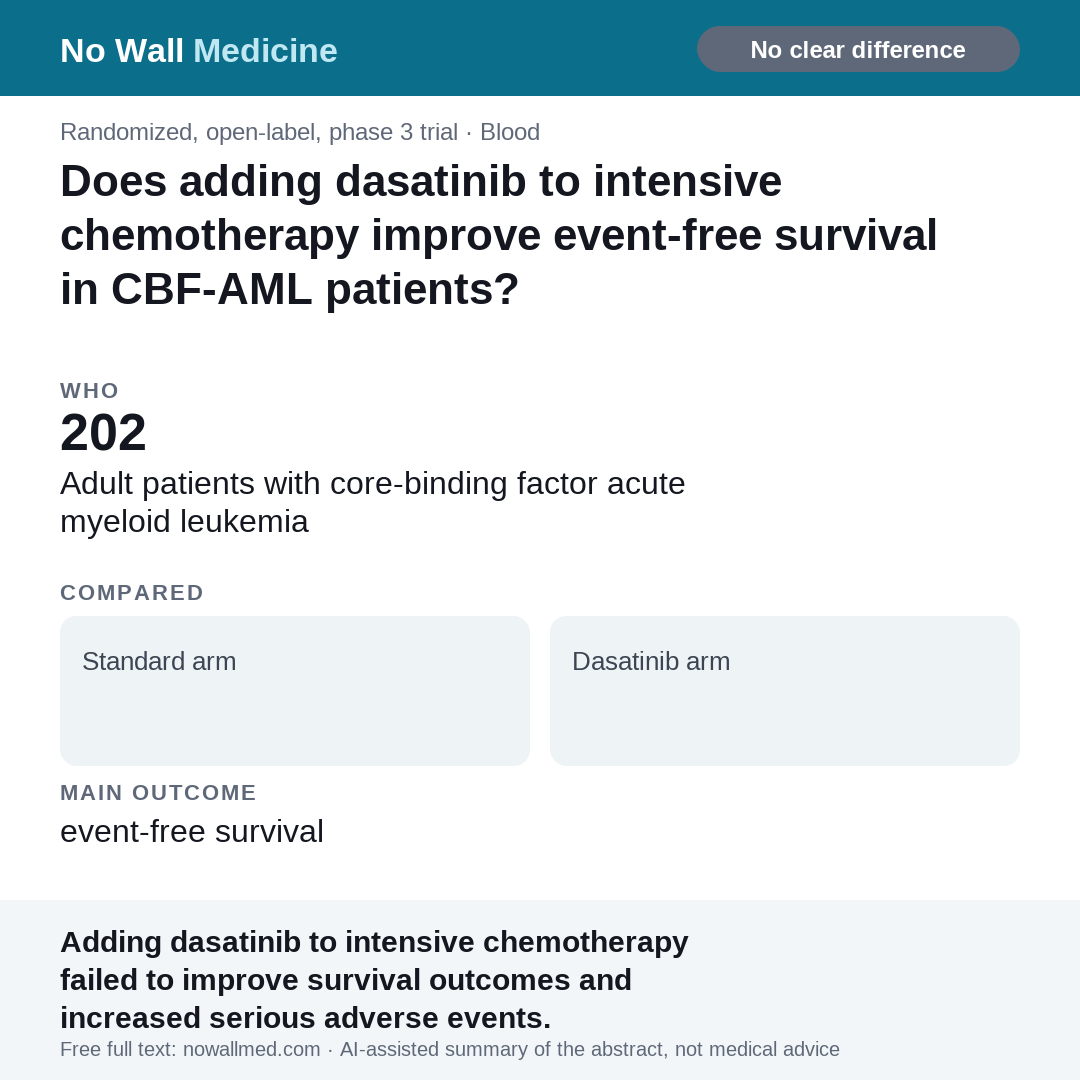
Clinical question: Does adding dasatinib to intensive chemotherapy improve event-free survival in CBF-AML patients?
Why it matters: Doctors have had limited trial evidence on using dasatinib with chemotherapy in CBF-AML
Key points
- 202 adult patients with CBF-AML were randomly assigned to standard or dasatinib arms.
- No statistically significant difference in event-free survival was found between arms.
- Dasatinib arm had higher incidence of serious adverse events at 64%.
Headline and key points written with AI from the paper’s abstract, with every number checked against it. Read the paper before relying on them.
Abstract
Core-binding factor acute myeloid leukemia (CBF-AML) is associated with KIT mutations and deregulated expression of KIT. We report results from the randomized, open-label, phase 3 trial of intensive chemotherapy with or without the multikinase inhibitor dasatinib in adult patients with CBF-AML. Patients received "3+7" induction therapy, followed by 4 cycles of high-dose cytarabine; in the investigational arm, patients received dasatinib 100 mg daily on days 8 to 21 in induction, and on days 6 to 28 in consolidation cycles, followed by 12-month single-agent dasatinib 100 mg daily. Primary end point was event-free survival (EFS). Secondary end points included overall survival, relapse-free survival, and cumulative incidence of relapse. A total of 202 patients were randomly assigned to the standard arm (n = 102) and to the dasatinib arm (n = 100). Median age was 49 years (range, 18-77); 94 patients had t(8;21), 108 had inv(16)/t(16;16); and 58 (28.7%) patients had a KIT comutation. There was no statistically significant difference in EFS (hazard ratio, 0.92; 95% confidence interval, 0.63-1.33; P = .66) or secondary end points between treatment arms. There was also no significant difference in EFS in subgroup analyses according to age, CBF-AML type, and KIT mutation status. The incidence of serious adverse events was higher in the investigational arm (64%) than in the standard arm (36%). In patients with CBF-AML, the addition of dasatinib to intensive chemotherapy failed to improve survival outcomes. The addition of dasatinib was associated with an increase in toxicity. This trial was registered at www.ClinicalTrials.gov as NCT02013648.
Abstract reproduced under the article’s CC BY NC ND licence.
Topics
Cite this article
Döhner H, Späth D, Saadati M, Fiedler W, Götze K, Koller E. A phase 3 study of intensive chemotherapy with or without dasatinib in core-binding factor acute myeloid leukemia. Blood. 2026. doi:10.1182/blood.2025030722
Spotted a mistake? Suggest a correction