Personalized precision medicine did not improve overall survival for patients with advanced pancreatic cancer
A Phase III Randomized Trial of Integrated Genomics and Avatar Models for Personalized Treatment of Pancreatic Cancer: The AVATAR Trial
Phase III randomized trialNo clear difference
Does comprehensive precision medicine improve efficacy compared to conventional treatment in pancreatic cancer?
Who
125
Patients with advanced pancreatic ductal adenocarcinoma
Compared
8.7 monthsConventional treatment
8.6 monthsPrecision medicine
Main outcome
median overall survival
Result: P = 0.849
Bottom line: Precision medicine did not improve overall survival compared to conventional treatment in the intention-to-treat analysis.
Limitation: Personalized medicine was challenging to implement in most patients, limiting intention-to-treat analysis.
Clin Cancer Res · 2024-11-14Download image
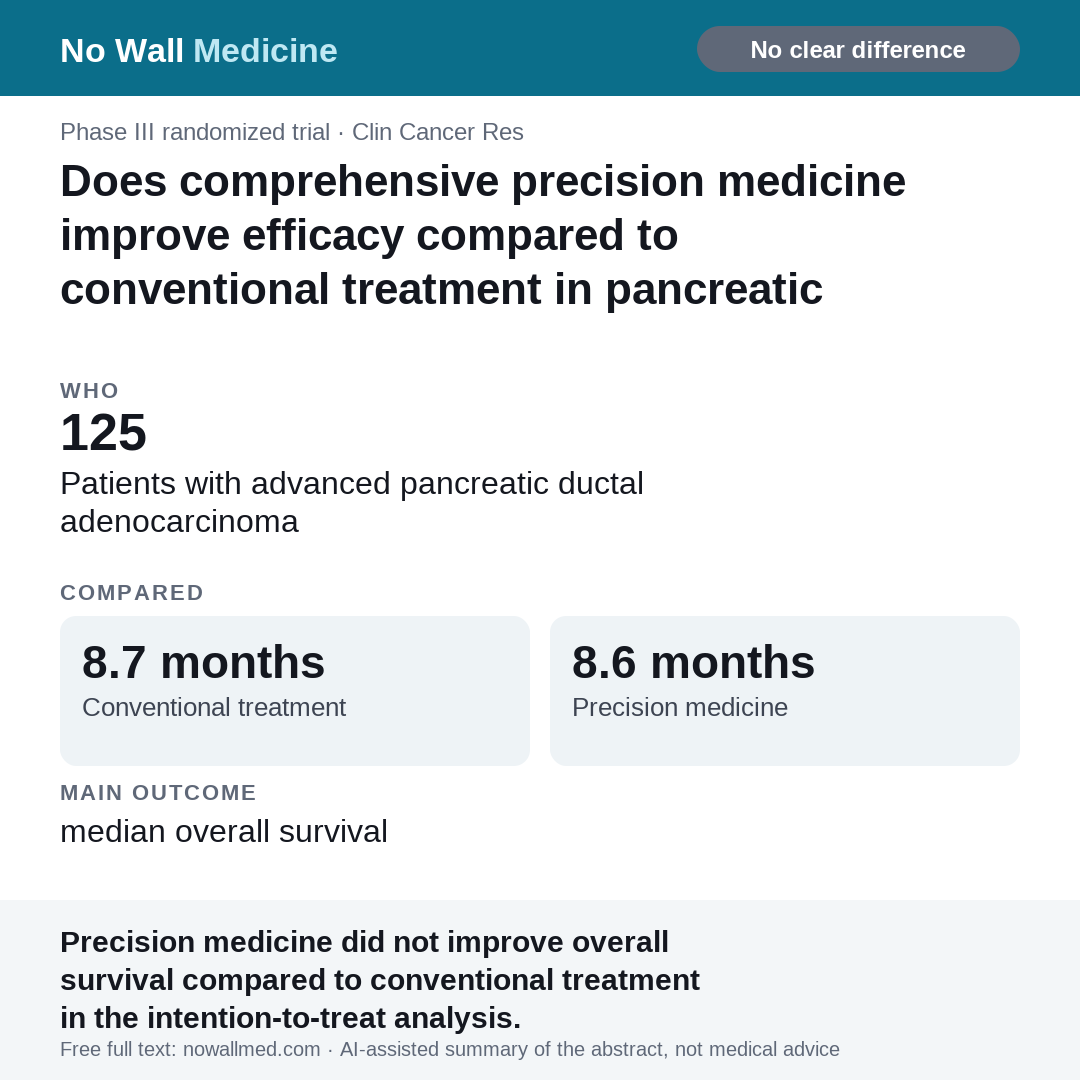
Clinical question: Does comprehensive precision medicine improve efficacy compared to conventional treatment in pancreatic cancer?
Why it matters: It is unknown if using whole-exome sequencing and tumor models to guide treatment improves survival for patients with advanced pancreatic ductal adenocarcinoma.
Key points
- Researchers randomized 125 patients with pancreatic ductal adenocarcinoma to either conventional treatment or precision medicine using genetic sequencing and tumor models.
- The median overall survival was 8.7 months for the conventional group and 8.6 months for the precision medicine group (P = 0.849).
- In the precision medicine group, only 10.2% of 39 patients receiving second-line treatment actually received personalized therapy.
Limitation the authors note: Personalized medicine was challenging to implement in most patients, which limited the interpretation of the intention-to-treat analysis.
Headline and key points written with AI from the paper’s abstract, with every number checked against it. Read the paper before relying on them.
Was this summary helpful?
Subject terms
Cite this article
Sarno F, Tenorio J, Perea S, Medina L, Pazo-Cid R, Juez I. A Phase III Randomized Trial of Integrated Genomics and Avatar Models for Personalized Treatment of Pancreatic Cancer: The AVATAR Trial. Clin Cancer Res. 2024. doi:10.1158/1078-0432.CCR-23-4026
Spotted a mistake? Suggest a correction
Top studies every Monday
The week’s key trials and guidelines in your specialties, plus any topics you follow. By email, free.
Get the weekly digest