Telephone-based peer support showed small to moderate improvements in psychological distress after stem cell transplantation
A pilot randomized clinical trial of a peer support intervention for hematopoietic stem cell transplantation
Pilot randomized clinical trialBenefit found
Does the STEPP peer support intervention reduce psychological distress and enhance quality of life?
Who
78
Patients undergoing hematopoietic stem cell transplantation
Compared
STEPP intervention: small-to-moderate improvements in day 30 anxiety (d = -0.36)
Usual care
Main outcome
psychological distress and quality of life
Bottom line: The STEPP peer support intervention is feasible, acceptable, and shows promising psychosocial benefits post-transplantation.
Limitation: This was a pilot study warranting a fully powered multisite efficacy trial.
Blood Adv · 2026-04-07Download image
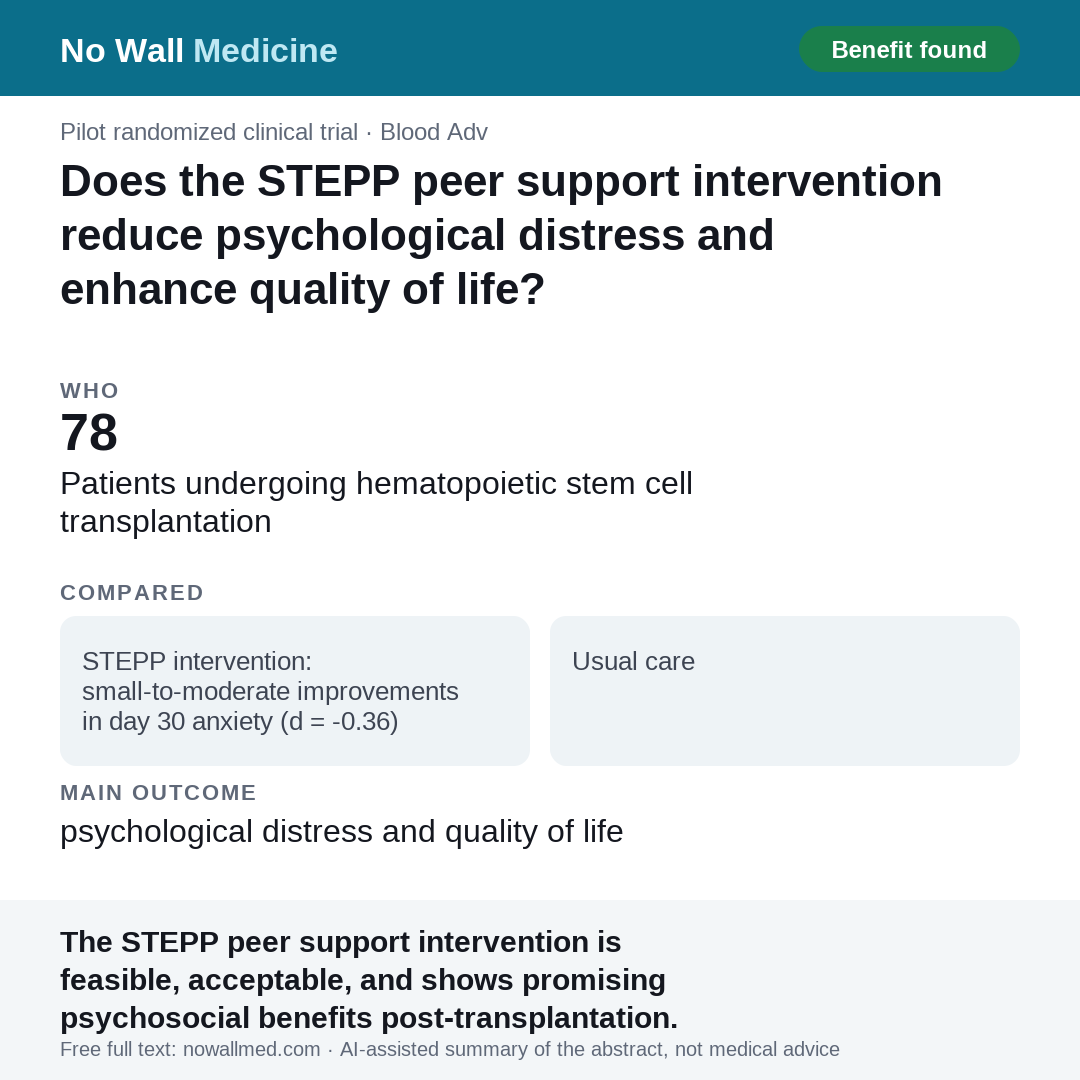
Clinical question: Does the STEPP peer support intervention reduce psychological distress and enhance quality of life?
Why it matters: Structured peer support interventions are limited for patients undergoing hematopoietic stem cell transplantation to help reduce psychological distress and improve quality of life.
Key points
- Researchers studied 78 participants undergoing hematopoietic stem cell transplantation, comparing a five-session telephone peer support program to usual care.
- The peer support program showed small-to-moderate improvements in anxiety at day 30 (d = -0.36) and day 60 (d = -0.58), as well as depression (d = -0.25) and posttraumatic stress (d = -0.28).
- The intervention also showed small-to-moderate improvements in quality of life (d = 0.48), social support (d = 0.36), and self-efficacy (d = 0.46).
Headline and key points written with AI from the paper’s abstract, with every number checked against it. Read the paper before relying on them.
Abstract
Peer support has been associated with improved patient-reported outcomes (PROs), including reduced psychological distress, among patients undergoing hematopoietic stem cell transplantation (HSCT), but structured interventions are limited. This study assessed the feasibility, acceptability, and preliminary effects of a scalable peer support intervention to reduce psychological distress and enhance quality of life (QOL) post-HSCT. We conducted a pilot randomized clinical trial evaluating the Supporting Transplant Experiences with Peer Program (STEPP), a 5-session, telephone-based intervention delivered by an HSCT survivor offering psychoeducation and coping strategies. Participants were recruited 1 to 2 weeks pre-HSCT admission and randomized to STEPP or usual care. Feasibility was defined as ≥60% enrollment and ≥60% completing ≥3 sessions. Acceptability was assessed using the Client Satisfaction Questionnaire (CSQ; ≥3/4 mean benchmark). PRO measures of anxiety, depression (Hospital Anxiety and Depression Scale), posttraumatic stress (Post-Traumatic Stress Disorder Checklist-Civilian Version), QOL (Functional Assessment of Cancer Therapy-Bone Marrow Transplant), social support (Social Support and Effectiveness Questionnaire), and self-efficacy (Cancer Self-Efficacy Scale) were assessed pre-HSCT and at 30 and 60 days post-HSCT. Mixed-effects models explored preliminary effects. We enrolled 77% (90 of 117) of eligible patients (STEPP, n = 45; usual care, n = 45); 12 became ineligible due to HSCT cancellation or postponement. Among 78 active participants (mean age, 58.9 years [standard deviation, 12.3]; 57.7% women), all STEPP participants completed ≥3 sessions, and the mean CSQ score was 3.5. STEPP showed small-to-moderate improvements in day 30 anxiety (d = -0.36) and day 60 anxiety (d = -0.58), depression (d = -0.25), posttraumatic stress (d = -0.28), QOL (d = 0.48), social support (d = 0.36), and self-efficacy (d = 0.46). STEPP exceeds feasibility and acceptability thresholds, showing promising psychosocial benefits warranting a fully powered multisite efficacy trial. This trial was registered at www.clinicaltrials.gov as NCT06010017.
Abstract reproduced under the article’s CC BY NC ND licence.
Topics
Cite this article
Amonoo HL, Keane EP, Guo M, Gudenkauf LM, Boardman AC, Larizza IS. A pilot randomized clinical trial of a peer support intervention for hematopoietic stem cell transplantation. Blood Adv. 2026. doi:10.1182/bloodadvances.2025018918
Spotted a mistake? Suggest a correction