Low-calorie plant-based diet did not improve clinical response to medications in ulcerative colitis patients
A Pilot Randomized Control Trial to Assess the Adjunctive Effect of Diet on Response to Advanced Therapies in Patients With Ulcerative Colitis
Randomized pilot control trialMixed results
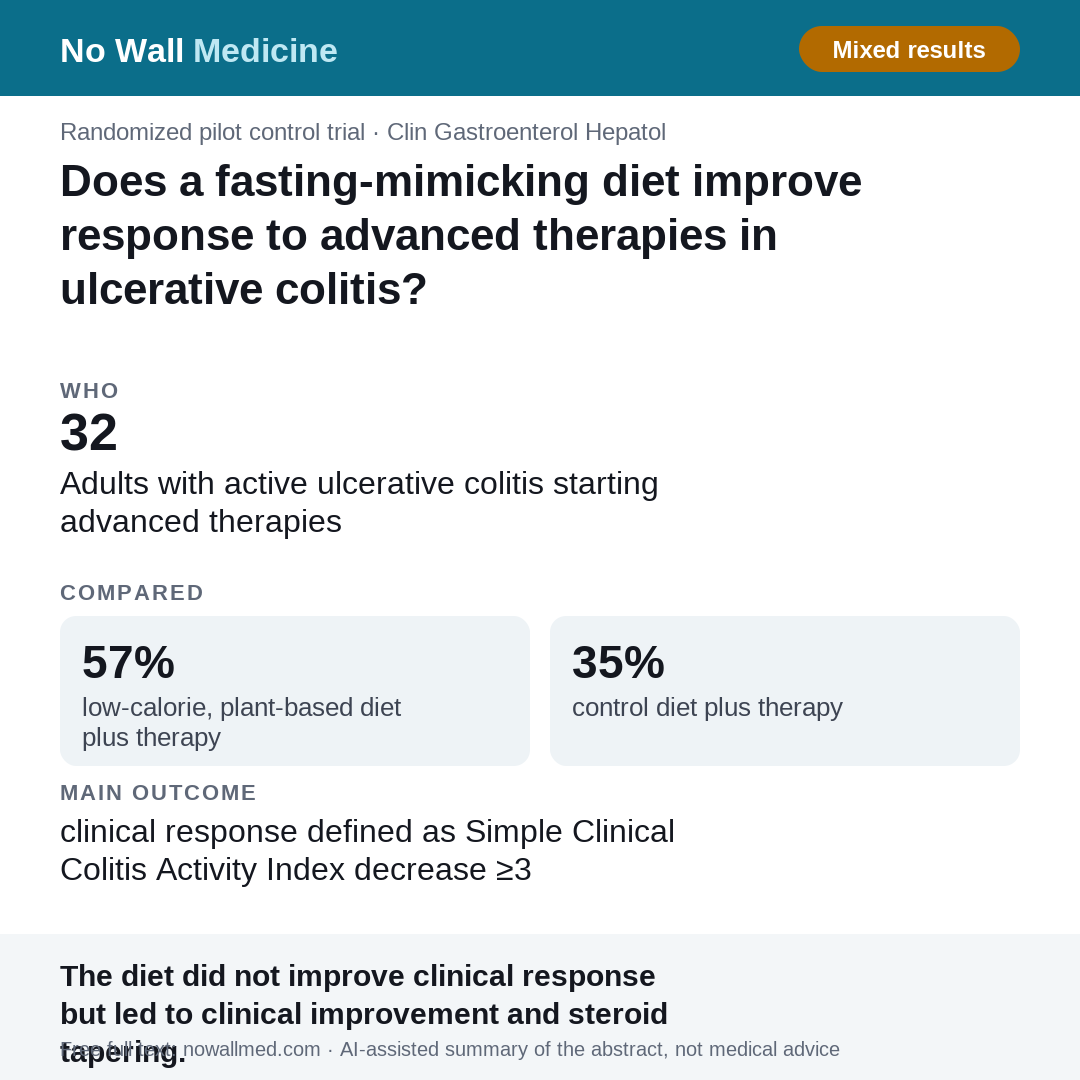
Does a fasting-mimicking diet improve response to advanced therapies in ulcerative colitis?
Who
32
Adults with active ulcerative colitis starting advanced therapies
Compared
57%low-calorie, plant-based diet plus therapy (n = 8 of 14)
35%control diet plus therapy (n = 6 of 17)
Main outcome
clinical response defined as Simple Clinical Colitis Activity Index decrease ≥3
Bottom line: The diet did not improve clinical response but led to clinical improvement and steroid tapering.
Limitation: Results were limited by sample size due to early study end.
Clin Gastroenterol Hepatol · 2025-05-14Download image
Clinical question: Does a fasting-mimicking diet improve response to advanced therapies in ulcerative colitis?
Why it matters: It is unclear if a low-calorie, plant-based, fasting-mimicking diet can improve how patients respond to advanced therapies for ulcerative colitis.
Key points
- Researchers studied 32 adults with active ulcerative colitis randomized to receive either a low-calorie, plant-based, fasting-mimicking diet plus medication or a control diet plus medication.
- The primary clinical response rate at week 8 was 57% (n = 8 of 14) in the diet group compared to 35% (n = 6 of 17) in the control group.
- The diet group showed greater clinical improvement in continuous Simple Clinical Colitis Activity Index scores, better subscores for urgency and well-being, and successful steroid tapering.
Limitation the authors note: The study ended early due to COVID-19 and results were limited by sample size.
Headline and key points written with AI from the paper’s abstract, with every number checked against it. Read the paper before relying on them.
Was this summary helpful?
Subject terms
Cite this article
Damas OM, Leo M, Colina N, Mijares M, Fernandez I, McALeavy J. A Pilot Randomized Control Trial to Assess the Adjunctive Effect of Diet on Response to Advanced Therapies in Patients With Ulcerative Colitis. Clin Gastroenterol Hepatol. 2025. doi:10.1016/j.cgh.2025.03.020
Spotted a mistake? Suggest a correction
Top studies every Monday
The week’s key trials and guidelines in your specialties, plus any topics you follow. By email, free.
Get the weekly digest