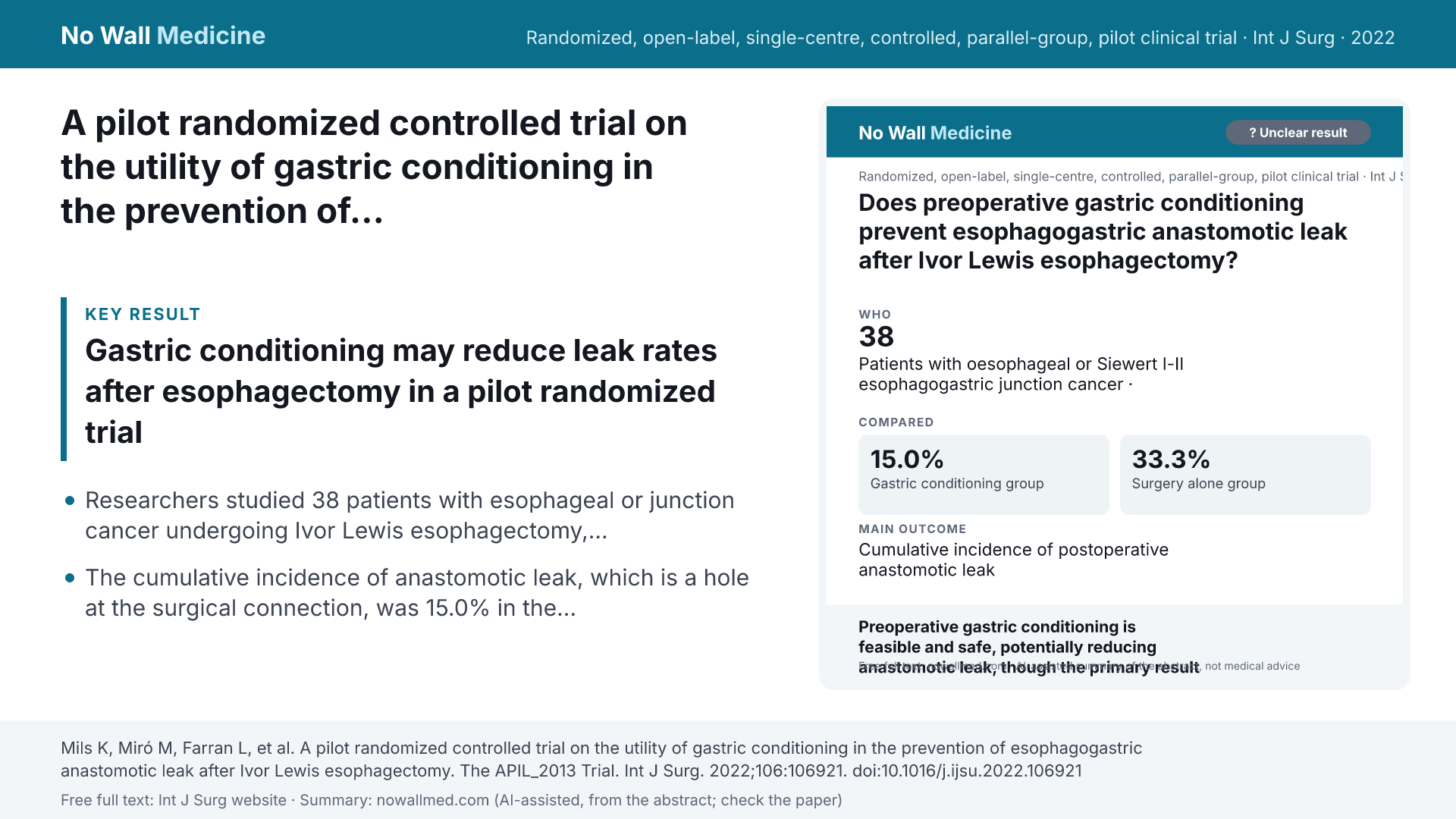
Gastric conditioning may reduce leak rates after esophagectomy in a pilot randomized trial
A pilot randomized controlled trial on the utility of gastric conditioning in the prevention of esophagogastric anastomotic leak after Ivor Lewis esophagectomy. The APIL_2013 Trial
Randomized, open-label, single-centre, controlled, parallel-group, pilot clinical trialUnclear result
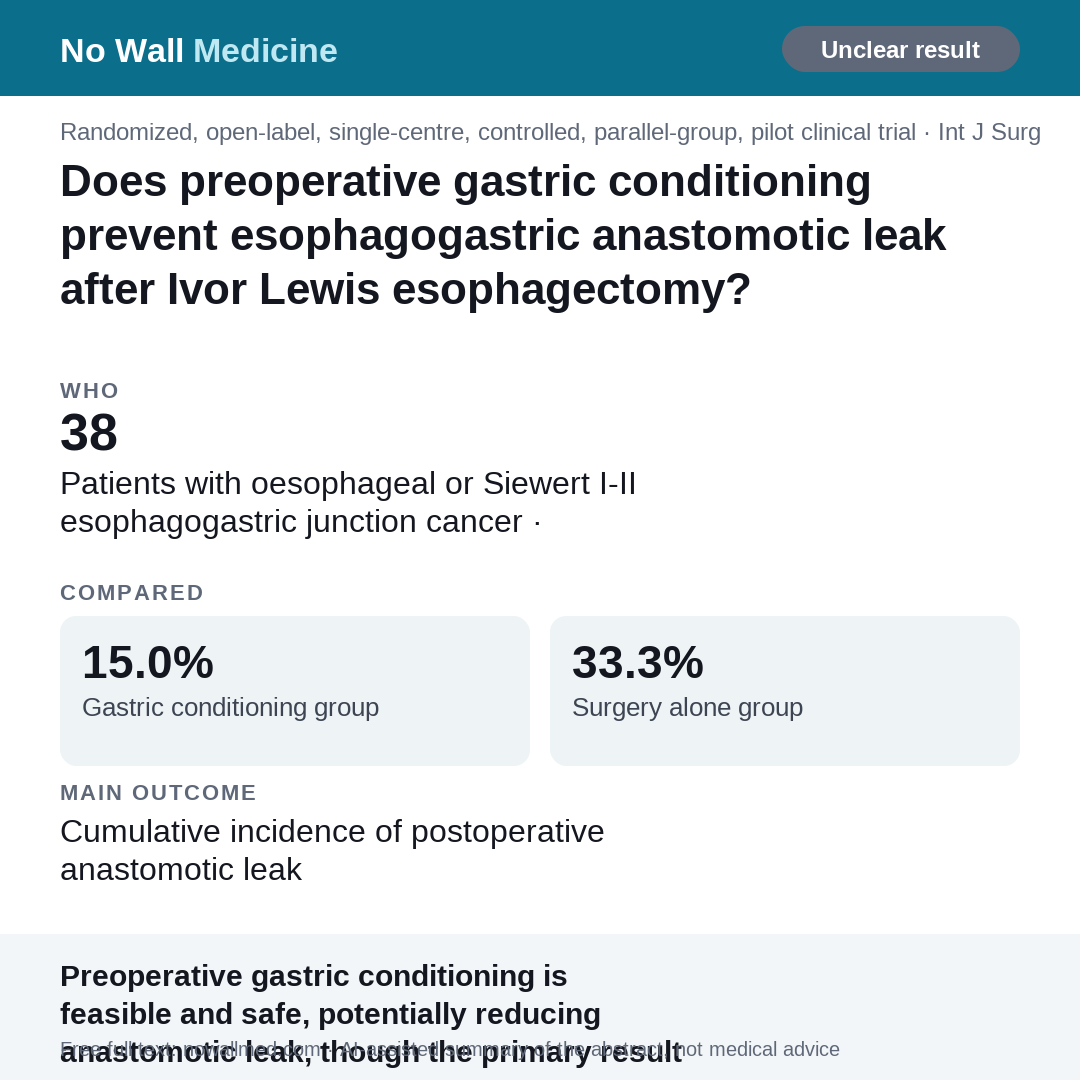
Does preoperative gastric conditioning prevent esophagogastric anastomotic leak after Ivor Lewis esophagectomy?
Who
38
Patients with oesophageal or Siewert I-II esophagogastric junction cancer · Single-centre
Compared
15.0%Gastric conditioning group (3/20, 95%CI: 5.2-36.0%)
33.3%Surgery alone group (6/18, 95%CI: 16.3-56.3%)
Main outcome
Cumulative incidence of postoperative anastomotic leak
Result: p-value: 0.184
Bottom line: Preoperative gastric conditioning is feasible and safe, potentially reducing anastomotic leak, though the primary result was not statistically significant.
Int J Surg · 2022-09-15Download image
Clinical question: Does preoperative gastric conditioning prevent esophagogastric anastomotic leak after Ivor Lewis esophagectomy?
Why it matters: It is unknown if preoperative gastric conditioning, which improves blood flow to the stomach, is a feasible and safe way to prevent leaks after esophagectomy.
Key points
- Researchers studied 38 patients with esophageal or junction cancer undergoing Ivor Lewis esophagectomy, comparing preoperative gastric conditioning to surgery alone.
- The cumulative incidence of anastomotic leak, which is a hole at the surgical connection, was 15.0% in the gastric conditioning group and 33.3% in the surgery alone group.
- When analyzing only successful gastric conditioning procedures, ischemia-related gastric conduit failure was lower in the gastric conditioning group.
Limitation the authors note: This was a single-centre pilot clinical trial.
Headline and key points written with AI from the paper’s abstract, with every number checked against it. Read the paper before relying on them.
Was this summary helpful?
Subject terms
Cite this article
Mils K, Miró M, Farran L, Videla S, Alba E, Estremiana F. A pilot randomized controlled trial on the utility of gastric conditioning in the prevention of esophagogastric anastomotic leak after Ivor Lewis esophagectomy. The APIL_2013 Trial. Int J Surg. 2022. doi:10.1016/j.ijsu.2022.106921
Spotted a mistake? Suggest a correction
Top studies every Monday
The week’s key trials and guidelines in your specialties, plus any topics you follow. By email, free.
Get the weekly digest