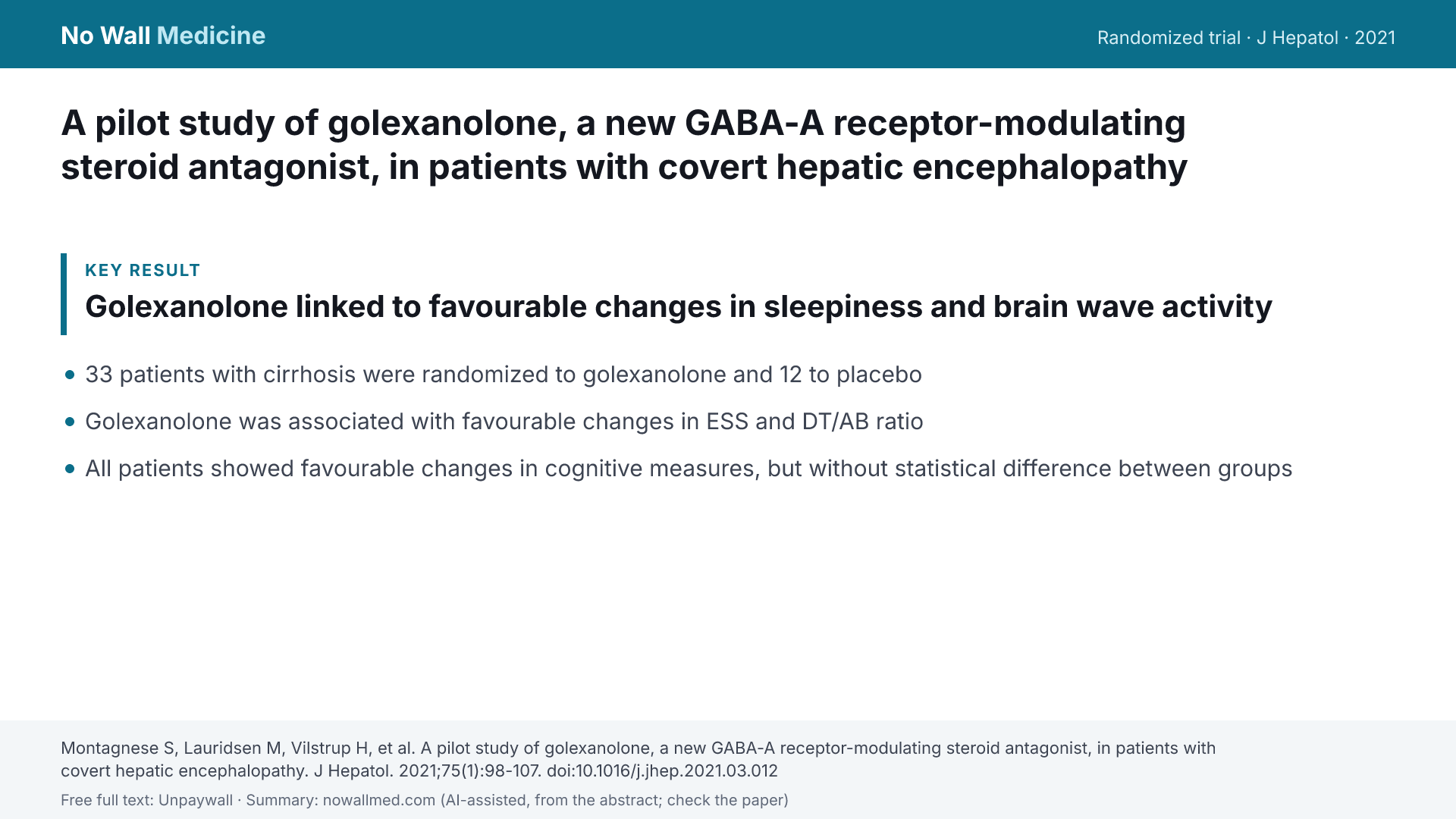
Golexanolone linked to favourable changes in sleepiness and brain wave activity
A pilot study of golexanolone, a new GABA-A receptor-modulating steroid antagonist, in patients with covert hepatic encephalopathy
Why it matters: Treatment for cognitive problems in cirrhosis patients is currently unavailable
Key points
- 33 patients with cirrhosis were randomized to golexanolone and 12 to placebo.
- Golexanolone was associated with favourable changes in ESS and DT/AB ratio.
- All patients showed favourable changes in cognitive measures, but without statistical difference between groups.
Limitation the authors note: This was a pilot study with a small sample size
Headline and key points written with AI from the paper’s abstract, with every number checked against it. Read the paper before relying on them.
Was this summary helpful?
Abstract
Background & aims
Golexanolone is a novel small molecule GABA-A receptor-modulating steroid antagonist under development for the treatment of cognitive and vigilance disorders caused by allosteric over-activation of GABA-A receptors by neurosteroids. It restored spatial learning and motor coordination in animal models of hepatic encephalopathy (HE) and mitigated the effects of intravenous allopregnanolone in healthy adults in a dose-dependent fashion. Herein, we report data on the safety, pharmacokinetics (PK) and efficacy of golexanolone in adult patients with cirrhosis.Methods
Following single/multiple ascending dose studies, adults with Child-Pugh A/B cirrhosis and abnormal continuous reaction time (CRT) on screening were randomized to 3 weeks' dosing with golexanolone (10, 40 or 80 mg BID) or placebo. CRT, psychometric hepatic encephalopathy score (PHES), animal naming test (ANT), Epworth sleepiness scale (ESS) and electroencephalogram (mean dominant frequency [MDF]; delta+theta/alpha+beta ratio [DT/AB]) were obtained at baseline, 10, and 21 days.Results
Golexanolone exhibited satisfactory safety and PK. Baseline characteristics were similar between the 12 and 33 patients randomized to placebo or golexanolone, respectively. By prespecified analyses, golexanolone was associated with directionally favourable changes vs. placebo in ESS (p = 0.047), MDF (p = 0.142) and DT/AB (p = 0.021). All patients also showed directionally favourable changes in CRT, PHES and ANT, but with no statistical difference between golexanolone and placebo. Post hoc analyses taking into account the variability and improvement in CRT, PHES and ANT observed between screening and baseline suggested an efficacy signal by cognitive measures as well.Conclusion
Golexanolone was well tolerated and associated with improvement in cognitive performance. These results implicate GABA-A receptor-modulating neurosteroids in the pathogenesis of HE and support the therapeutic potential of golexanolone.Lay summary
Many patients with cirrhosis experience subtle but disabling cognitive problems, including sleepiness and poor attention span, that impair their ability to be gainfully employed or carry out activities of daily living. This pilot study tested the hypothesis that these problems with cognition, for which there is no approved treatment, might be improved by an experimental drug, golexanolone, designed to normalize the function of receptors which inhibit brain function. The results of this study suggest that golexanolone is well tolerated and may improve cognition, as reflected by measures of sleepiness, attention span and brain wave activity, paving the way for future larger studies of this promising experimental drug.Clinical trial registration number
EudraCT 2016-003651-30.
Abstract reproduced under the article’s CC BY-NC-ND licence.
Subject terms
Cite this article
Montagnese S, Lauridsen M, Vilstrup H, Zarantonello L, Lakner G, Fitilev S. A pilot study of golexanolone, a new GABA-A receptor-modulating steroid antagonist, in patients with covert hepatic encephalopathy. J Hepatol. 2021. doi:10.1016/j.jhep.2021.03.012
Spotted a mistake? Suggest a correction
Top studies every Monday
The week’s key trials and guidelines in your specialties, plus any topics you follow. By email, free.
Get the weekly digest