A three eicosanoid plasma metabolite score was associated with increased risk of type 2 diabetes
A plasma metabolite score of three eicosanoids predicts incident type 2 diabetes: a prospective study in three independent cohorts
Prospective studyKey finding
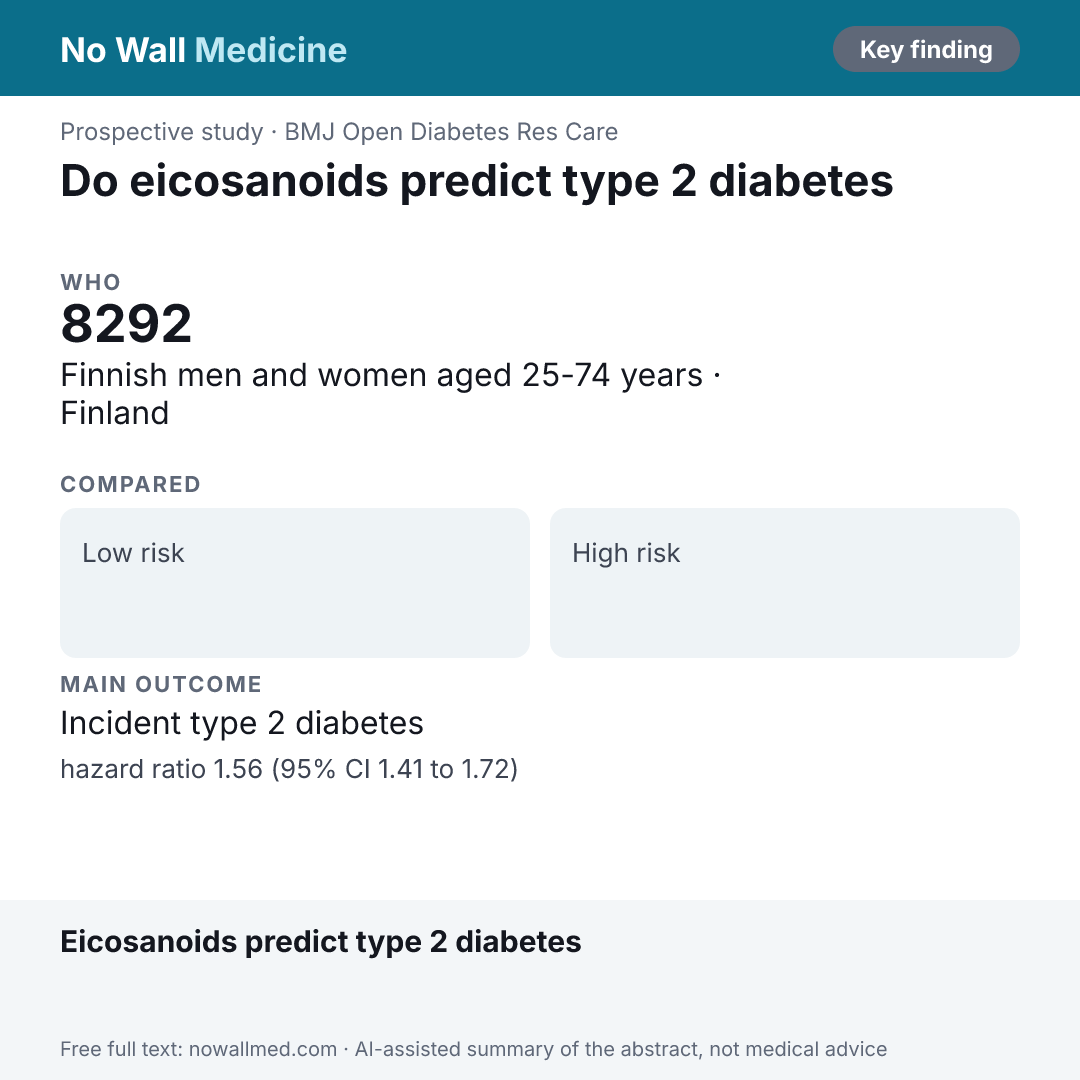
Do eicosanoids predict type 2 diabetes
Who
8292
Finnish men and women aged 25-74 years · Finland
Compared
Low risk
High risk
Main outcome
Incident type 2 diabetes
Result: hazard ratio 1.56 (95% CI 1.41 to 1.72)
Bottom line: Eicosanoids predict type 2 diabetes
BMJ Open Diabetes Res Care · 2022-04-01 · Save PNG
Key points
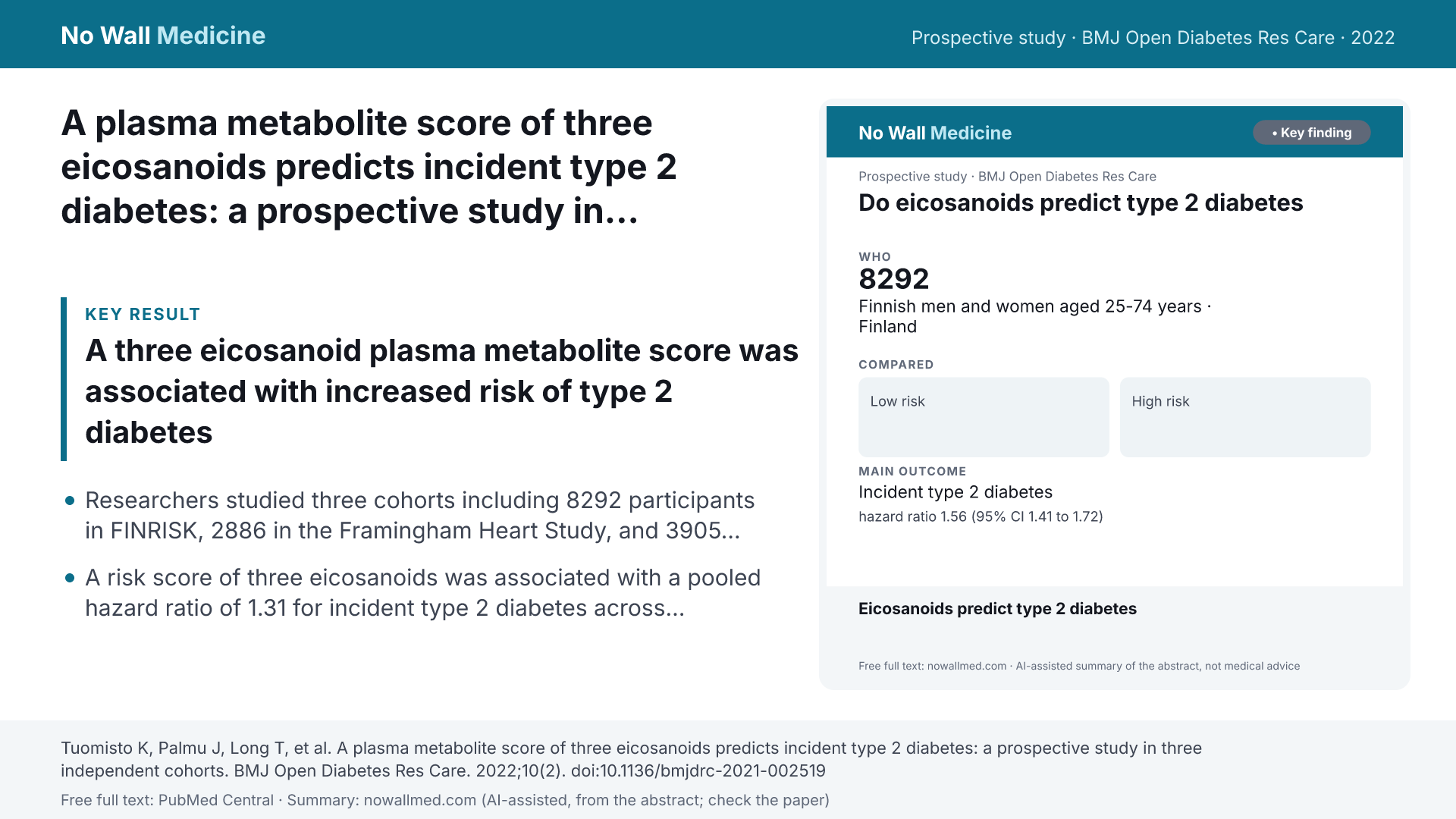
- Researchers studied three cohorts including 8292 participants in FINRISK, 2886 in the Framingham Heart Study, and 3905 in DILGOM to examine eicosanoids, which are lipid-derived mediators of inflammation.
- A risk score of three eicosanoids was associated with a pooled hazard ratio of 1.31 for incident type 2 diabetes across the three cohorts.
- In the FINRISK cohort, the top quartile of the risk score was associated with a hazard ratio of 2.80 compared to the lowest quartile.
Headline and key points written with AI from the paper’s abstract, with every number checked against it. Read the paper before relying on them.
Was this summary helpful?
Abstract
Introduction
Peptide markers of inflammation have been associated with the development of type 2 diabetes. The role of upstream, lipid-derived mediators of inflammation such as eicosanoids, remains less clear. The aim of this study was to examine whether eicosanoids are associated with incident type 2 diabetes. Research design & methods
In the FINRISK (Finnish Cardiovascular Risk Study) 2002 study, a population-based sample of Finnish men and women aged 25-74 years, we used directed, non-targeted liquid chromatography-mass spectrometry to identify 545 eicosanoids and related oxylipins in the participants' plasma samples (n=8292). We used multivariable-adjusted Cox regression to examine associations between eicosanoids and incident type 2 diabetes. The significant independent findings were replicated in the Framingham Heart Study (FHS, n=2886) and DIetary, Lifestyle and Genetic determinants of Obesity and Metabolic syndrome (DILGOM) 2007 (n=3905). Together, these three cohorts had 1070 cases of incident type 2 diabetes. Results
In the FINRISK 2002 cohort, 76 eicosanoids were associated individually with incident type 2 diabetes. We identified three eicosanoids independently associated with incident type 2 diabetes using stepwise Cox regression with forward selection and a Bonferroni-corrected inclusion threshold. A three-eicosanoid risk score produced an HR of 1.56 (95% CI 1.41 to 1.72) per 1 SD increment for risk of incident diabetes. The HR for comparing the top quartile with the lowest was 2.80 (95% CI 2.53 to 3.07). In the replication analyses, the three-eicosanoid risk score was significant in FHS (HR 1.24 (95% CI 1.10 to 1.39, p<0.001)) and directionally consistent in DILGOM (HR 1.12 (95% CI 0.99 to 1.27, p=0.07)). Meta-analysis of the three cohorts yielded a pooled HR of 1.31 (95% CI 1.05 to 1.56). Conclusions
Plasma eicosanoid profiles predict incident type 2 diabetes and the clearest signals replicate in three independent cohorts. Our findings give new information on the biology underlying type 2 diabetes and suggest opportunities for early identification of people at risk.
Abstract reproduced under the article’s CC BY NC licence.
Subject terms
Headline, design, result, key points, caveat and citation as plain text.
Cite this article
Tuomisto K, Palmu J, Long T, et al. A plasma metabolite score of three eicosanoids predicts incident type 2 diabetes: a prospective study in three independent cohorts. BMJ Open Diabetes Res Care. 2022;10(2). doi:10.1136/bmjdrc-2021-002519
Spotted a mistake? Suggest a correction