Psychosocial intervention for caregivers of children with autism showed potential cost-effectiveness in a randomized trial
A post-diagnostic psycho-education, acceptance and commitment therapy programme for caregivers of children recently diagnosed with autism: a randomised controlled trial-based cost-effectiveness analysis (REACH-ASD Trial)
Multicentre, assessor-masked, randomised controlled trialMixed results
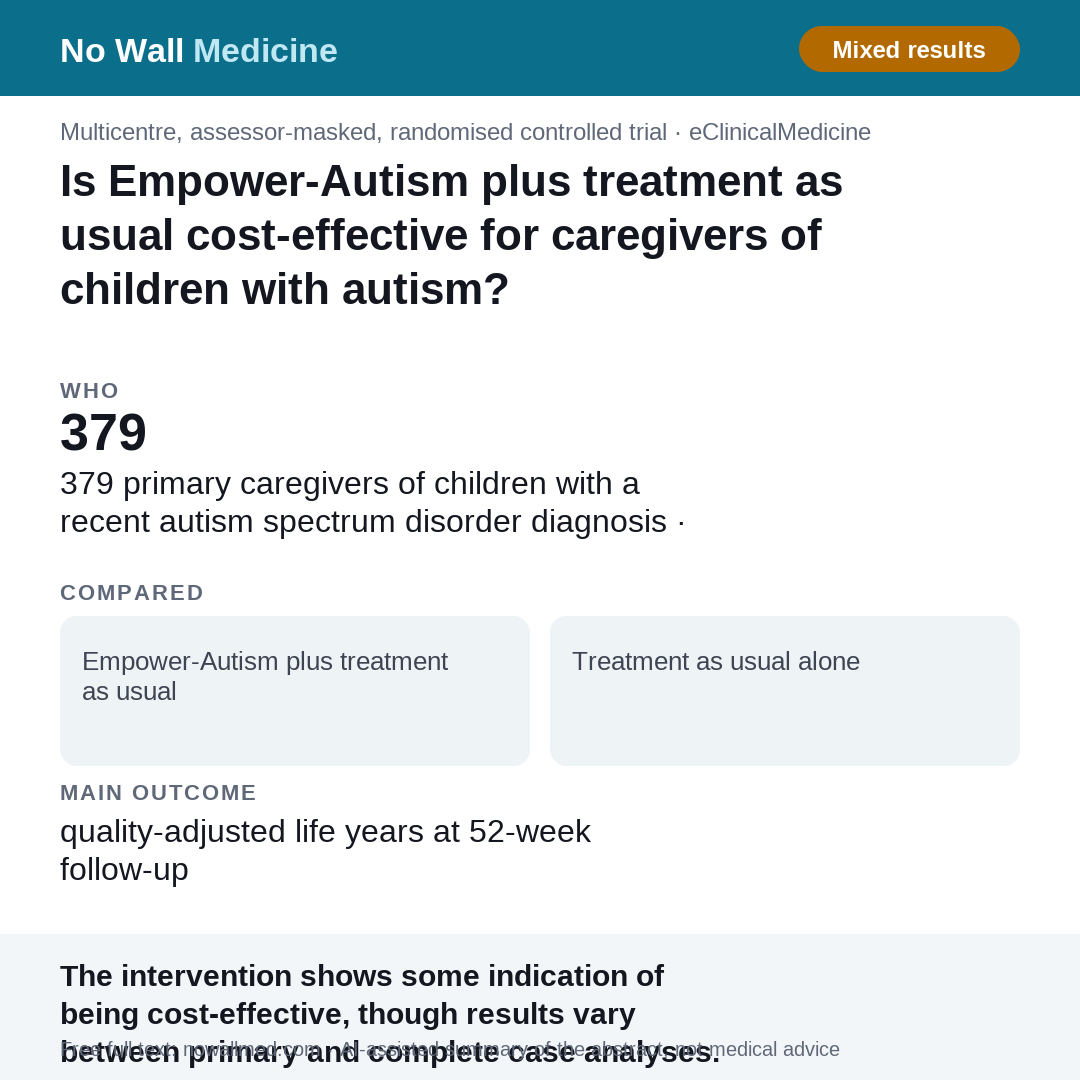
Is Empower-Autism plus treatment as usual cost-effective for caregivers of children with autism?
Who
379
379 primary caregivers of children with a recent autism spectrum disorder diagnosis · North-West England
Compared
Empower-Autism plus treatment as usual
Treatment as usual alone
Main outcome
quality-adjusted life years at 52-week follow-up
Result: ICER ∼£51 k
Bottom line: The intervention shows some indication of being cost-effective, though results vary between primary and complete case analyses.
Limitation: The proportion of participants with incomplete data, likely due to the COVID-19 pandemic, results in uncertainty.
Funded by: NIHRHTA Programme
eClinicalMedicine · 2025-09-12Download image
Clinical question: Is Empower-Autism plus treatment as usual cost-effective for caregivers of children with autism?
Why it matters: Caregivers of children with autism spectrum disorder experience higher rates of mental health difficulties and employment challenges, necessitating evaluation of psychosocial interventions.
Key points
- Researchers studied 379 primary caregivers of children recently diagnosed with autism spectrum disorder in North-West England.
- The primary analysis showed a net cost of £756 and a net quality-adjusted life year gain of 0.015, with an incremental cost-effectiveness ratio of approximately £51 k.
- A complete case analysis suggested the intervention may be cost-effective with a net cost of £786 and a net quality-adjusted life year gain of 0.049.
Headline and key points written with AI from the paper’s abstract, with every number checked against it. Read the paper before relying on them.
Cite this article
Shields G, Rowlandson A, Davies L, Leadbitter K, Smallman R, Langhorne S. A post-diagnostic psycho-education, acceptance and commitment therapy programme for caregivers of children recently diagnosed with autism: a randomised controlled trial-based cost-effectiveness analysis (REACH-ASD Trial). eClinicalMedicine. 2025. doi:10.1016/j.eclinm.2025.103470
Spotted a mistake? Suggest a correction