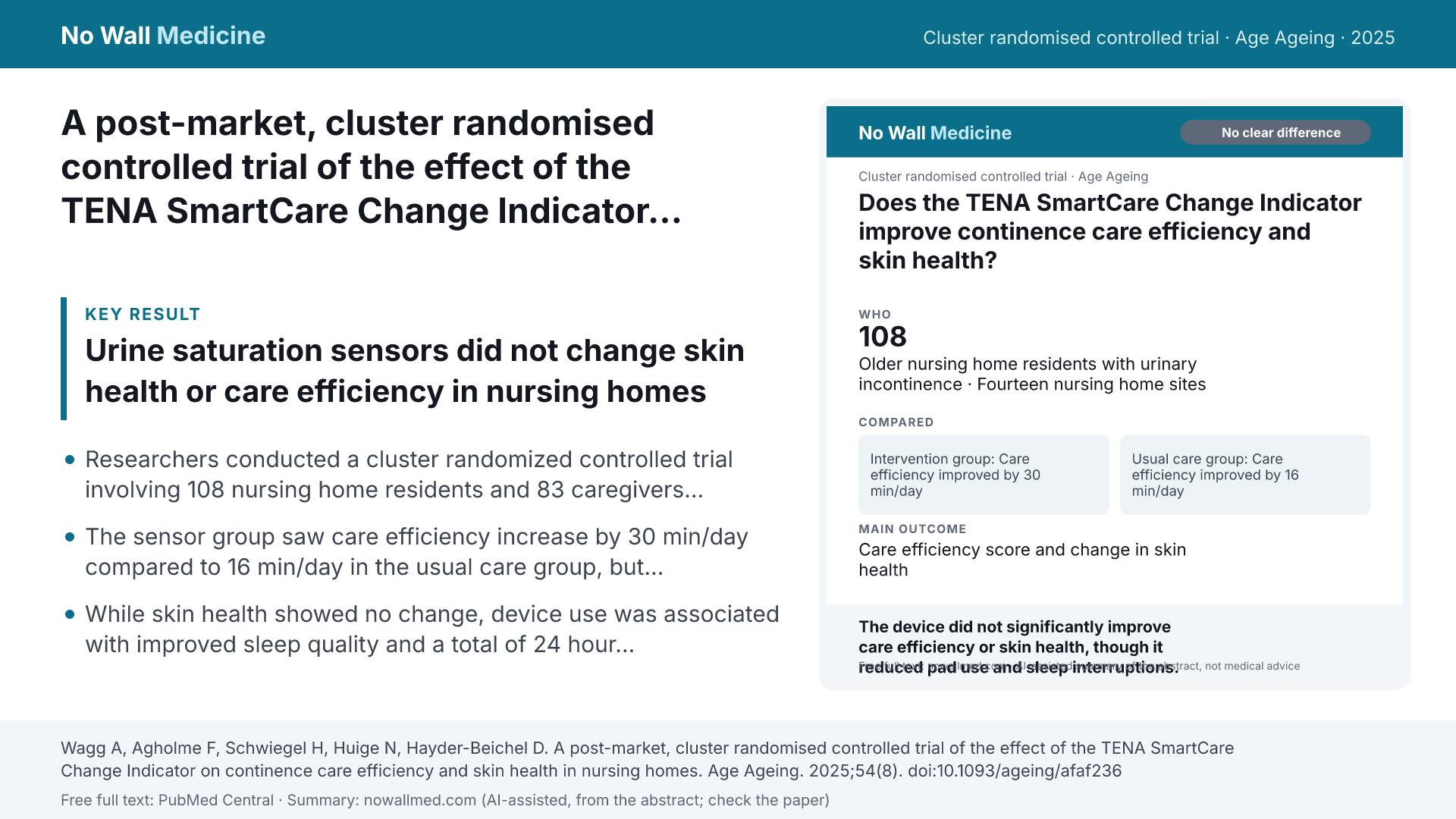
Urine saturation sensors did not change skin health or care efficiency in nursing homes
A post-market, cluster randomised controlled trial of the effect of the TENA SmartCare Change Indicator on continence care efficiency and skin health in nursing homes
Cluster randomised controlled trialNo clear difference
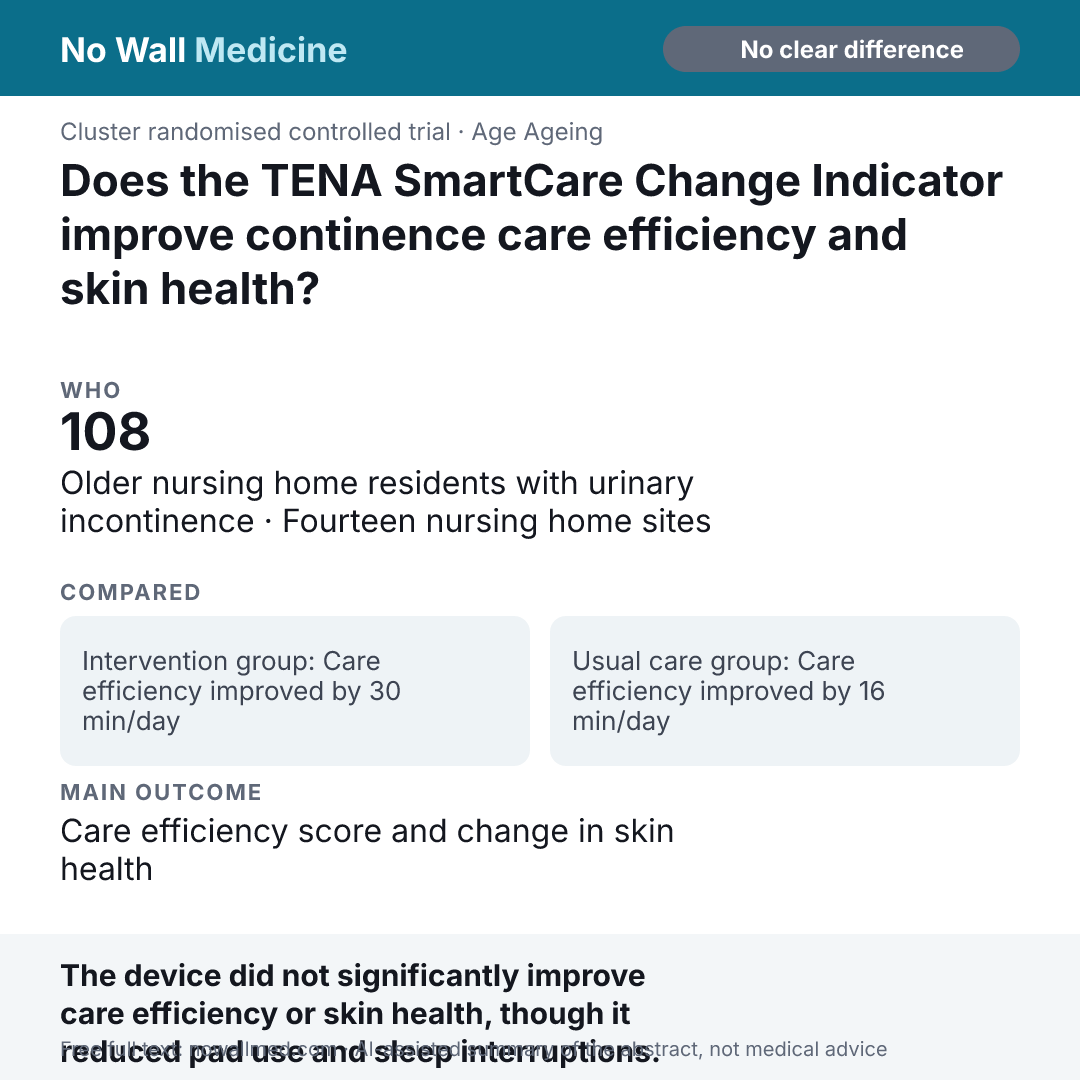
Does the TENA SmartCare Change Indicator improve continence care efficiency and skin health?
Who
108
Older nursing home residents with urinary incontinence · Fourteen nursing home sites
Compared
Intervention group: Care efficiency improved by 30 min/day
Usual care group: Care efficiency improved by 16 min/day
Main outcome
Care efficiency score and change in skin health
Bottom line: The device did not significantly improve care efficiency or skin health, though it reduced pad use and sleep interruptions.
Age Ageing · 2025-08-20
Why it matters: Management of urinary incontinence in nursing homes is often poorly managed through routine check and change regimens, creating a need to see if digital sensors help.
Headline and visual abstract written with AI from the paper’s abstract, with every number checked against it. Read the paper before relying on them.
Was this summary helpful?
Subject terms
Cite this article
Wagg A, Agholme F, Schwiegel H, Huige N, Hayder-Beichel D. A post-market, cluster randomised controlled trial of the effect of the TENA SmartCare Change Indicator on continence care efficiency and skin health in nursing homes. Age Ageing. 2025;54(8). doi:10.1093/ageing/afaf236
Spotted a mistake? Suggest a correction