Automated prescribing orders increased use of colony-stimulating factors but did not change febrile neutropenia rates
A Pragmatic Cluster-Randomized Trial of a Standing Order Entry Intervention for Colony-Stimulating Factor Use Among Patients at Intermediate Risk for Febrile Neutropenia
Pragmatic cluster randomized trialNo clear difference
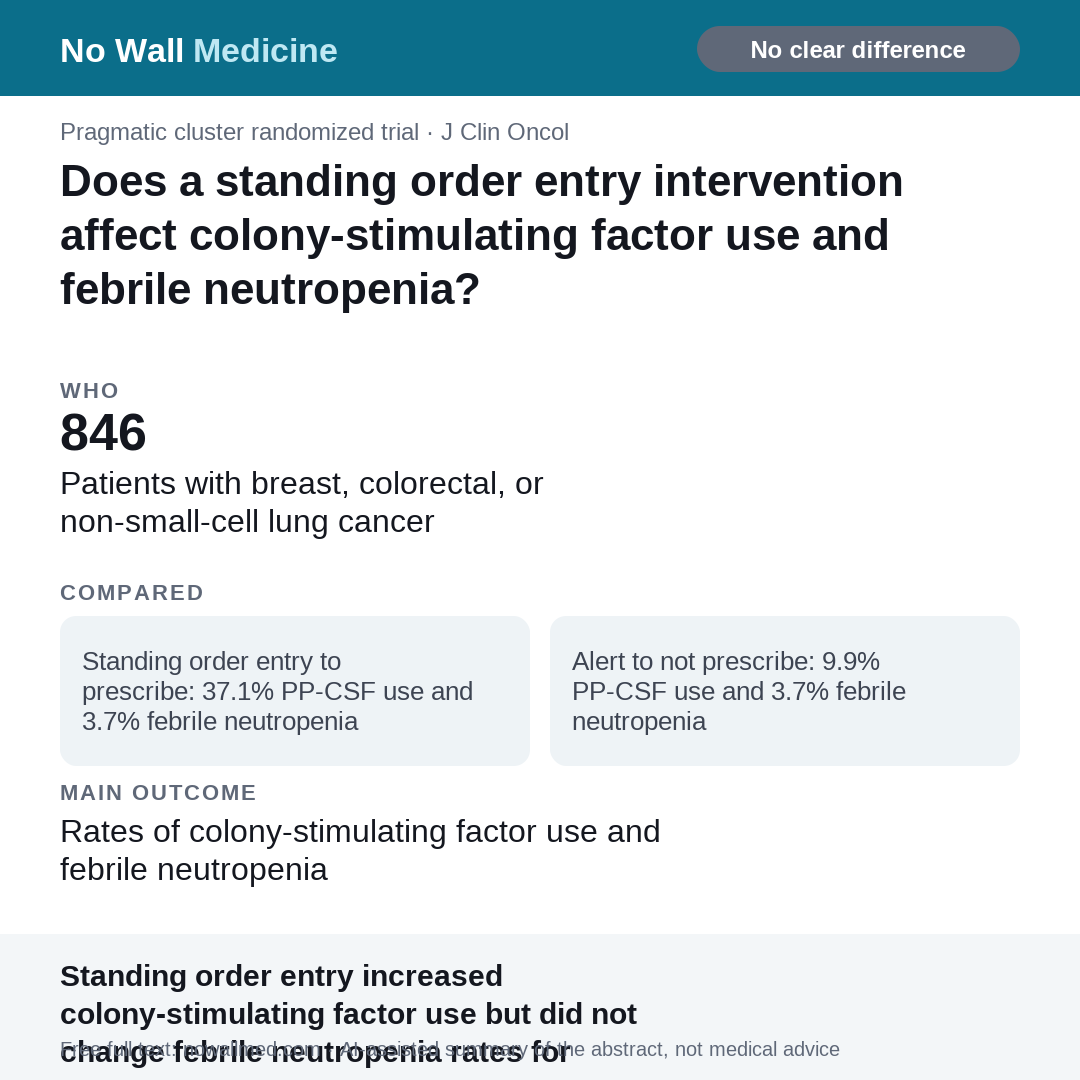
Does a standing order entry intervention affect colony-stimulating factor use and febrile neutropenia?
Who
846
Patients with breast, colorectal, or non-small-cell lung cancer
Compared
Standing order entry to prescribe: 37.1% PP-CSF use and 3.7% febrile neutropenia
Alert to not prescribe: 9.9% PP-CSF use and 3.7% febrile neutropenia
Main outcome
Rates of colony-stimulating factor use and febrile neutropenia
Result: odds ratio 5.91 (95% CI 1.77 to 19.70)
Bottom line: Standing order entry increased colony-stimulating factor use but did not change febrile neutropenia rates for intermediate-risk patients.
J Clin Oncol · 2022-10-13Download image
Clinical question: Does a standing order entry intervention affect colony-stimulating factor use and febrile neutropenia?
Why it matters: The benefit of using colony-stimulating factors to prevent febrile neutropenia, a condition where white blood cell counts drop during chemotherapy, is uncertain for patients at intermediate risk.
Key points
- Researchers studied 846 patients with breast, colorectal, or non-small-cell lung cancer across 24 medical sites.
- Automated standing orders increased the use of colony-stimulating factors from 9.9% to 37.1%, but febrile neutropenia rates were identical at 3.7% in both groups.
- Clinicians were permitted to override the automated prescribing orders during the trial.
Headline and key points written with AI from the paper’s abstract, with every number checked against it. Read the paper before relying on them.
Was this summary helpful?
Subject terms
Cite this article
Hershman DL, Bansal A, Sullivan SD, Barlow WE, Arnold KB, Watabayashi K. A Pragmatic Cluster-Randomized Trial of a Standing Order Entry Intervention for Colony-Stimulating Factor Use Among Patients at Intermediate Risk for Febrile Neutropenia. J Clin Oncol. 2022. doi:10.1200/JCO.22.01258
Spotted a mistake? Suggest a correction
Top studies every Monday
The week’s key trials and guidelines in your specialties, plus any topics you follow. By email, free.
Get the weekly digest