Hybrid parent and health worker engagement increased timely childhood vaccination coverage in Nigeria
A pragmatic covariate-constrained cluster-randomised controlled trial of hybrid parents and health workers adaptive intervention for optimal (timely, cumulative age-appropriate) community-wide routine childhood immunisation coverage: the AGINTOPIC trial
Pragmatic covariate-constrained cluster-randomised controlled trialBenefit found
Does a hybrid parents and health workers adaptive intervention increase optimal routine childhood immunisation coverage?
Who
Children aged 5-9 months in Ebonyi state, Nigeria · 16 geographical clusters in Ebonyi state, Nigeria
Compared
6.0%control arm (SD 8.1)
14.3%intervention arm (11.7)
Main outcome
proportion of children with optimal/timely receipt of every recommended vaccine
Result: adjusted prevalence difference 10.8%, 95% CI 0.8% to 20.9%
Bottom line: The adaptive engagement intervention significantly increased optimal and timely routine childhood immunisation coverage in Nigeria.
BMJ Glob Health · 2025-04-02Download image
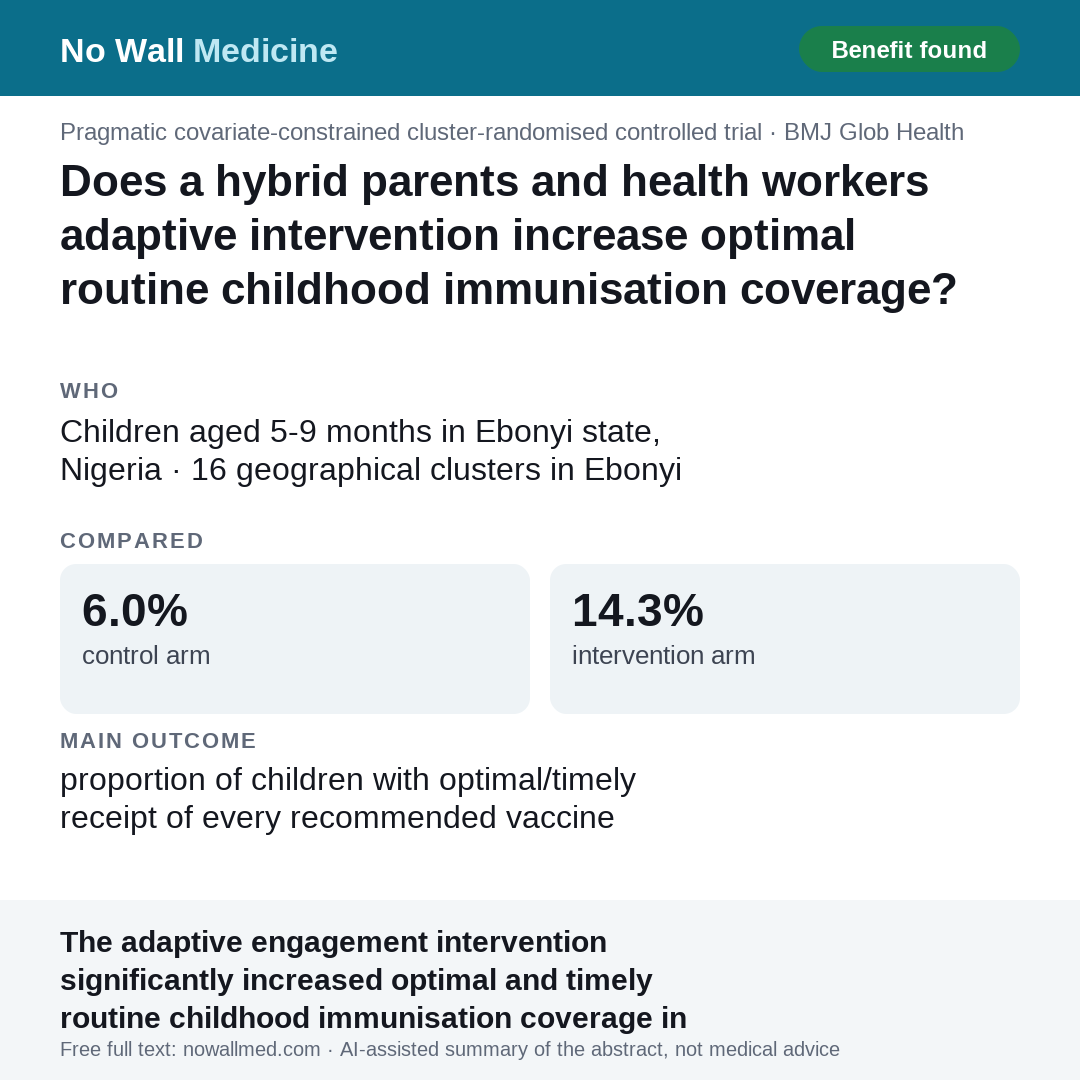
Clinical question: Does a hybrid parents and health workers adaptive intervention increase optimal routine childhood immunisation coverage?
Why it matters: Vaccine-preventable infectious diseases cause significant illness and death because outbreaks continue to occur despite efforts to increase routine childhood immunisation coverage.
Key points
- Researchers conducted a trial in 16 geographical clusters in Ebonyi state, Nigeria, comparing a control group to an intervention group using adaptive engagement between parents and health workers.
- The intervention group had a 14.3% (SD 11.7) mean proportion of children aged 5-9 months with optimal vaccine receipt compared to 6.0% (SD 8.1) in the control group.
- The mean age-appropriate vaccine receipt score was 85.5 (9.5) in the intervention arm versus 75.1 (17.8) in the control arm.
Headline and key points written with AI from the paper’s abstract, with every number checked against it. Read the paper before relying on them.
Was this summary helpful?
Abstract
Introduction
Vaccine-preventable infectious diseases (VPDs) covered by routine childhood immunisation programmes are major causes of morbidity/mortality as outbreaks continue to reoccur despite repeated efforts to increase immunisation coverage. This trial aimed at increasing optimal/timely immunisation coverage. Methods
The Adaptive Group Intervention for Optimal routine childhood Immunisation Coverage (AGINTOPIC) trial was conducted from 1 June 2022 to 31 May 2023 in Ebonyi state, Nigeria. 16 geographical clusters (where the primary healthcare facilities were providing weekly routine childhood immunisation) were covariate-constrained-randomised (1:1) to control arm (receiving no intervention) and intervention arm (receiving hybrid parents/health workers adaptive engagement to enlighten/facilitate regular communications/working relationships between them regarding optimal immunisation). The primary outcomes included the proportion of children aged 5-9 months who had optimal/timely (cumulative age-appropriate) receipt of every recommended birth to 14 weeks vaccine and the age-appropriate vaccines receipt (receipt timeliness) score. The outcomes were measured via baseline and end-of-study repeated cross-sectional surveys. All analyses were done using a cluster-level method on intention-to-treat basis, and randomisation-based inference was done via adjusted clustered permutation tests (aCPTs) to check the robustness/validity of the main findings. Results
A mean proportion of 6.0% (SD 8.1) of children aged 5-9 months in the control arm had optimal/timely receipt of every recommended birth to 14 weeks vaccine, vs 14.3% (11.7) in the intervention arm (adjusted prevalence difference 10.8%, 95% CI 0.8% to 20.9%, p=0.0376, aCPT p=0.0093). The mean age-appropriate vaccines receipt score was 75.1 (17.8) in the control arm, vs 85.5 (9.5) in the intervention arm (adjusted mean difference 9.5, 95% CI 1.0 to 17.9, p=0.0317, aCPT p=0.0155). Conclusions
The AGINTOPIC intervention significantly increased the optimal/timely (cumulative age-appropriate) community-wide routine childhood immunisation coverage, and the evidence illuminates the need for the exploration and adaptation of such pragmatic/dynamic/scalable community engagement intervention by routine childhood immunisation programmes in the global efforts to address the recurrent outbreaks of VPDs. Trial registration number
ISRCTN59811905.
Abstract reproduced under the article’s CC BY NC licence.
Subject terms
Cite this article
Omale UI, Ewah RL, Amuzie CI, Ikegwuonu CO, Nkwo GE, Iwegbulam CC. A pragmatic covariate-constrained cluster-randomised controlled trial of hybrid parents and health workers adaptive intervention for optimal (timely, cumulative age-appropriate) community-wide routine childhood immunisation coverage: the AGINTOPIC trial. BMJ Glob Health. 2025. doi:10.1136/bmjgh-2024-017403
Spotted a mistake? Suggest a correction
Top studies every Monday
The week’s key trials and guidelines in your specialties, plus any topics you follow. By email, free.
Get the weekly digest