Cognitive therapy for post-traumatic stress disorder showed varying results in children exposed to multiple traumas
A pragmatic randomized controlled trial of cognitive therapy for post-traumatic stress disorder in children and adolescents exposed to multiple traumatic stressors: the DECRYPT trial
Pragmatic randomized controlled trialMixed results
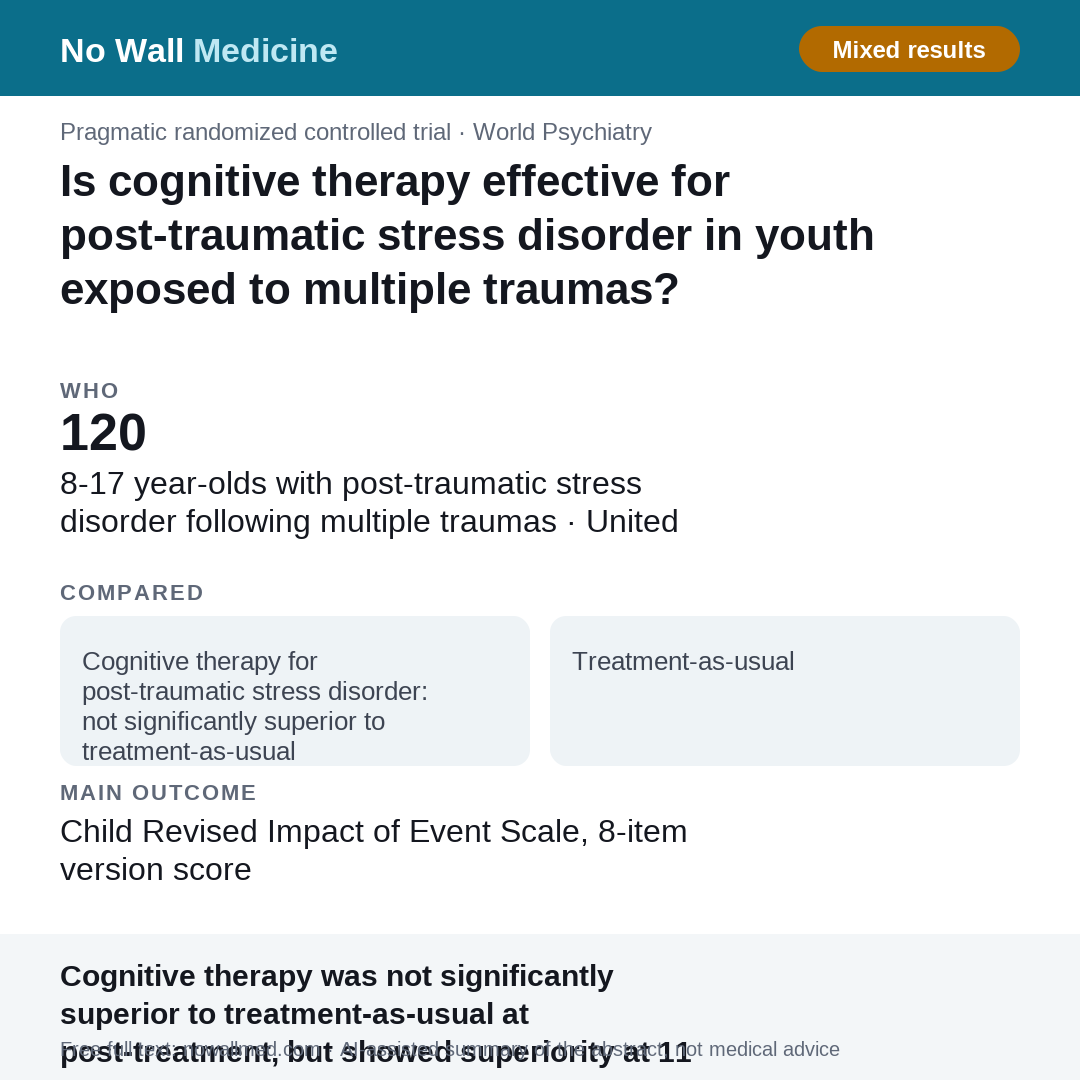
Is cognitive therapy effective for post-traumatic stress disorder in youth exposed to multiple traumas?
Who
120
8-17 year-olds with post-traumatic stress disorder following multiple traumas · United Kingdom mental health services
Compared
Cognitive therapy for post-traumatic stress disorder: not significantly superior to treatment-as-usual
Treatment-as-usual
Main outcome
Child Revised Impact of Event Scale, 8-item version score
Result: adjusted difference: -3.80, 95% CI: -7.56 to -0.06
Bottom line: Cognitive therapy was not significantly superior to treatment-as-usual at post-treatment, but showed superiority at 11 months.
World Psychiatry · 2025-09-15Download image
Clinical question: Is cognitive therapy effective for post-traumatic stress disorder in youth exposed to multiple traumas?
Why it matters: Evidence is limited regarding whether trauma-focused cognitive-behavioral therapies are effective for youth exposed to multiple traumas in real-world mental health settings.
Key points
- Researchers studied 120 children and adolescents aged 8 to 17 years with post-traumatic stress disorder who were randomized to receive cognitive therapy or treatment-as-usual.
- Cognitive therapy was not significantly superior to treatment-as-usual on the primary outcome score at post-treatment, but it was superior at 11 months post-randomization.
- The therapy was also associated with better parent-reported emotional difficulties at post-treatment and 11 months, as well as several child-reported anxiety and depression measures.
Headline and key points written with AI from the paper’s abstract, with every number checked against it. Read the paper before relying on them.
Was this summary helpful?
Cite this article
Meiser-Stedman R, Allen L, Ashford PA, Beeson E, Byford S, Danese A. A pragmatic randomized controlled trial of cognitive therapy for post-traumatic stress disorder in children and adolescents exposed to multiple traumatic stressors: the DECRYPT trial. World Psychiatry. 2025. doi:10.1002/wps.21355
Spotted a mistake? Suggest a correction
Top studies every Monday
The week’s key trials and guidelines in your specialties, plus any topics you follow. By email, free.
Get the weekly digest