Intensive treatment support improved hepatitis C cure rates only for minimal risk patients
A precision randomized trial of hepatitis C treatment support among people who inject drugs in India: The STOP-C trial
Precision randomized trialMixed results
Does hepatitis C treatment support impact adherence among people who inject drugs in India?
Who
3000
Treatment-naïve people who inject drugs in India · Community-based clinics across seven cities in India
Compared
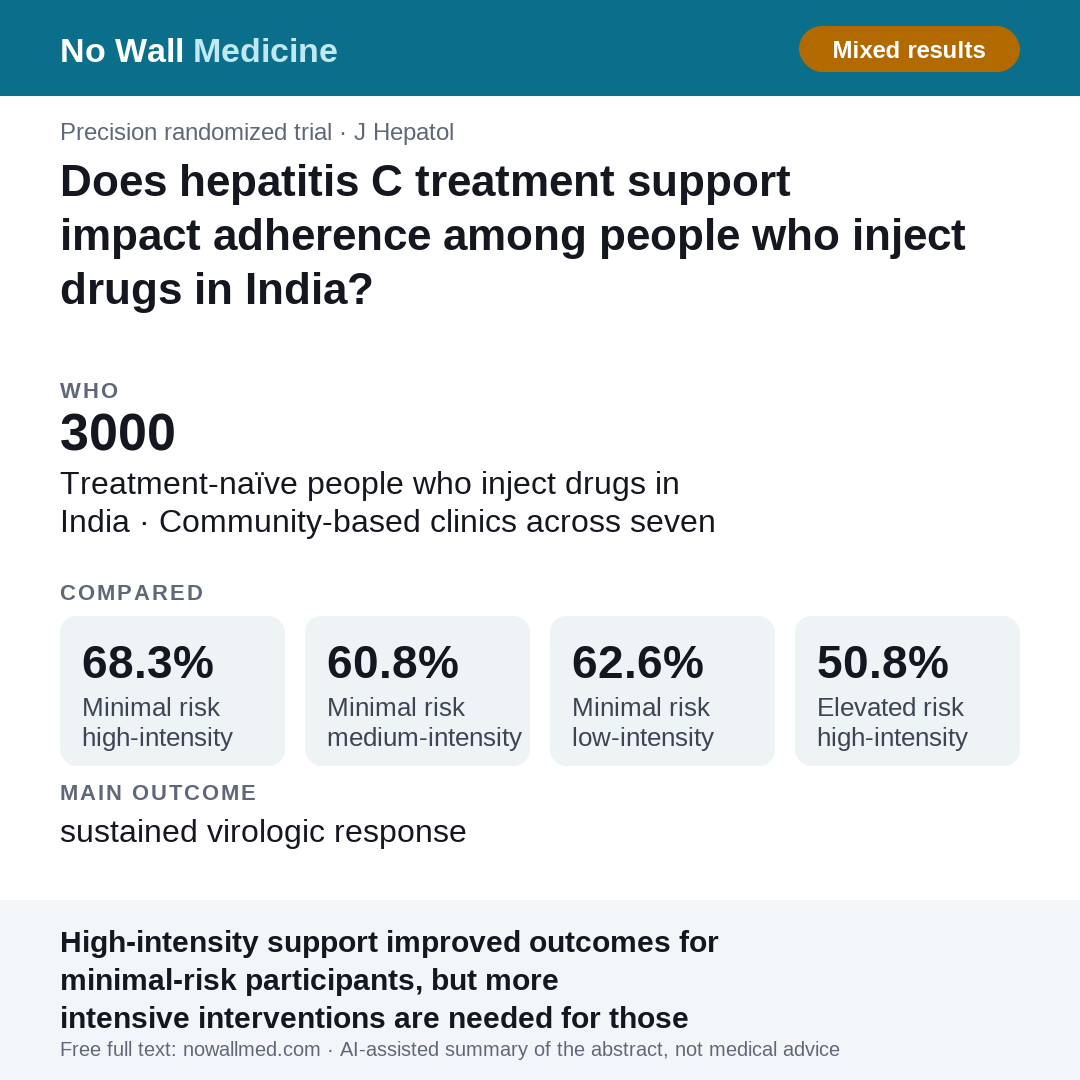
68.3%Minimal risk high-intensity support
60.8%Minimal risk medium-intensity support
62.6%Minimal risk low-intensity support
50.8%Elevated risk high-intensity support
Main outcome
sustained virologic response
Result: adjusted relative risk 1.09 (95% CI 1.00-1.19) for high vs low intensity in minimal risk
Bottom line: High-intensity support improved outcomes for minimal-risk participants, but more intensive interventions are needed for those at elevated risk.
Limitation: more intensive adherence support and/or novel interventions are needed to improve sustained virologic response among those at highest predicted risk
J Hepatol · 2026-06-30Download image
Clinical question: Does hepatitis C treatment support impact adherence among people who inject drugs in India?
Why it matters: It is unclear how different levels of treatment adherence support affect hepatitis C cure rates among people who inject drugs.
Key points
- Researchers studied 3,000 people who inject drugs in India receiving 12 weeks of sofosbuvir/velpatasvir medication.
- Among minimal-risk participants, high-intensity support resulted in a 68.3% sustained virologic response compared to 62.6% for low-intensity support.
- In elevated-risk participants, sustained virologic response rates were 50.8% for high-intensity, 45.5% for medium-intensity, and 48.4% for low-intensity support.
Headline and key points written with AI from the paper’s abstract, with every number checked against it. Read the paper before relying on them.
Cite this article
Solomon SS, Srikrishnan AK, McFall AM, Baishya J, Gunaratne MP, Kedar A. A precision randomized trial of hepatitis C treatment support among people who inject drugs in India: The STOP-C trial. J Hepatol. 2026. doi:10.1016/j.jhep.2026.06.034
Spotted a mistake? Suggest a correction