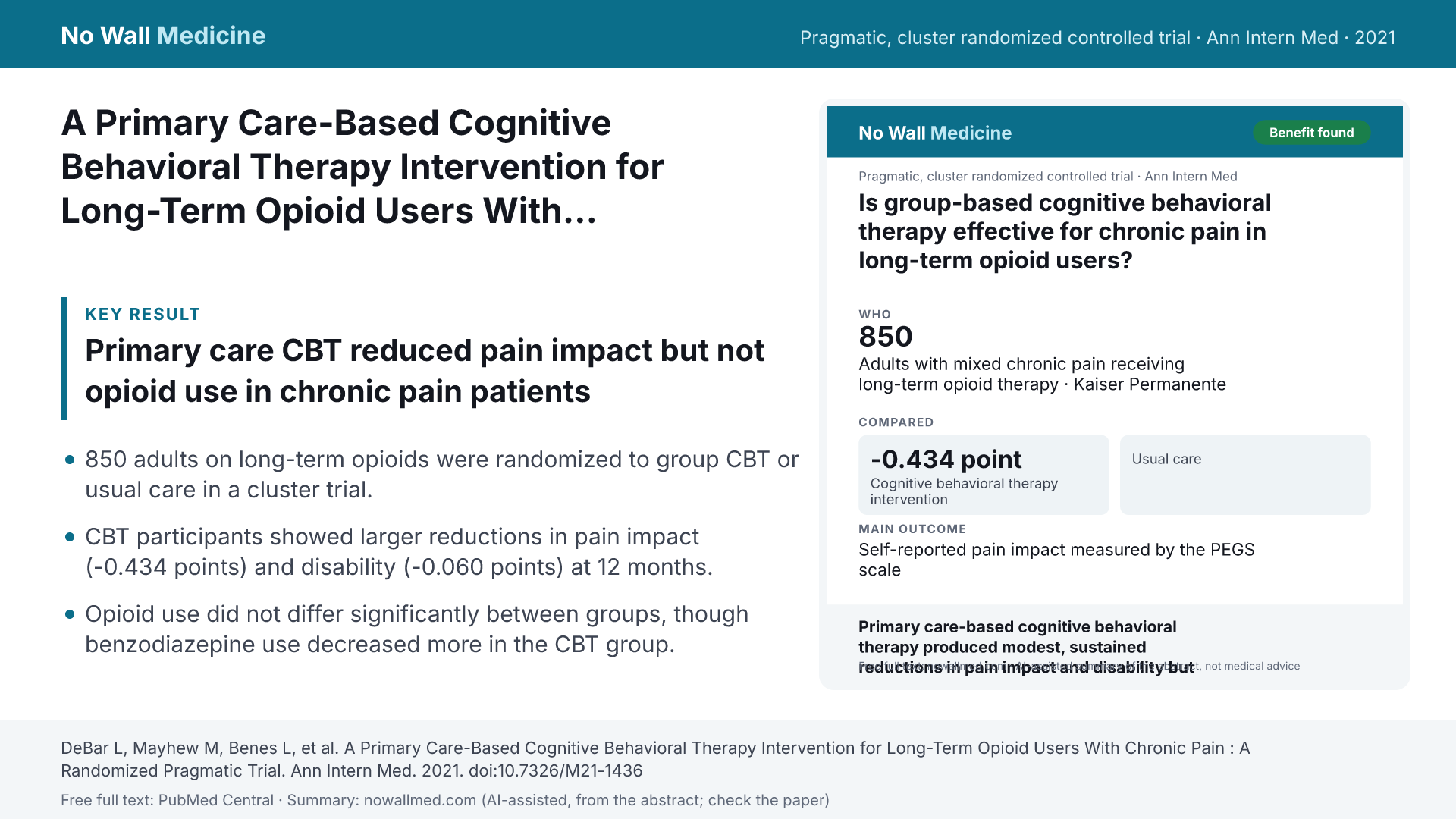
Primary care CBT reduced pain impact but not opioid use in chronic pain patients
A Primary Care-Based Cognitive Behavioral Therapy Intervention for Long-Term Opioid Users With Chronic Pain : A Randomized Pragmatic Trial
Pragmatic, cluster randomized controlled trialBenefit found
Is group-based cognitive behavioral therapy effective for chronic pain in long-term opioid users?
Who
850
Adults with mixed chronic pain receiving long-term opioid therapy · Kaiser Permanente health care systems in three US regions
Compared
-0.434 pointCognitive behavioral therapy intervention (95% CI, -0.690 to -0.178 point)
Usual care
Main outcome
Self-reported pain impact measured by the PEGS scale
Result: -0.434 point (95% CI, -0.690 to -0.178 point)
Bottom line: Primary care-based cognitive behavioral therapy produced modest, sustained reductions in pain impact and disability but did not reduce opioid use.
Limitation: Inclusion of only insured patients in large integrated health care systems limited generalizability.
Funded by: National Institutes of Health
Ann Intern Med · 2021-11-02Download image
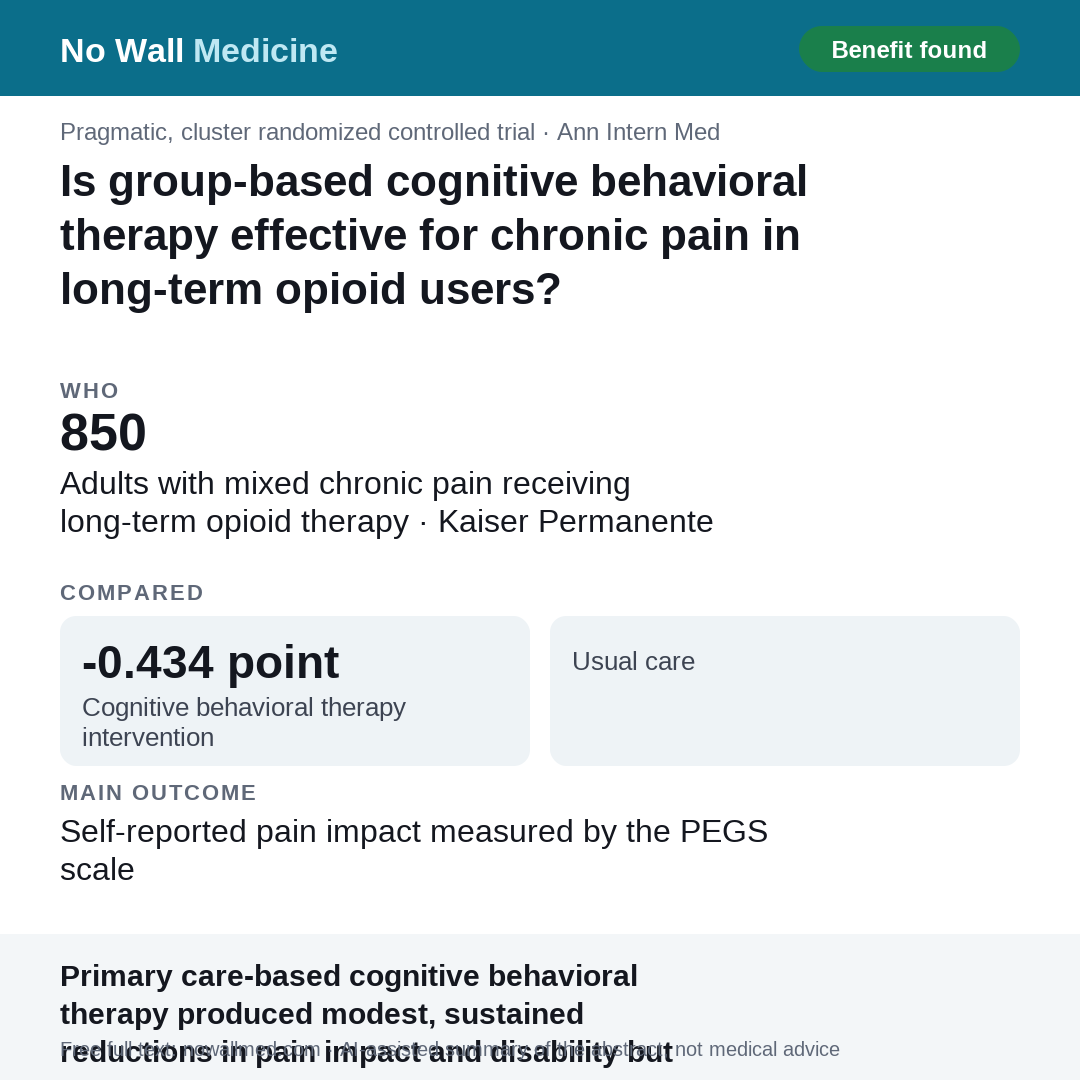
Clinical question: Is group-based cognitive behavioral therapy effective for chronic pain in long-term opioid users?
Why it matters: Few clinical trials have examined cognitive behavioral therapy interventions embedded in primary care settings to improve chronic pain among those receiving long-term opioid therapy.
Key points
- 850 adults on long-term opioids were randomized to group CBT or usual care in a cluster trial.
- CBT participants showed larger reductions in pain impact (-0.434 points) and disability (-0.060 points) at 12 months.
- Opioid use did not differ significantly between groups, though benzodiazepine use decreased more in the CBT group.
Limitation the authors note: The inclusion of only patients with insurance in large integrated health care systems limited generalizability, and the clinical effect of change in scores is unclear.
Headline and key points written with AI from the paper’s abstract, with every number checked against it. Read the paper before relying on them.
Was this summary helpful?
Subject terms
Headline, design, result, key points, caveat and citation as plain text.
Cite this article
DeBar L, Mayhew M, Benes L, et al. A Primary Care-Based Cognitive Behavioral Therapy Intervention for Long-Term Opioid Users With Chronic Pain : A Randomized Pragmatic Trial. Ann Intern Med. 2021. doi:10.7326/M21-1436
Spotted a mistake? Suggest a correction