Systematic review examines methods for predicting movement in musculoskeletal simulations
A PRISMA systematic review through time on predictive musculoskeletal simulations
PRISMA systematic reviewUnclear result
What are the current methods and trends in predictive musculoskeletal simulations?
Who
literature on predictive musculoskeletal simulations
Compared
Neural models
Optimization methods
Main outcome
methods, accuracies, simulation times, and limitations of predictive simulations
Bottom line: The review categorizes predictive musculoskeletal simulation methods into neural models and optimization-based approaches.
Limitation: The review calls for quantitative validation to establish comprehensive comparisons between methods.
J Neuroeng Rehabil · 2025-07-04Download image
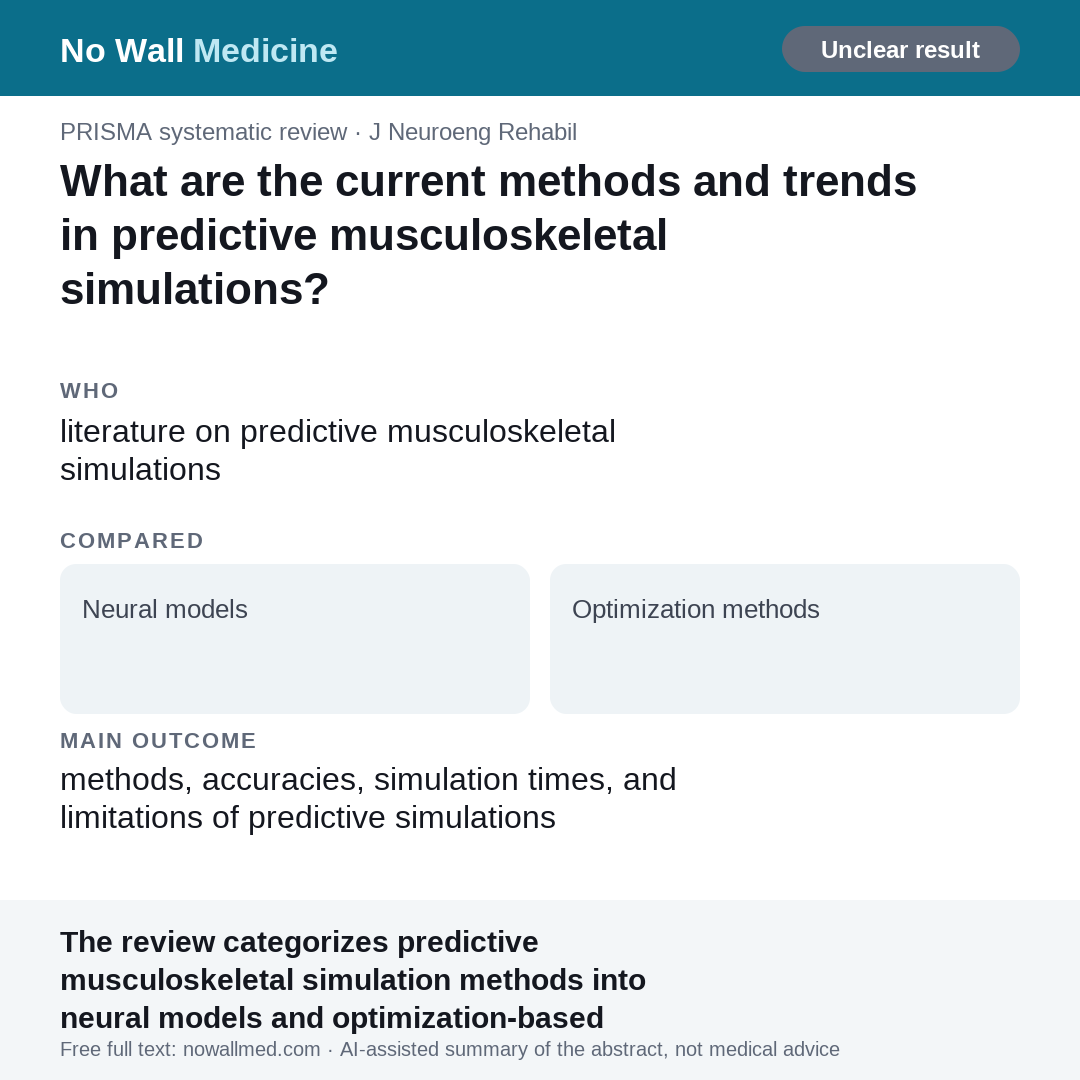
Clinical question: What are the current methods and trends in predictive musculoskeletal simulations?
Why it matters: The current literature on musculoskeletal simulations suffers from inconsistent nomenclature and a lack of quantitative validation for comparing different predictive methods.
Key points
- Researchers conducted a systematic review of literature regarding predictive musculoskeletal simulations, which are computer models used to simulate how muscles and bones move.
- The review distinguishes between neural models, such as muscle-reflex-based models, and optimization methods, such as deep reinforcement learning.
- The authors identified that the majority of existing works employ optimization methods to simulate movement.
Headline and key points written with AI from the paper’s abstract, with every number checked against it. Read the paper before relying on them.
Topics
Cite this article
Denayer M, Alfio E, Díaz MA, Sartori M, De Groote F, De Pauw K. A PRISMA systematic review through time on predictive musculoskeletal simulations. J Neuroeng Rehabil. 2025. doi:10.1186/s12984-025-01686-w
Spotted a mistake? Suggest a correction
Top studies every Monday
The week’s key trials and guidelines in your specialties, by email. Free.
Get the weekly digest