Computational pathology signature for immune cells linked to recurrence risk in breast cancer
A prognostic and predictive computational pathology immune signature for ductal carcinoma in situ: retrospective results from a cohort within the UK/ANZ DCIS trial
Retrospective cohort studyBenefit found
Is a computational pathology lymphocyte signature prognostic and predictive in ductal carcinoma in situ?
Who
755
Patients with ductal carcinoma in situ · UK/ANZ DCIS trial
Compared
CPath TIL-high: HR 2·10 (95% CI 1·39-3·18)
CPath TIL-low
Main outcome
Ipsilateral breast event
Result: hazard ratio 2·10 (95% CI 1·39-3·18)
Bottom line: High lymphocyte density is associated with higher recurrence risk and greater radiotherapy benefit in ductal carcinoma in situ.
Funded by: National Cancer Institute, Cancer Research UK, and Breast Cancer Research Foundation
Lancet Digit Health · 2024-07-09Download image
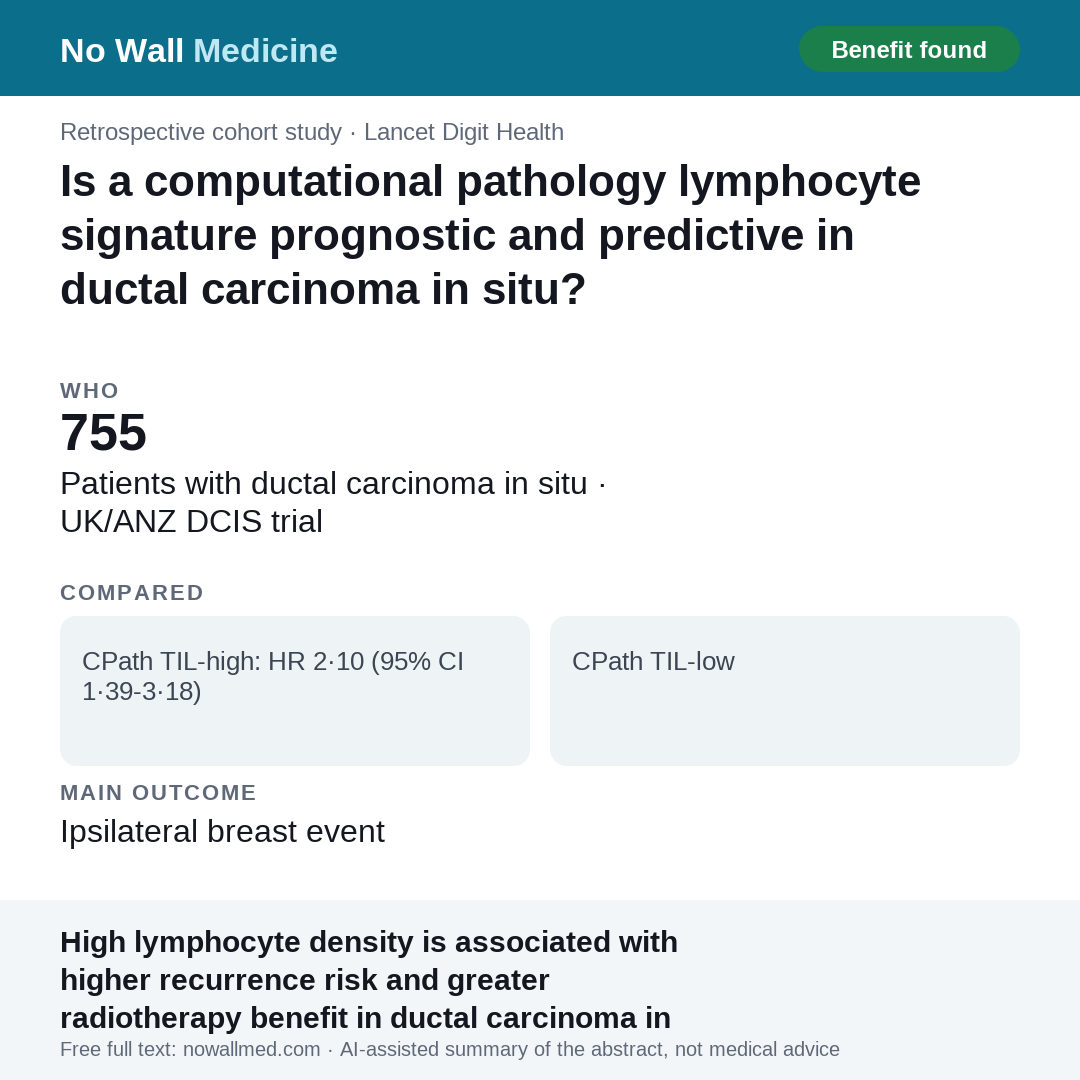
Clinical question: Is a computational pathology lymphocyte signature prognostic and predictive in ductal carcinoma in situ?
Why it matters: Manual counting of tumor-infiltrating lymphocytes is time-consuming and prone to variability between different observers.
Key points
- Researchers studied 755 patients with ductal carcinoma in situ using a computational pathology pipeline to measure tumor-infiltrating lymphocytes, which are immune cells within the tumor.
- High levels of these immune cells were associated with a greater risk of ipsilateral breast events (HR 2.10) and invasive progression (HR 3.09).
- A significant interaction was observed between immune cell levels and radiotherapy, with a greater magnitude of radiotherapy benefit in preventing breast events for patients with high immune cell density.
Headline and key points written with AI from the paper’s abstract, with every number checked against it. Read the paper before relying on them.
Was this summary helpful?
Abstract
Background
The density of tumour-infiltrating lymphocytes (TILs) could be prognostic in ductal carcinoma in situ (DCIS). However, manual TIL quantification is time-consuming and suffers from interobserver and intraobserver variability. In this study, we developed a TIL-based computational pathology biomarker and evaluated its association with the risk of recurrence and benefit of adjuvant treatment in a clinical trial cohort. Methods
In this retrospective cohort study, a computational pathology pipeline was developed to generate a TIL-based biomarker (CPath TIL categories). Subsequently, the signature underwent a masked independent validation on H&E-stained whole-section images of 755 patients with DCIS from the UK/ANZ DCIS randomised controlled trial. Specifically, continuous biomarker CPath TIL score was calculated as the average TIL density in the DCIS microenvironment and dichotomised into binary biomarker CPath TIL categories (CPath TIL-high vs CPath TIL-low) using the median value as a cutoff. The primary outcome was ipsilateral breast event (IBE; either recurrence of DCIS [DCIS-IBE] or invasive progression [I-IBE]). The Cox proportional hazards model was used to estimate the hazard ratio (HR). Findings
CPath TIL-score was evaluable in 718 (95%) of 755 patients (151 IBEs). Patients with CPath TIL-high DCIS had a greater risk of IBE than those with CPath TIL-low DCIS (HR 2·10 [95% CI 1·39-3·18]; p=0·0004). The risk of I-IBE was greater in patients with CPath TIL-high DCIS than those with CPath TIL-low DCIS (3·09 [1·56-6·14]; p=0·0013), and the risk of DCIS-IBE was non-significantly higher in those with CPath TIL-high DCIS (1·61 [0·95-2·72]; p=0·077). A significant interaction (pinteraction=0·025) between CPath TIL categories and radiotherapy was observed with a greater magnitude of radiotherapy benefit in preventing IBE in CPath TIL-high DCIS (0·32 [0·19-0·54]) than CPath TIL-low DCIS (0·40 [0·20-0·81]). Interpretation
High TIL density is associated with higher recurrence risk-particularly of invasive recurrence-and greater radiotherapy benefit in patients with DCIS. Our TIL-based computational pathology signature has a prognostic and predictive role in DCIS. Funding
National Cancer Institute under award number U01CA269181, Cancer Research UK (C569/A12061; C569/A16891), and the Breast Cancer Research Foundation, New York (NY, USA).
Abstract reproduced under the article’s CC BY licence.
Subject terms
Cite this article
Li H, Aggarwal A, Toro P, Fu P, Badve SS, Cuzick J. A prognostic and predictive computational pathology immune signature for ductal carcinoma in situ: retrospective results from a cohort within the UK/ANZ DCIS trial. Lancet Digit Health. 2024. doi:10.1016/S2589-7500(24)00116-X
Spotted a mistake? Suggest a correction
Top studies every Monday
The week’s key trials and guidelines in your specialties, plus any topics you follow. By email, free.
Get the weekly digest