Personalized dosing model helped more kidney transplant recipients reach target tacrolimus levels than standard weight-based dosing
A prospective controlled, randomized clinical trial of kidney transplant recipients developed personalized tacrolimus dosing using model-based Bayesian Prediction
Prospective, two-arm, randomized, clinical trialBenefit found
Does model-based Bayesian prediction improve tacrolimus trough concentration achievement in kidney transplant recipients?
Who
90
Kidney transplant recipients
Compared
20.8%Manufacturer's labeling dosage
54.8%Population pharmacokinetic group
Main outcome
Achievement of therapeutic trough tacrolimus concentration
Bottom line: Bayesian prediction model dosing significantly improves achievement of therapeutic tacrolimus trough concentrations compared to manufacturer labeling.
Kidney Int · 2023-06-28Download image
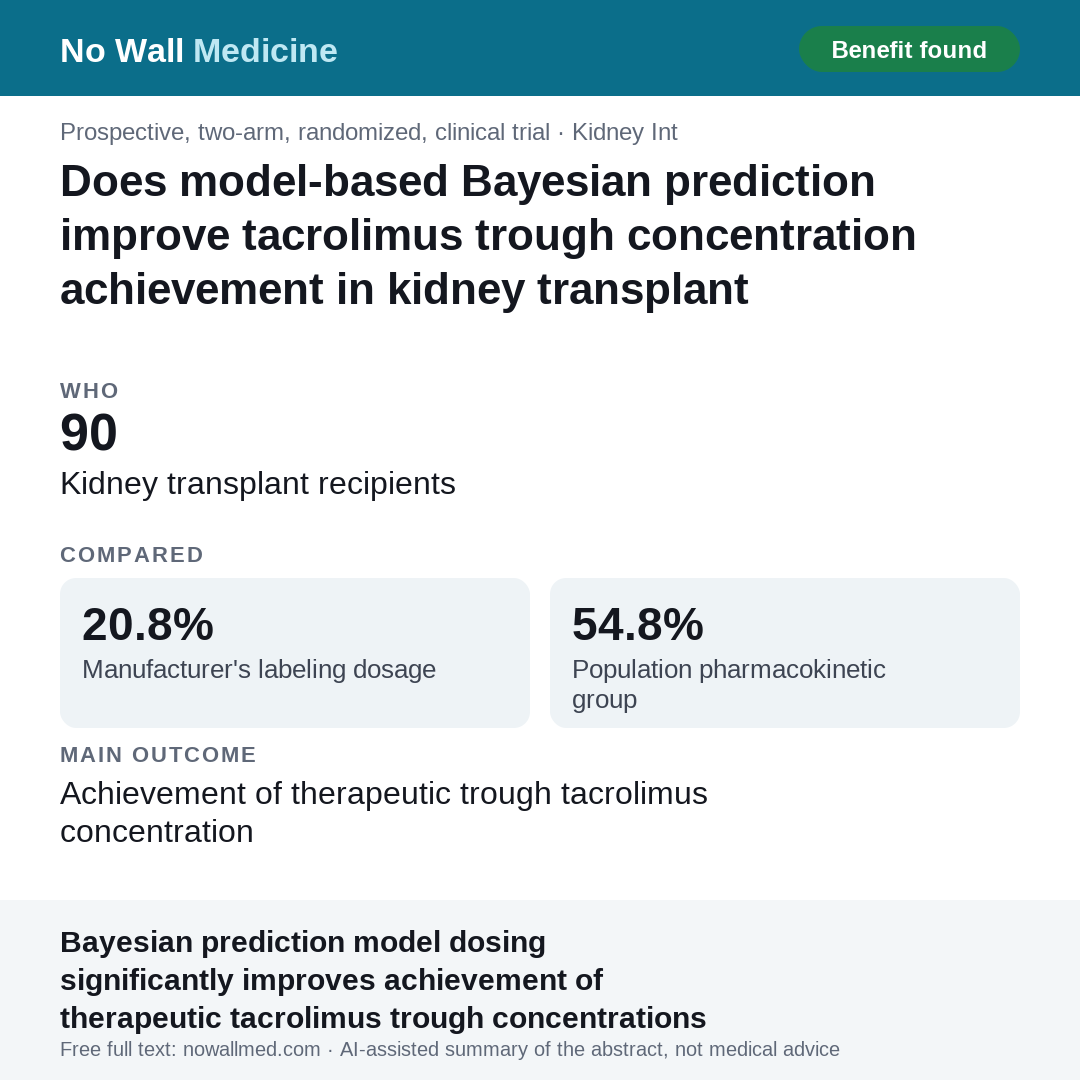
Clinical question: Does model-based Bayesian prediction improve tacrolimus trough concentration achievement in kidney transplant recipients?
Why it matters: Standard tacrolimus dosing is currently calculated based on body weight, but it is unknown if personalized mathematical models can better achieve target drug concentrations.
Key points
- Researchers conducted a randomized trial with 90 kidney transplant recipients comparing a personalized mathematical model to standard manufacturer labeling for tacrolimus dosing.
- The personalized group had a 54.8% success rate in reaching target drug levels compared to 20.8% in the control group.
- Patients using the personalized model reached target levels in 5 days versus 10 days and required fewer dose changes within 90 days.
Headline and key points written with AI from the paper’s abstract, with every number checked against it. Read the paper before relying on them.
Was this summary helpful?
Subject terms
Cite this article
Lloberas N, Grinyó JM, Colom H, Vidal-Alabró A, Fontova P, Rigo-Bonnin R. A prospective controlled, randomized clinical trial of kidney transplant recipients developed personalized tacrolimus dosing using model-based Bayesian Prediction. Kidney Int. 2023. doi:10.1016/j.kint.2023.06.021
Spotted a mistake? Suggest a correction
Top studies every Monday
The week’s key trials and guidelines in your specialties, plus any topics you follow. By email, free.
Get the weekly digest