A prospective, historical-controlled evaluation of oliceridine for moderate or severe pain in patients with acute burn injuries (RELIEVE)
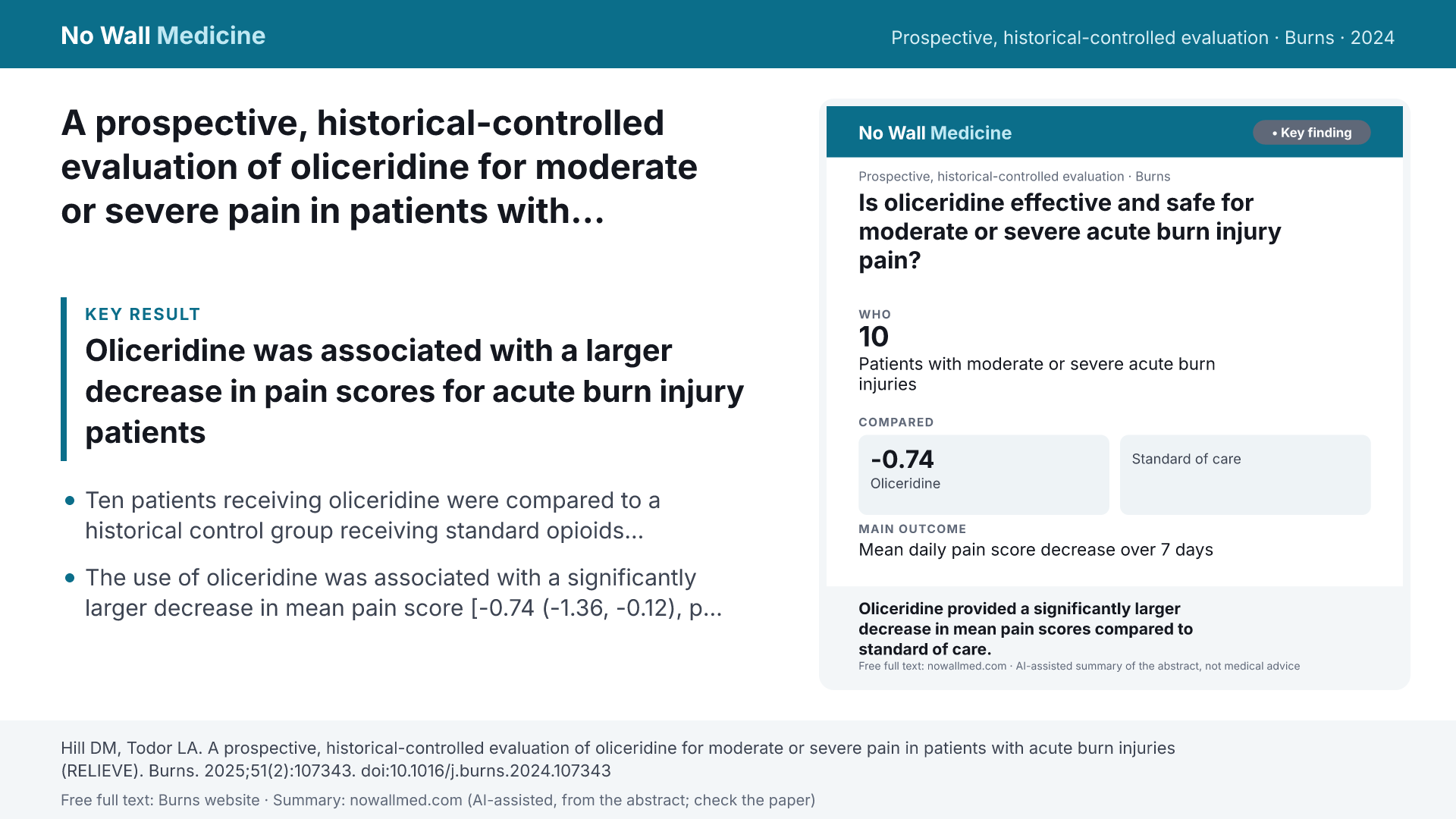
Key result: Oliceridine was associated with a larger decrease in pain scores for acute burn injury patients
Prospective, historical-controlled evaluationKey finding
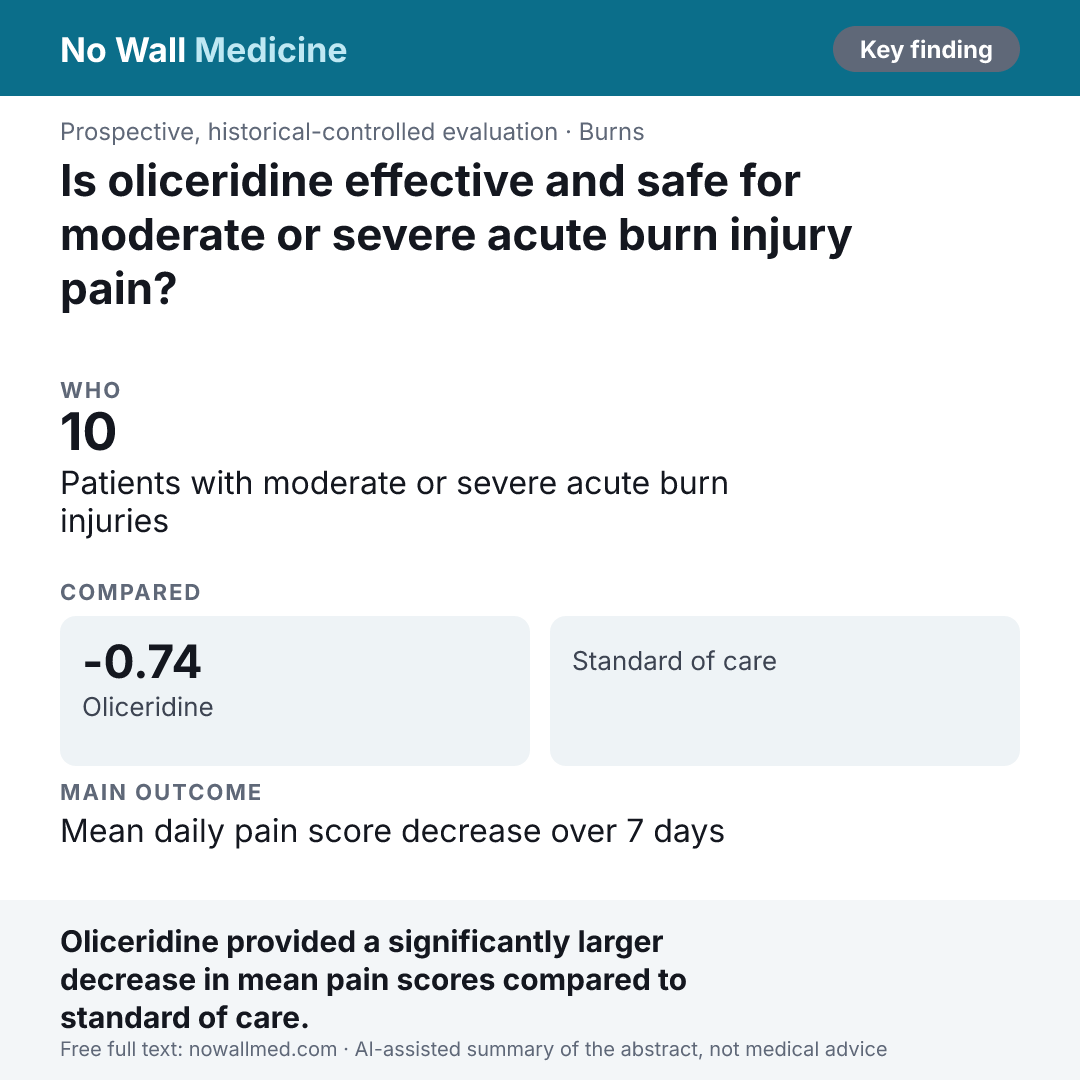
Is oliceridine effective and safe for moderate or severe acute burn injury pain?
Who
10
Patients with moderate or severe acute burn injuries
Compared
-0.74Oliceridine (-1.36, -0.12)
Standard of care
Main outcome
Mean daily pain score decrease over 7 days
Bottom line: Oliceridine provided a significantly larger decrease in mean pain scores compared to standard of care.
Limitation: Small sample size of ten patients and use of a historical control group.
Burns · 2024-11-30 · Save PNG
Key points
- Ten patients receiving oliceridine were compared to a historical control group receiving standard opioids like fentanyl or morphine for up to 7 days.
- The use of oliceridine was associated with a significantly larger decrease in mean pain score [-0.74 (-1.36, -0.12), p = 0.0215] compared to the control group.
- There was no difference in average daily morphine milligram equivalents [-14.02 (-67.22, 39.19), p = 0.5939] between the two groups.
Discussion prompts
- Would these patients look like yours? Who was left out?
- Is the main outcome one that matters to patients?
- Is the difference large enough to change what you do?
Cite: Hill DM, Todor LA. A prospective, historical-controlled evaluation of oliceridine for moderate or severe pain in patients with acute burn injuries (RELIEVE). Burns. 2025;51(2):107343. doi:10.1016/j.burns.2024.107343
Free full text: Burns website · Summary and visual abstract: nowallmed.com/a/a-prospective-historical-controlled-evaluation-of-oliceridine-for-1u38m8v/ (AI-assisted from the abstract; check the paper before relying on it).