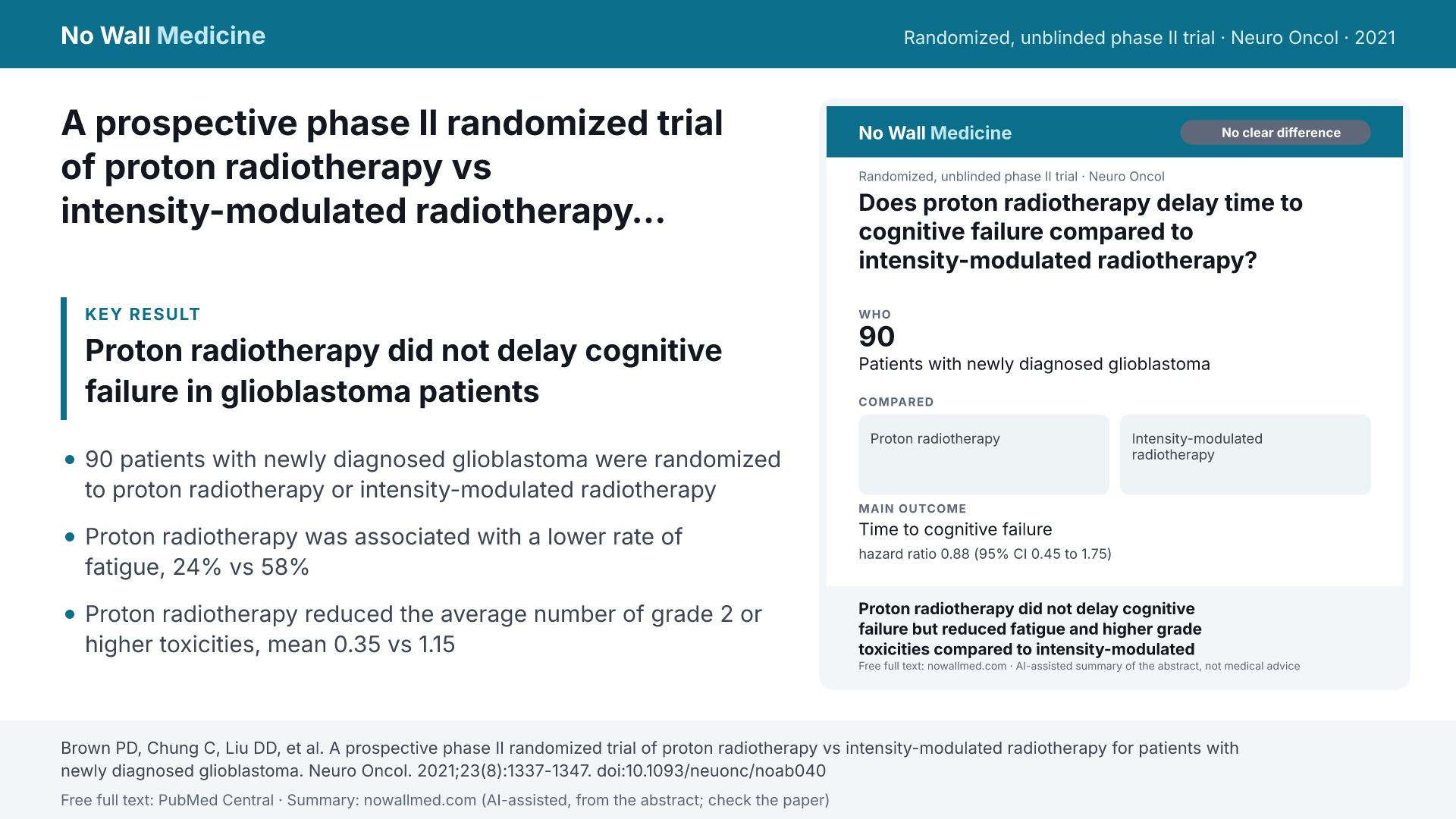
A prospective phase II randomized trial of proton radiotherapy vs intensity-modulated radiotherapy for patients with newly diagnosed glioblastoma
Key result: Proton radiotherapy did not delay cognitive failure in glioblastoma patients
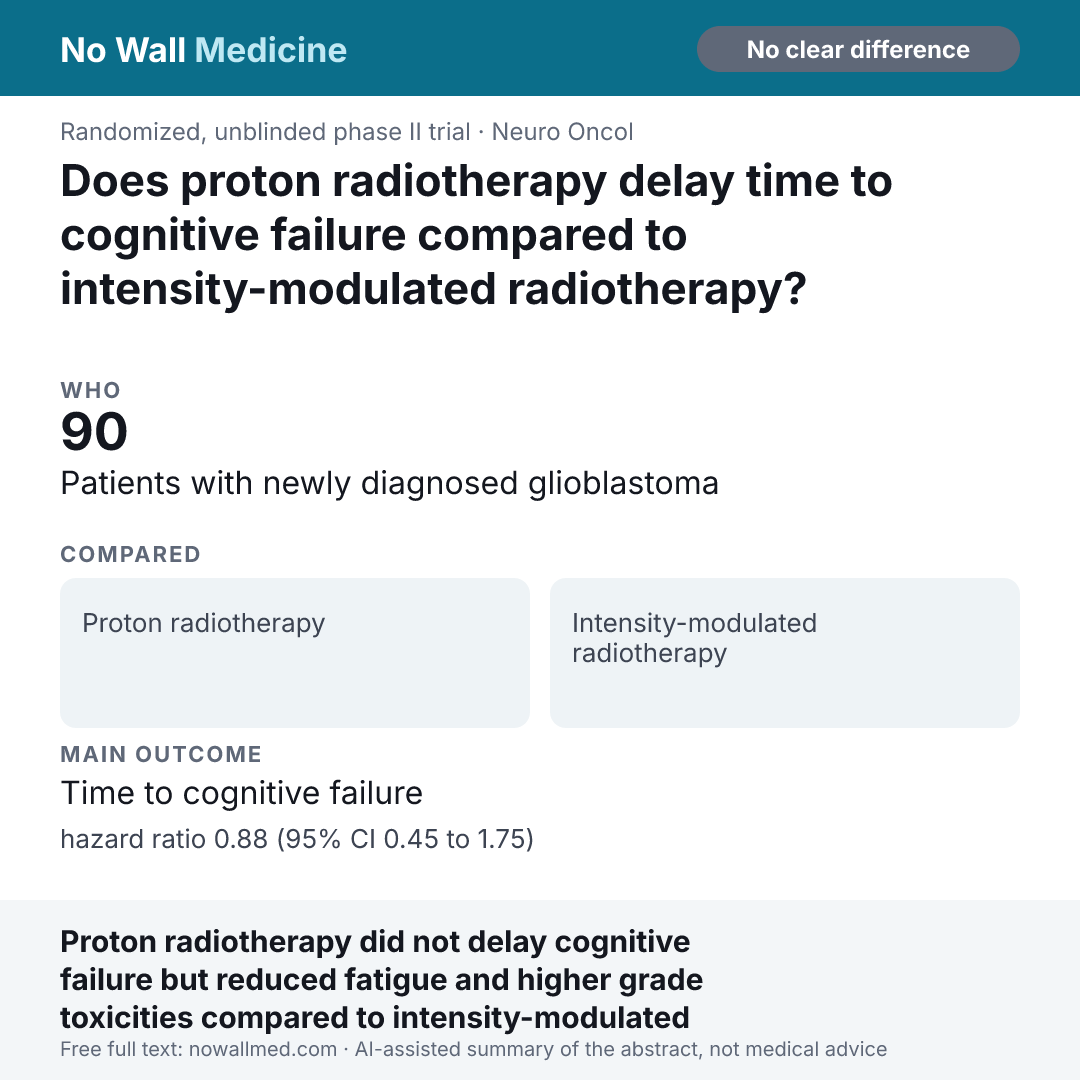
Randomized, unblinded phase II trialNo clear difference
Does proton radiotherapy delay time to cognitive failure compared to intensity-modulated radiotherapy?
Who
90
Patients with newly diagnosed glioblastoma
Compared
Proton radiotherapy
Intensity-modulated radiotherapy
Main outcome
Time to cognitive failure
Result: hazard ratio 0.88 (95% CI 0.45 to 1.75)
Bottom line: Proton radiotherapy did not delay cognitive failure but reduced fatigue and higher grade toxicities compared to intensity-modulated radiotherapy.
Limitation: This was a signal-seeking phase II trial; larger randomized trials are needed.
Neuro Oncol · 2021-03-02 · Save PNG
Key points
- 90 patients with newly diagnosed glioblastoma were randomized to proton radiotherapy or intensity-modulated radiotherapy.
- Proton radiotherapy was associated with a lower rate of fatigue, 24% vs 58%.
- Proton radiotherapy reduced the average number of grade 2 or higher toxicities, mean 0.35 vs 1.15.
Discussion prompts
- Would these patients look like yours? Who was left out?
- Is the main outcome one that matters to patients?
- Is the difference large enough to change what you do?
Cite: Brown PD, Chung C, Liu DD, et al. A prospective phase II randomized trial of proton radiotherapy vs intensity-modulated radiotherapy for patients with newly diagnosed glioblastoma. Neuro Oncol. 2021;23(8):1337-1347. doi:10.1093/neuonc/noab040
Free full text: PubMed Central · Summary and visual abstract: nowallmed.com/a/a-prospective-phase-ii-randomized-trial-of-proton-radiotherapy-vs-1ss10vd/ (AI-assisted from the abstract; check the paper before relying on it).