Pilot study protocol evaluates feasibility of lidocaine infusion during colorectal cancer surgery
A protocol for a pilot study to assess the feasibility of a randomised clinical trial of perioperative intravenous lidocaine on colorectal cancer outcome after surgery (FLICOR trial)
Double-blinded, randomised, controlled pilot studyUnclear result
Is perioperative intravenous lidocaine infusion feasible for colorectal cancer surgery outcomes?
Who
Patients undergoing minimally invasive colorectal cancer surgery · Two National Health Service Trusts
Compared
Intravenous lidocaine
Placebo
Main outcome
Feasibility of data collection and exploratory outcomes
Bottom line: This is a protocol for a pilot study to assess the feasibility of a future clinical trial.
BJA Open · 2023-06-30Download image
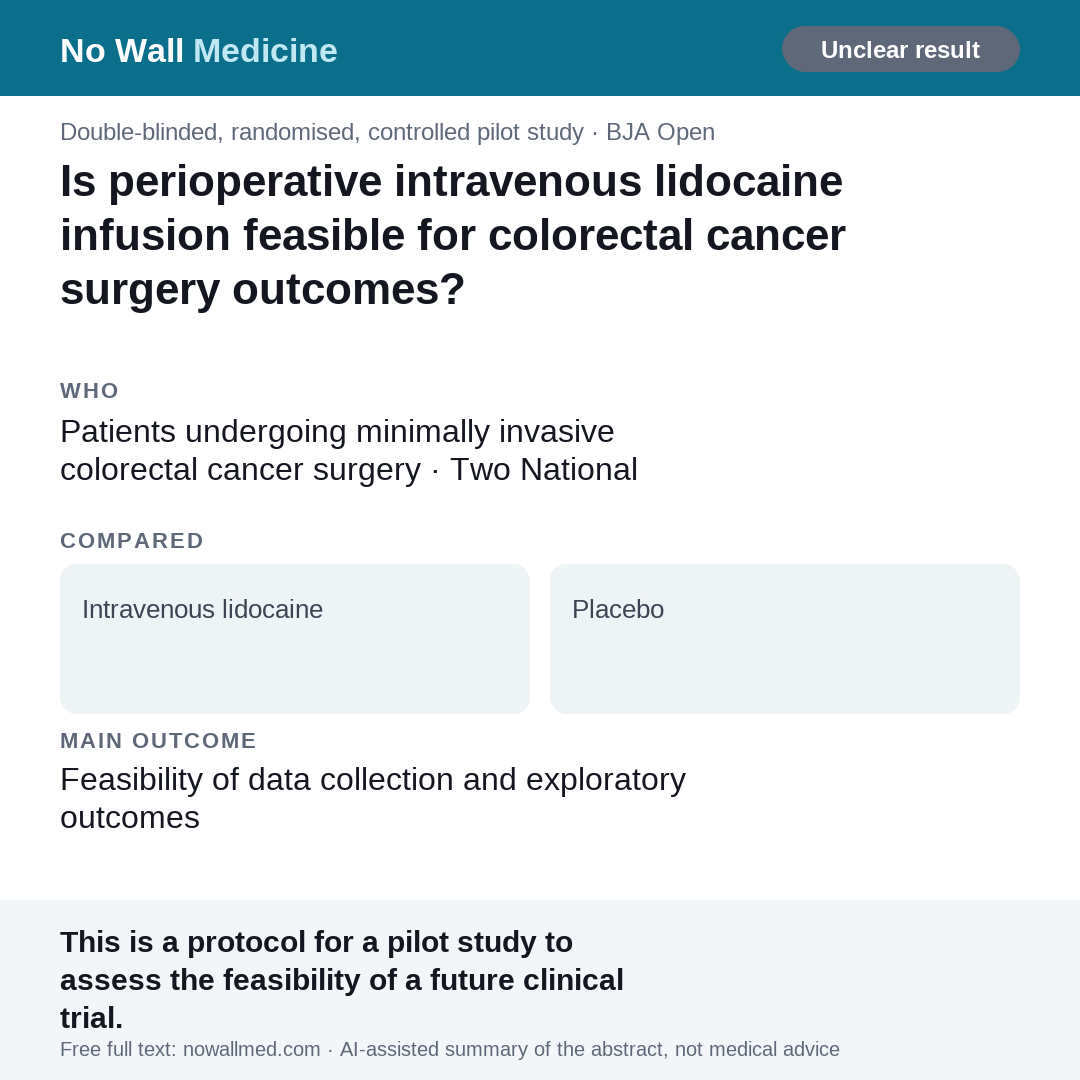
Clinical question: Is perioperative intravenous lidocaine infusion feasible for colorectal cancer surgery outcomes?
Why it matters: It is unknown if perioperative intravenous lidocaine infusion is feasible for a large-scale clinical trial to assess colorectal cancer outcomes.
Key points
- The FLICOR trial is a double-blinded, randomized, controlled pilot study comparing intravenous lidocaine to a placebo in patients undergoing minimally invasive colorectal cancer surgery.
- Researchers will assess the feasibility of data collection for future economic, clinical, and patient-reported outcomes, alongside exploratory blood sample analysis.
- The protocol involves a 1.5 mg kg-1 bolus of lidocaine followed by a 1.5 mg kg-1 h-1 infusion for 24 h.
Headline and key points written with AI from the paper’s abstract, with every number checked against it. Read the paper before relying on them.
Was this summary helpful?
Cite this article
West R, Soo CP, Murphy J, Vizcaychipi MP, Ma D. A protocol for a pilot study to assess the feasibility of a randomised clinical trial of perioperative intravenous lidocaine on colorectal cancer outcome after surgery (FLICOR trial). BJA Open. 2023. doi:10.1016/j.bjao.2023.100138
Spotted a mistake? Suggest a correction
Top studies every Monday
The week’s key trials and guidelines in your specialties, plus any topics you follow. By email, free.
Get the weekly digest