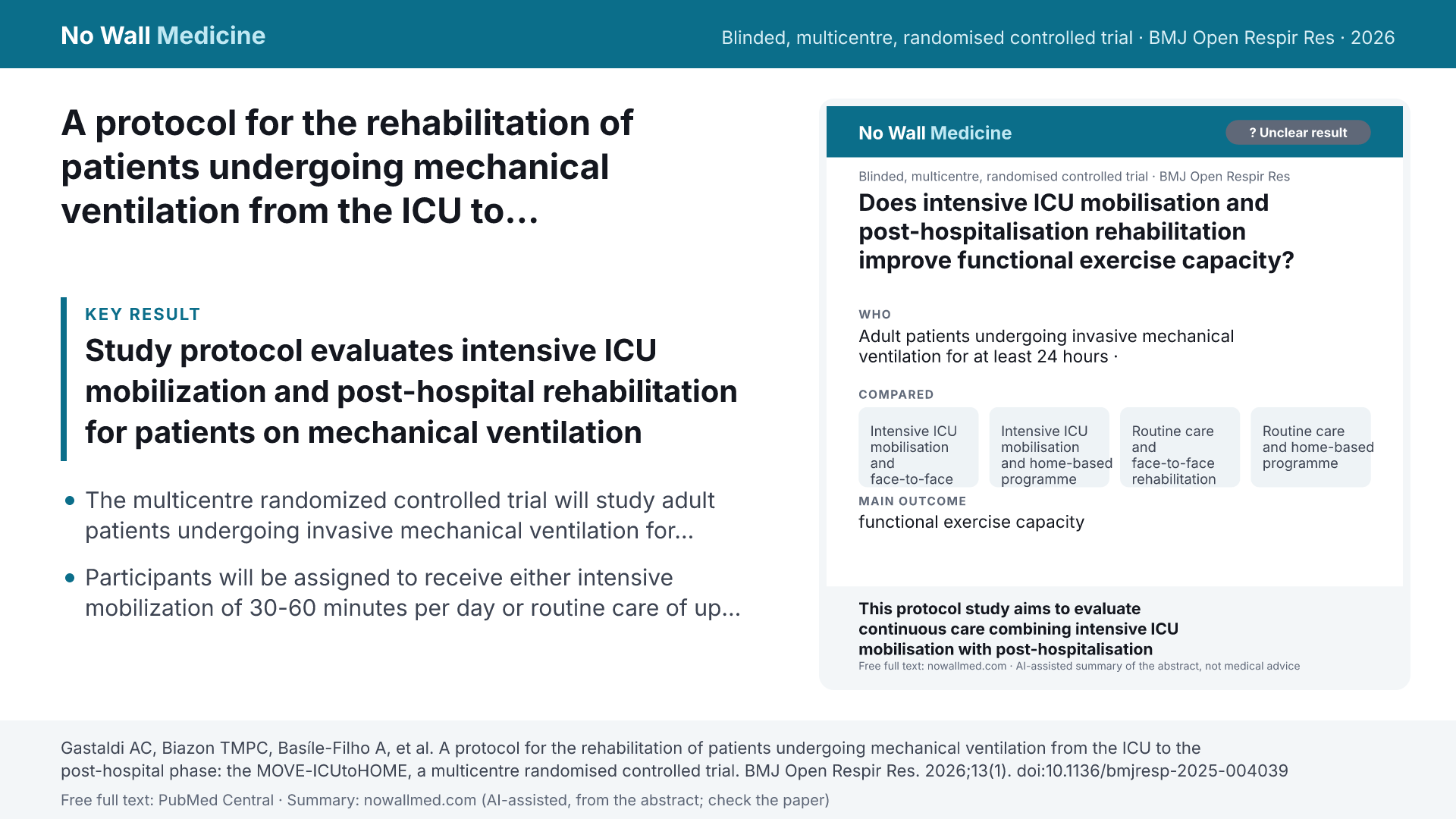
Study protocol evaluates intensive ICU mobilization and post-hospital rehabilitation for patients on mechanical ventilation
A protocol for the rehabilitation of patients undergoing mechanical ventilation from the ICU to the post-hospital phase: the MOVE-ICUtoHOME, a multicentre randomised controlled trial
Blinded, multicentre, randomised controlled trialUnclear result
Does intensive ICU mobilisation and post-hospitalisation rehabilitation improve functional exercise capacity?
Who
Adult patients undergoing invasive mechanical ventilation for at least 24 hours · Multicentre
Compared
Intensive ICU mobilisation and face-to-face rehabilitation
Intensive ICU mobilisation and home-based programme
Routine care and face-to-face rehabilitation
Routine care and home-based programme
Main outcome
functional exercise capacity
Bottom line: This protocol study aims to evaluate continuous care combining intensive ICU mobilisation with post-hospitalisation rehabilitation.
BMJ Open Respir Res · 2026-08-20 · Save PNG
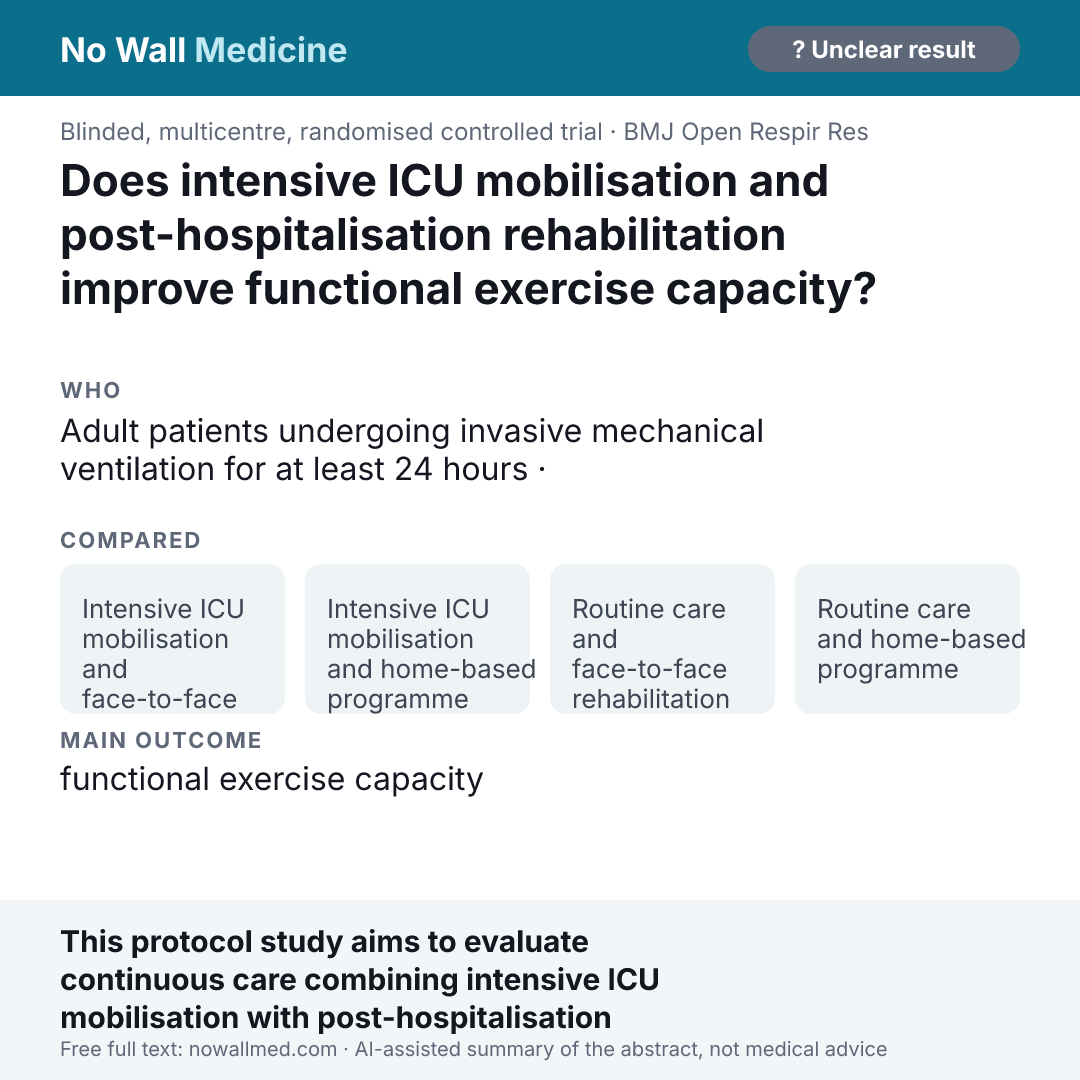
Clinical question: Does intensive ICU mobilisation and post-hospitalisation rehabilitation improve functional exercise capacity?
Why it matters: Evidence remains limited regarding how intensive mobilization in the intensive care unit and post-discharge rehabilitation affect patients with intensive care unit-acquired weakness.
Key points
- The multicentre randomized controlled trial will study adult patients undergoing invasive mechanical ventilation for at least 24 hours.
- Participants will be assigned to receive either intensive mobilization of 30-60 minutes per day or routine care of up to 10 minutes per day.
- The study will compare the effects of face-to-face rehabilitation for 8 weeks against a home-based program after hospital discharge.
Headline and key points written with AI from the paper’s abstract, with every number checked against it. Read the paper before relying on them.
Was this summary helpful?
Abstract
Introduction
Intensive care unit-acquired weakness (ICU-AW) in patients with acute respiratory failure requiring invasive mechanical ventilation (IMV) is associated with reduced functional exercise capacity and increased mortality. Early mobilisation in the ICU may improve functional outcomes and reduce length of stay; however, evidence remains limited, protocols are heterogeneous and post-discharge rehabilitation is frequently lacking. This study aims to evaluate the effects of a continuous care programme combining early intensive ICU mobilisation with post-hospitalisation rehabilitation on functional exercise capacity, with inflammation, quality of life, mortality and cost-effectiveness as secondary outcomes in critically ill patients receiving IMV. Methods and analysis
This blinded, multicentre, randomised controlled trial will include adult patients undergoing invasive MV for at least 24 hours. Participants will be randomly allocated to one of four groups: intervention group (IG)-Rehab, control group (CG)-Rehab, IG-Home or CG-Home. During hospitalisation, the IG will receive an intensive mobilisation protocol (30-60 minutes/day), while the CG will receive routine care (up to 10 min/day). After hospital discharge, participants will undergo either 8 weeks of face-to-face rehabilitation (Rehab) or a home-based programme (Home), with follow-up for 6 months. Exploratory analyses will evaluate clinical parameters, severity indices, functional status, pulmonary function and mechanics, additional measures of functional exercise capacity, muscle strength and mass, energy expenditure, and symptoms of anxiety and depression. The 2×2 factorial design will allow for the evaluation of the independent effects of in-hospital mobilisation intensity and post-discharge rehabilitation strategy. Statistical analyses will use appropriate parametric or non-parametric tests, with significance set at p<0.05. Ethics and dissemination
The study will follow the Brazilian National Health Council guidelines, the Brazilian General Data Protection Law and Research Electronic Data Capture standards. Results will be disseminated through peer-reviewed journals, scientific meetings and social media. The trial is registered at ClinicalTrials.gov (NCT06405529; 8 May 2024) and follows Consolidated Standards of Reporting Trials guidelines.
Abstract reproduced under the article’s CC BY NC licence.
Subject terms
Headline, design, result, key points, caveat and citation as plain text.
Cite this article
Gastaldi AC, Biazon TMPC, Basíle-Filho A, et al. A protocol for the rehabilitation of patients undergoing mechanical ventilation from the ICU to the post-hospital phase: the MOVE-ICUtoHOME, a multicentre randomised controlled trial. BMJ Open Respir Res. 2026;13(1). doi:10.1136/bmjresp-2025-004039
Spotted a mistake? Suggest a correction