Culturally adapted psychoeducation was feasible and acceptable for people with bipolar disorders in Nigeria
A randomised controlled feasibility trial comparing culturally adapted psychoeducation and treatment as usual for persons with bipolar disorders in Nigeria
Randomised controlled feasibility trialBenefit found
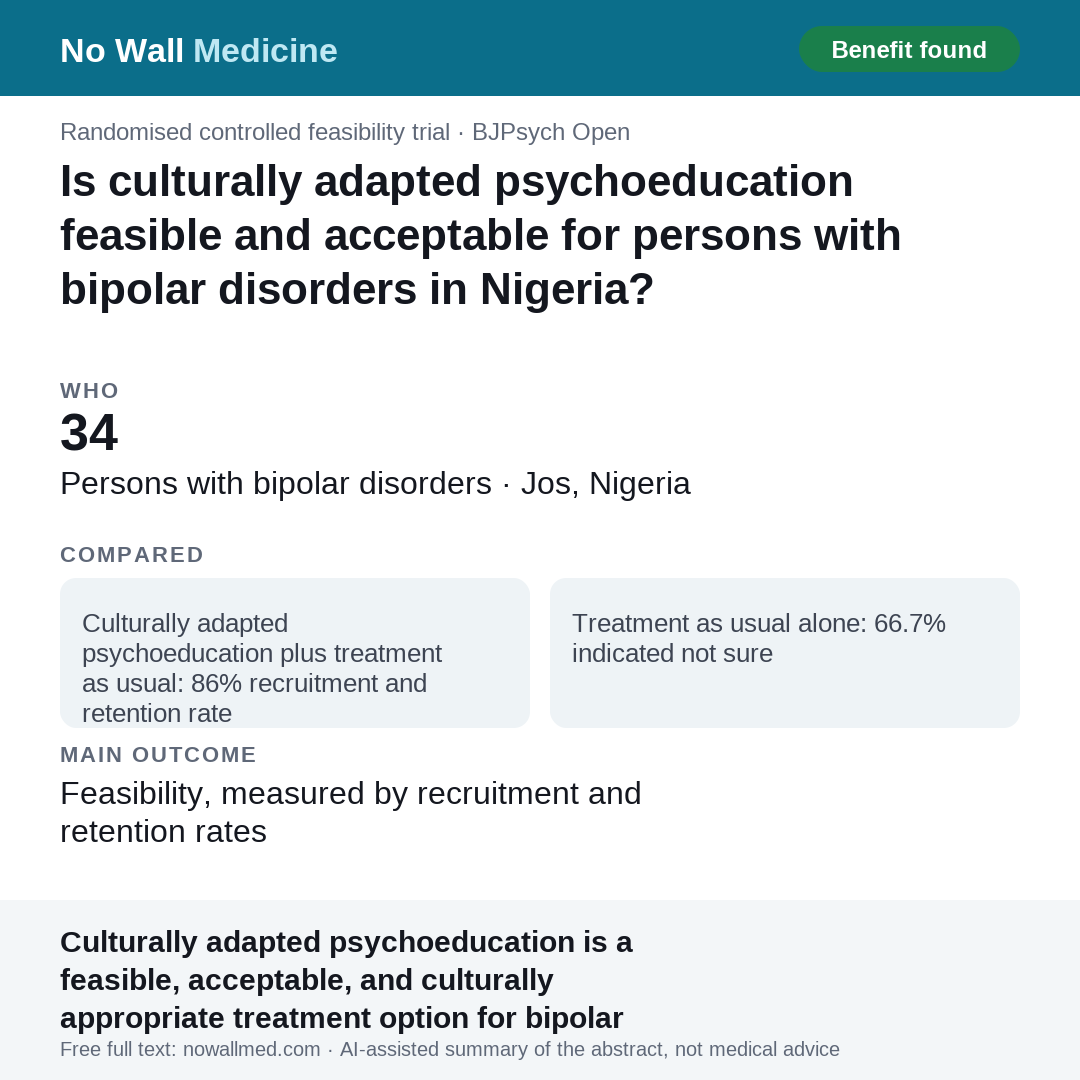
Is culturally adapted psychoeducation feasible and acceptable for persons with bipolar disorders in Nigeria?
Who
34
Persons with bipolar disorders · Jos, Nigeria
Compared
Culturally adapted psychoeducation plus treatment as usual: 86% recruitment and retention rate
Treatment as usual alone: 66.7% indicated not sure
Main outcome
Feasibility, measured by recruitment and retention rates
Bottom line: Culturally adapted psychoeducation is a feasible, acceptable, and culturally appropriate treatment option for bipolar disorders in Nigeria.
Limitation: Further adequately powered randomized controlled trials evaluating clinical and cost-effectiveness are warranted.
BJPsych Open · 2025-06-27Download image
Clinical question: Is culturally adapted psychoeducation feasible and acceptable for persons with bipolar disorders in Nigeria?
Why it matters: There is limited evidence regarding whether culturally appropriate interventions for bipolar disorders are effective or feasible in Nigeria.
Key points
- Researchers conducted a randomized controlled trial with 34 people with bipolar disorders in Jos, Nigeria, comparing culturally adapted psychoeducation plus usual care to usual care alone.
- The intervention group had an 86% recruitment and retention rate and 87.5% reported being very satisfied compared to 66.7% who were not sure in the usual care group.
- The intervention group showed reductions in depression scores (PHQ-9) of -12.01 at the end of intervention and -7.39 at follow-up, alongside improved quality of life and bipolar symptom scores.
Limitation the authors note: The authors state that further adequately powered randomized controlled trials are needed to evaluate clinical and cost-effectiveness.
Headline and key points written with AI from the paper’s abstract, with every number checked against it. Read the paper before relying on them.
Cite this article
Jidong DE, Husain MI, Ike TJ, Khoso A, Taru MY, Nwoga CN. A randomised controlled feasibility trial comparing culturally adapted psychoeducation and treatment as usual for persons with bipolar disorders in Nigeria. BJPsych Open. 2025. doi:10.1192/bjo.2025.66
Spotted a mistake? Suggest a correction
Top studies every Monday
The week’s key trials and guidelines in your specialties, by email. Free.
Get the weekly digest