A randomised trial of bilateral erector spinae plane block vs. no block for thoracolumbar decompressive spinal surgery
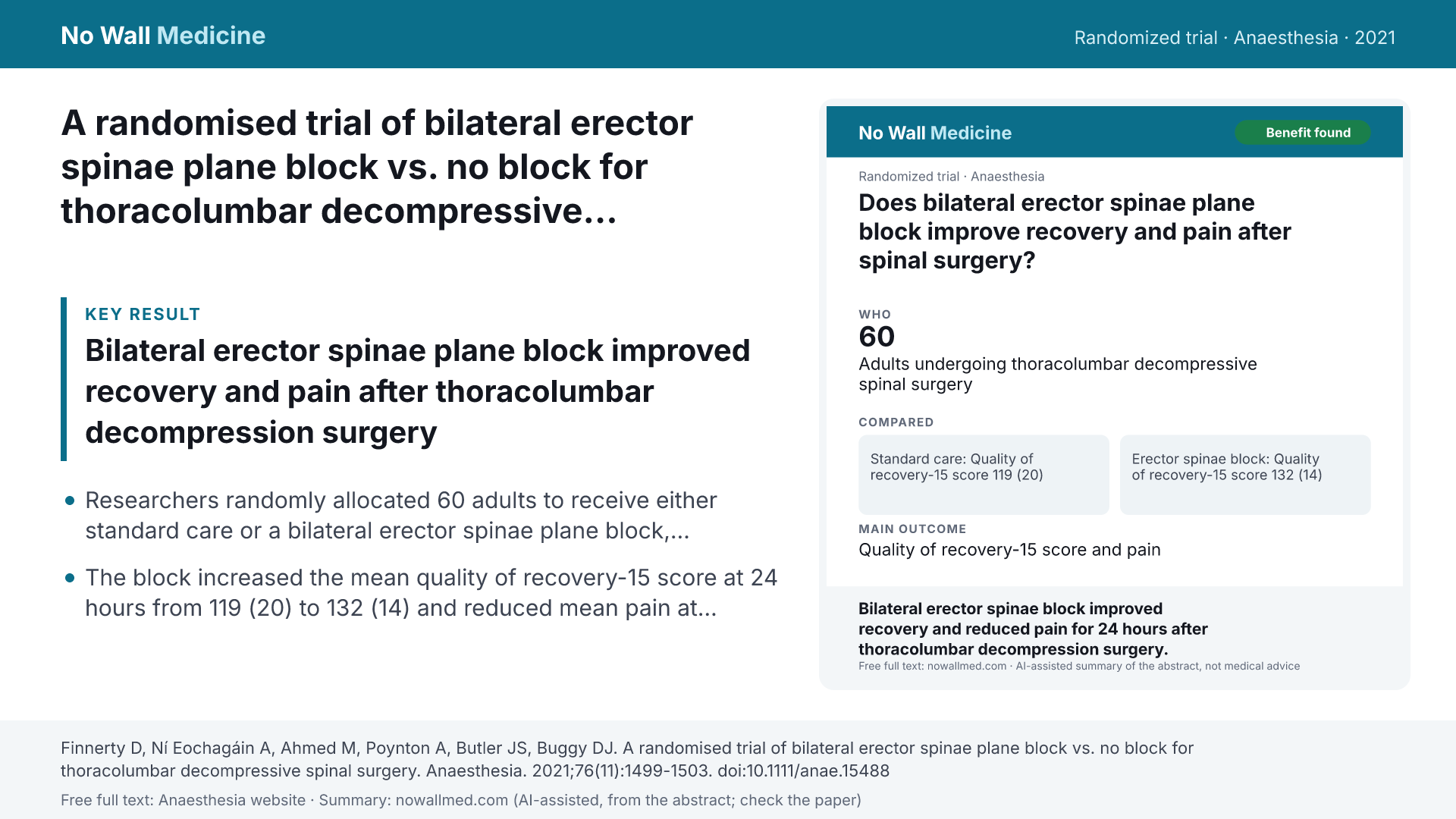
Key result: Bilateral erector spinae plane block improved recovery and pain after thoracolumbar decompression surgery
Randomized trialBenefit found
Does bilateral erector spinae plane block improve recovery and pain after spinal surgery?
Who
60
Adults undergoing thoracolumbar decompressive spinal surgery
Compared
Standard care: Quality of recovery-15 score 119 (20)
Erector spinae block: Quality of recovery-15 score 132 (14)
Main outcome
Quality of recovery-15 score and pain
Result: increase (95%CI) of 13 (4-22)
Bottom line: Bilateral erector spinae block improved recovery and reduced pain for 24 hours after thoracolumbar decompression surgery.
Anaesthesia · 2021-04-20
Key points
- Researchers randomly allocated 60 adults to receive either standard care or a bilateral erector spinae plane block, which is a type of regional anesthesia, during spinal surgery.
- The block increased the mean quality of recovery-15 score at 24 hours from 119 (20) to 132 (14) and reduced mean pain at rest from 78 (49) to 50 (39).
- The median comprehensive complication index was 1 (0-3 [0-5]) in the control group compared to 1 (0-1 [0-4]) in the block group, with no significant difference.
Discussion prompts
- Would these patients look like yours? Who was left out?
- Is the main outcome one that matters to patients?
- Is the difference large enough to change what you do?
Cite: Finnerty D, Ní Eochagáin A, Ahmed M, Poynton A, Butler JS, Buggy DJ. A randomised trial of bilateral erector spinae plane block vs. no block for thoracolumbar decompressive spinal surgery. Anaesthesia. 2021;76(11):1499-1503. doi:10.1111/anae.15488
Free full text: Anaesthesia website · Summary and visual abstract: nowallmed.com/a/a-randomised-trial-of-bilateral-erector-spinae-plane-block-vs-no-hju88q/ (AI-assisted from the abstract; check the paper before relying on it).