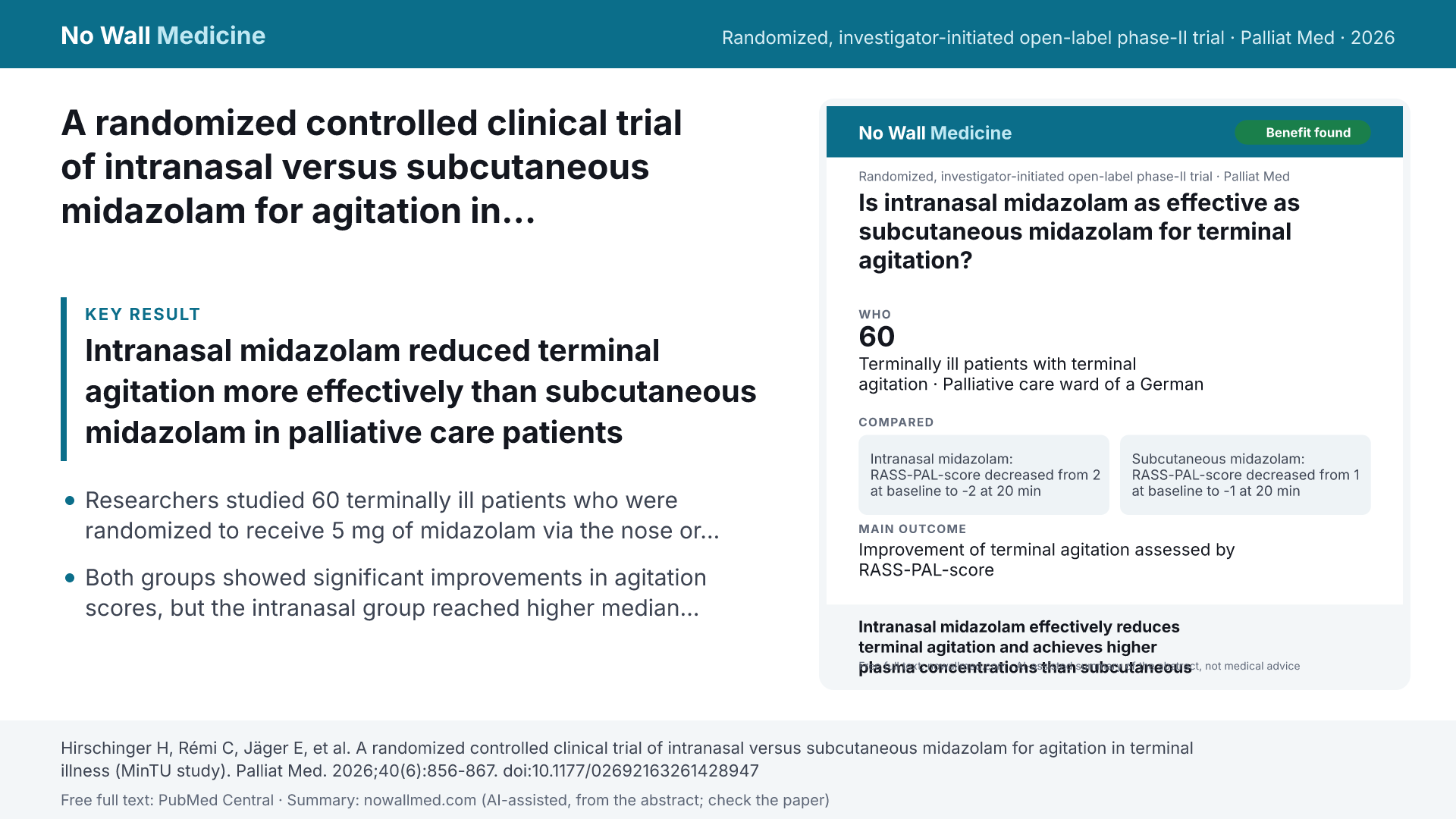
Intranasal midazolam reduced terminal agitation more effectively than subcutaneous midazolam in palliative care patients
A randomized controlled clinical trial of intranasal versus subcutaneous midazolam for agitation in terminal illness (MinTU study)
Randomized, investigator-initiated open-label phase-II trialBenefit found
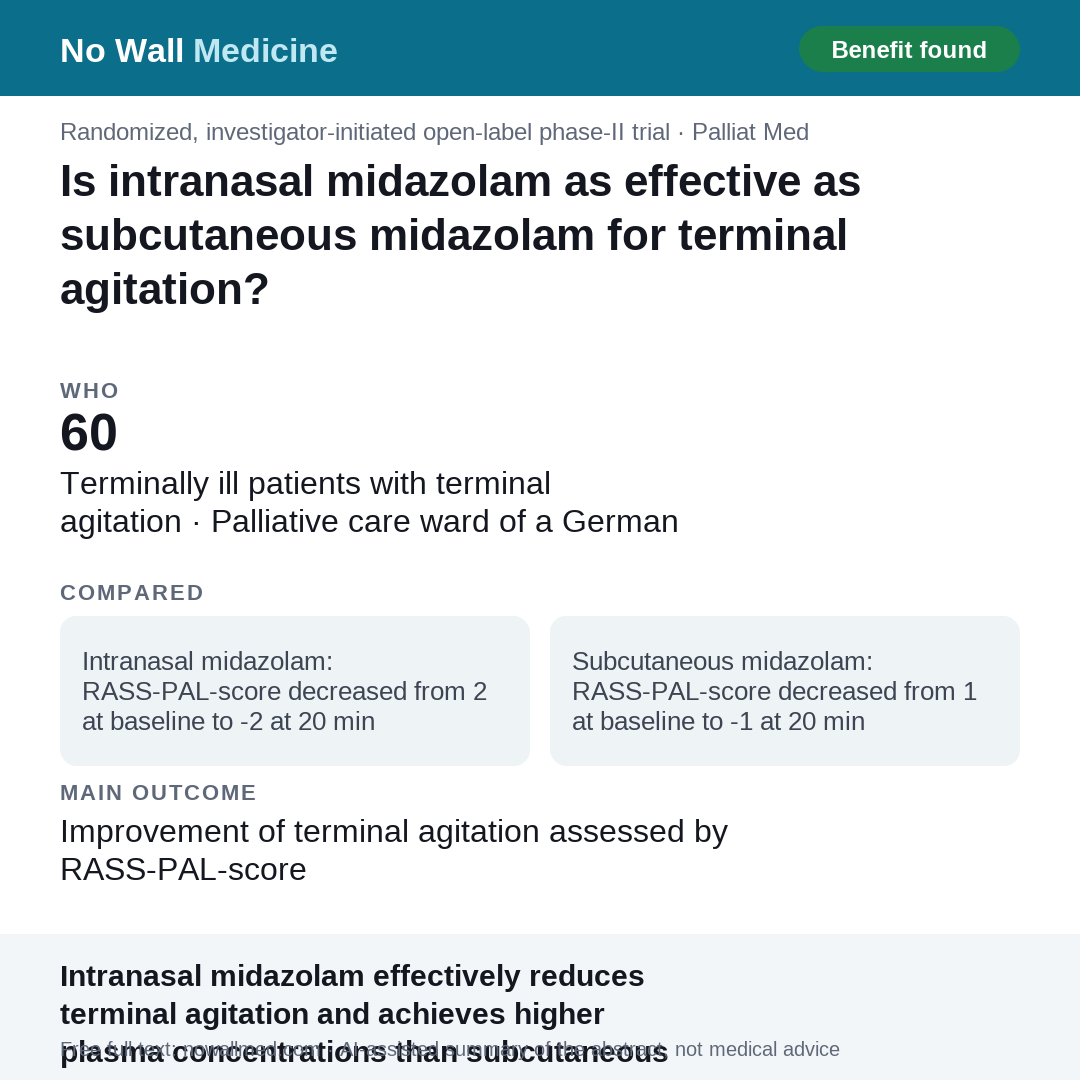
Is intranasal midazolam as effective as subcutaneous midazolam for terminal agitation?
Who
60
Terminally ill patients with terminal agitation · Palliative care ward of a German University Hospital
Compared
Intranasal midazolam: RASS-PAL-score decreased from 2 at baseline to -2 at 20 min
Subcutaneous midazolam: RASS-PAL-score decreased from 1 at baseline to -1 at 20 min
Main outcome
Improvement of terminal agitation assessed by RASS-PAL-score
Bottom line: Intranasal midazolam effectively reduces terminal agitation and achieves higher plasma concentrations than subcutaneous administration.
Palliat Med · 2026-03-22Download image
Clinical question: Is intranasal midazolam as effective as subcutaneous midazolam for terminal agitation?
Why it matters: Doctors need evidence-based information on fast-acting and minimally invasive ways to administer medication to terminally ill patients who have difficulty swallowing.
Key points
- Researchers studied 60 terminally ill patients who were randomized to receive 5 mg of midazolam via the nose or through a needle under the skin.
- Both groups showed significant improvements in agitation scores, but the intranasal group reached higher median plasma concentrations at 5 minutes (90 ng/ml) and 20 minutes (83 ng/ml).
- No patients in the study withdrew from the trial due to adverse effects.
Headline and key points written with AI from the paper’s abstract, with every number checked against it. Read the paper before relying on them.
Was this summary helpful?
Subject terms
Cite this article
Hirschinger H, Rémi C, Jäger E, et al. A randomized controlled clinical trial of intranasal versus subcutaneous midazolam for agitation in terminal illness (MinTU study). Palliat Med. 2026. doi:10.1177/02692163261428947
Spotted a mistake? Suggest a correction