Nasal administration of modified bacteria provided partial protection against pneumococcal recolonization in a human challenge trial
A Randomized Controlled Clinical Trial of Nasal Immunization with Live Virulence Attenuated Streptococcus pneumoniae Strains Using Human Infection Challenge
Randomized controlled clinical trialBenefit found
Does nasal administration of attenuated Streptococcus pneumoniae strains protect against wild-type recolonization?
Who
125
Healthy adults aged 18-50 years
Compared
47%Saline solution
29%Wild-type Streptococcus pneumoniae 6B
30%Genetically modified strain SpnA1
50%Genetically modified strain SpnA3
Main outcome
Recolonization rates with wild-type Streptococcus pneumoniae after challenge
Bottom line: Nasal administration of attenuated strains SpnWT or SpnA1 provided partial protection against wild-type recolonization.
AJRCCM · 2023-08-09Download image
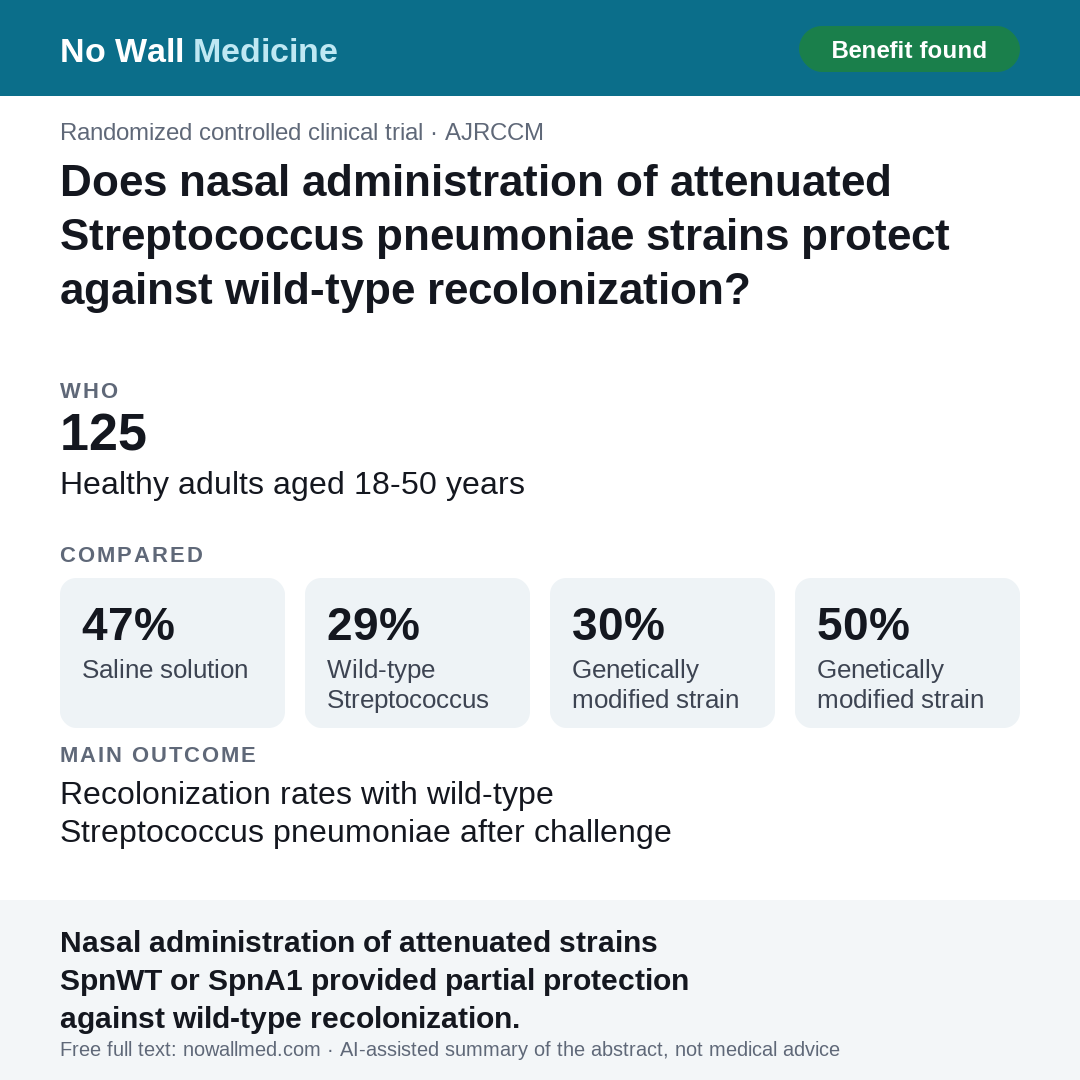
Clinical question: Does nasal administration of attenuated Streptococcus pneumoniae strains protect against wild-type recolonization?
Why it matters: It was unknown if nasal colonization with live attenuated Streptococcus pneumoniae strains could protect against subsequent infection with wild-type strains.
Key points
- Researchers studied 125 healthy adults aged 18-50 years who received nasal doses of saline, wild-type bacteria, or two genetically modified bacteria strains.
- Participants given wild-type or SpnA1 strains had recolonization rates of 29% and 30% after challenge, compared to 47% in the saline group.
- The SpnA3 group achieved a recolonization rate of 50%, which was similar to the 47% rate seen in the saline control group.
Headline and key points written with AI from the paper’s abstract, with every number checked against it. Read the paper before relying on them.
Was this summary helpful?
Subject terms
Cite this article
Hill H, Mitsi E, Nikolaou E, Blizard A, Pojar S, Howard A. A Randomized Controlled Clinical Trial of Nasal Immunization with Live Virulence Attenuated Streptococcus pneumoniae Strains Using Human Infection Challenge. AJRCCM. 2023. doi:10.1164/rccm.202302-0222OC
Spotted a mistake? Suggest a correction
Top studies every Monday
The week’s key trials and guidelines in your specialties, plus any topics you follow. By email, free.
Get the weekly digest