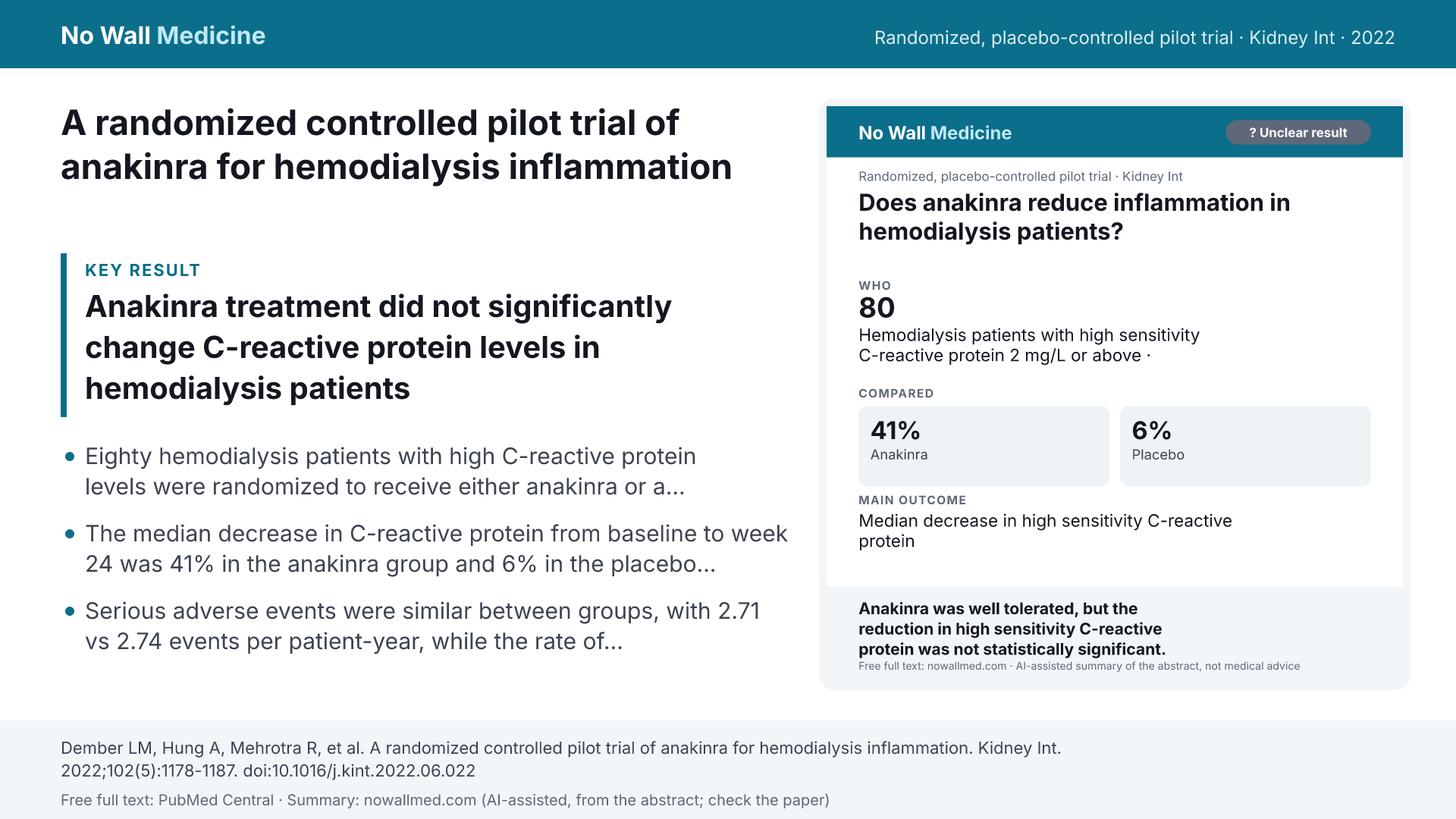
Anakinra treatment did not significantly change C-reactive protein levels in hemodialysis patients
A randomized controlled pilot trial of anakinra for hemodialysis inflammation
Randomized, placebo-controlled pilot trialUnclear result
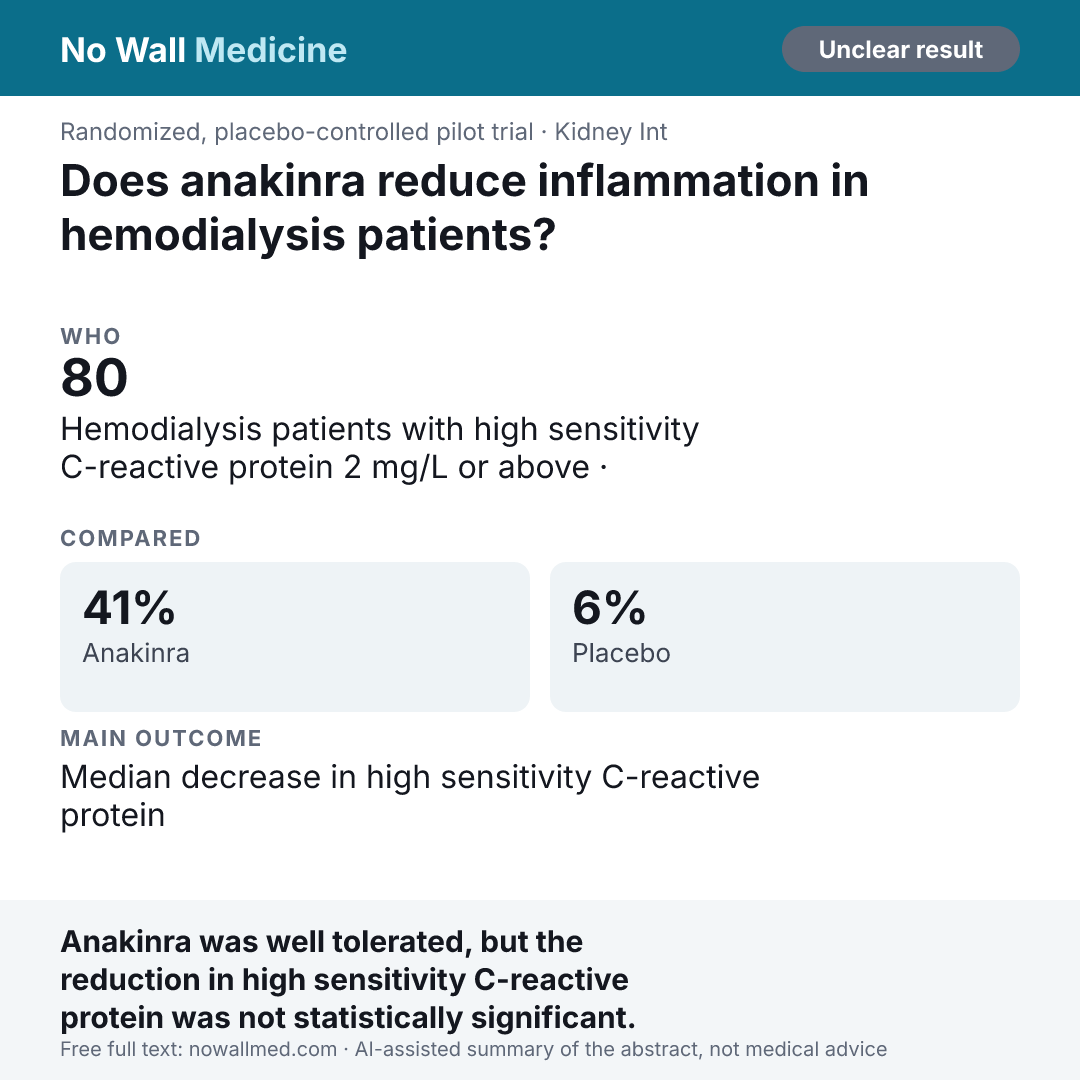
Does anakinra reduce inflammation in hemodialysis patients?
Who
80
Hemodialysis patients with high sensitivity C-reactive protein 2 mg/L or above · Multicenter
Compared
41%Anakinra
6%Placebo
Main outcome
Median decrease in high sensitivity C-reactive protein
Result: not statistically significant
Bottom line: Anakinra was well tolerated, but the reduction in high sensitivity C-reactive protein was not statistically significant.
Kidney Int · 2022-07-19 · Save PNG
Clinical question: Does anakinra reduce inflammation in hemodialysis patients?
Key points
- Eighty hemodialysis patients with high C-reactive protein levels were randomized to receive either anakinra or a placebo via their dialysis circuit for 24 weeks.
- The median decrease in C-reactive protein from baseline to week 24 was 41% in the anakinra group and 6% in the placebo group, but this difference was not statistically significant.
- Serious adverse events were similar between groups, with 2.71 vs 2.74 events per patient-year, while the rate of infections and low blood cell counts was lower with anakinra at 0.48 vs 1.40 events per patient-year.
Headline and key points written with AI from the paper’s abstract, with every number checked against it. Read the paper before relying on them.
Was this summary helpful?
Subject terms
Headline, design, result, key points, caveat and citation as plain text.
Cite this article
Dember LM, Hung A, Mehrotra R, et al. A randomized controlled pilot trial of anakinra for hemodialysis inflammation. Kidney Int. 2022;102(5):1178-1187. doi:10.1016/j.kint.2022.06.022
Spotted a mistake? Suggest a correction