Virtual reality experiences increased intentions for prudent antibiotic use compared to information alone
A randomized controlled trial investigating experiential virtual reality communication on prudent antibiotic use
Randomized controlled trialBenefit found
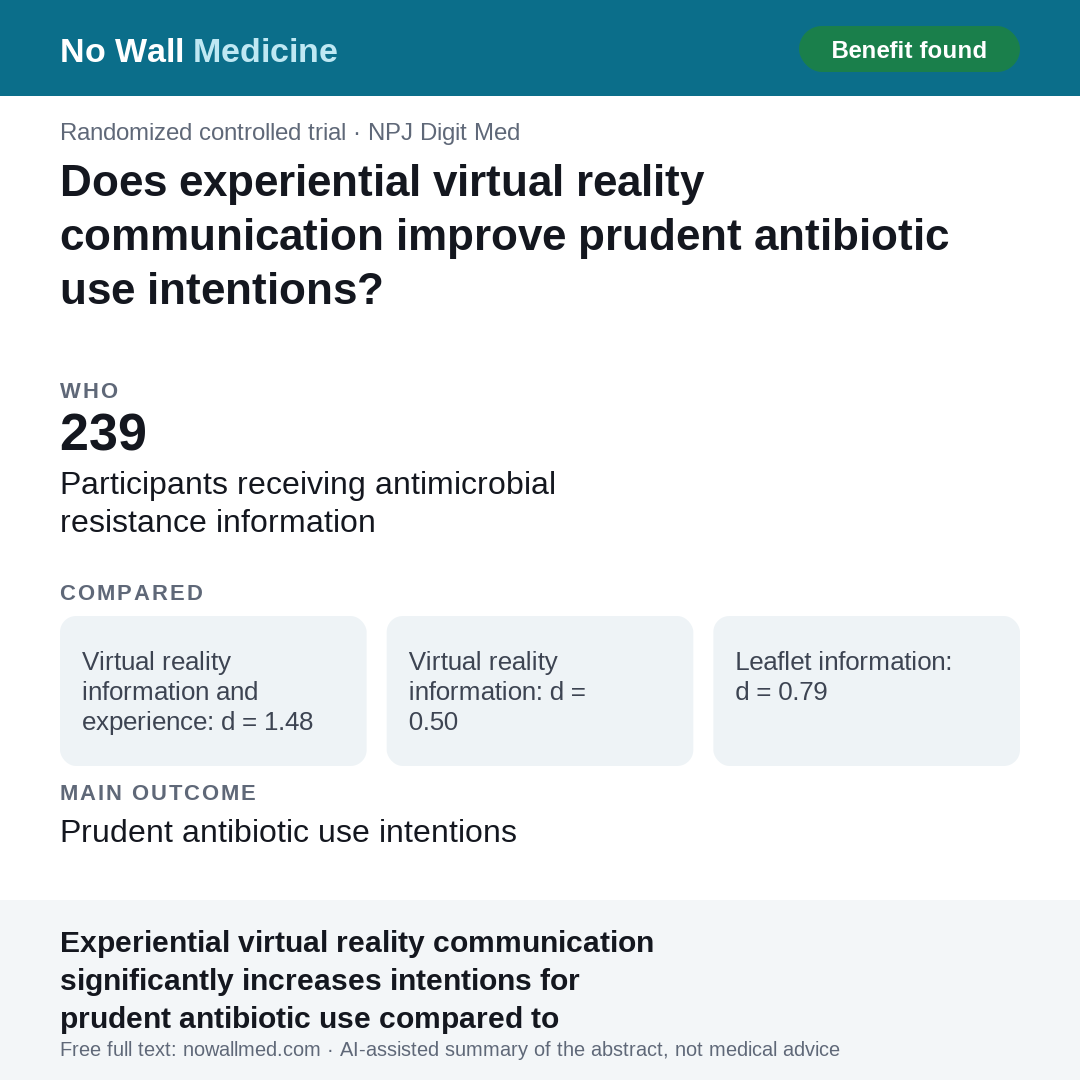
Does experiential virtual reality communication improve prudent antibiotic use intentions?
Who
239
Participants receiving antimicrobial resistance information
Compared
Virtual reality information and experience: d = 1.48
Virtual reality information: d = 0.50
Leaflet information: d = 0.79
Main outcome
Prudent antibiotic use intentions
Bottom line: Experiential virtual reality communication significantly increases intentions for prudent antibiotic use compared to information alone.
NPJ Digit Med · 2024-09-12Download image
Clinical question: Does experiential virtual reality communication improve prudent antibiotic use intentions?
Why it matters: It is unknown whether experiential virtual reality communication is more effective than providing information via virtual reality or leaflets for promoting prudent antibiotic use.
Key points
- Researchers randomized 249 participants into three groups: virtual reality (VR) with an experience, VR with information only, or a printed leaflet.
- The group using VR with an experience showed a larger increase in intentions for prudent antibiotic use from baseline (d = 1.48) than the VR information (d = 0.50) or leaflet (d = 0.79) groups.
- The increase in intentions for the VR with experience group remained significant at follow-up (d = 1.25).
Headline and key points written with AI from the paper’s abstract, with every number checked against it. Read the paper before relying on them.
Was this summary helpful?
Cite this article
Plechatá A, Makransky G, Böhm R. A randomized controlled trial investigating experiential virtual reality communication on prudent antibiotic use. NPJ Digit Med. 2024. doi:10.1038/s41746-024-01240-3
Spotted a mistake? Suggest a correction
Top studies every Monday
The week’s key trials and guidelines in your specialties, plus any topics you follow. By email, free.
Get the weekly digest