Step-tip catheters showed lower dysfunction rates than side-hole catheters in continuous renal replacement therapy patients
A randomized controlled trial of catheters with different tips and lengths for patients requiring continuous renal replacement therapy in intensive care unit
Open-label, three-arm, randomized trialBenefit found
Do different catheter tip designs and lengths affect continuous renal replacement therapy outcomes?
Who
351
Critically ill patients receiving continuous renal replacement therapy
Compared
35.7%20 cm side-hole catheters (51/143)
17.7%20 cm step-tip catheters (22/124)
15.6%25 cm step-tip catheters (23/147)
Main outcome
Incidence of catheter dysfunction and catheter survival time
Bottom line: Step-tip catheters reduce dysfunction, and longer catheters improve survival time and filter lifespan.
Limitation: Further high-quality, multicenter randomized controlled trials are essential to strengthen the evidence.
Crit Care · 2025-04-11Download image
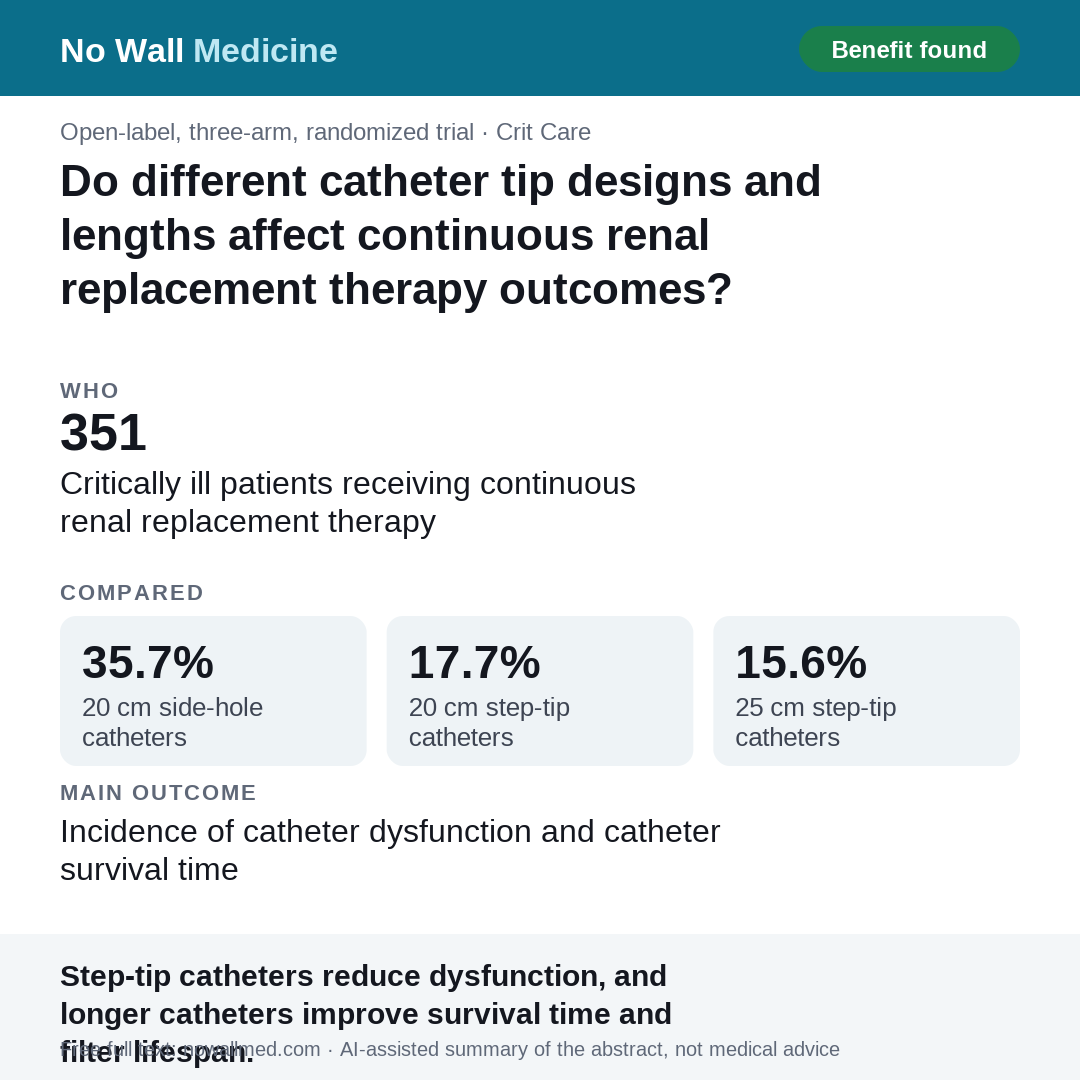
Clinical question: Do different catheter tip designs and lengths affect continuous renal replacement therapy outcomes?
Why it matters: Evidence is insufficient regarding how different catheter tip designs and lengths affect the efficacy and safety of continuous renal replacement therapy.
Key points
- Researchers randomized 351 critically ill patients to receive 20 cm side-hole, 20 cm step-tip, or 25 cm step-tip catheters for continuous renal replacement therapy.
- Catheter dysfunction occurred in 35.7% of the side-hole group compared to 17.7% in the 20 cm step-tip group and 15.6% in the 25 cm step-tip group.
- The 25 cm step-tip group had a longer catheter survival time of 6.4 days compared to 5.0 days in the 20 cm step-tip group.
Headline and key points written with AI from the paper’s abstract, with every number checked against it. Read the paper before relying on them.
Was this summary helpful?
Subject terms
Cite this article
Zhou Z, Liu C, Li P, Yang Y, Wang F, Xu Q. A randomized controlled trial of catheters with different tips and lengths for patients requiring continuous renal replacement therapy in intensive care unit. Crit Care. 2025. doi:10.1186/s13054-025-05389-5
Spotted a mistake? Suggest a correction
Top studies every Monday
The week’s key trials and guidelines in your specialties, plus any topics you follow. By email, free.
Get the weekly digest