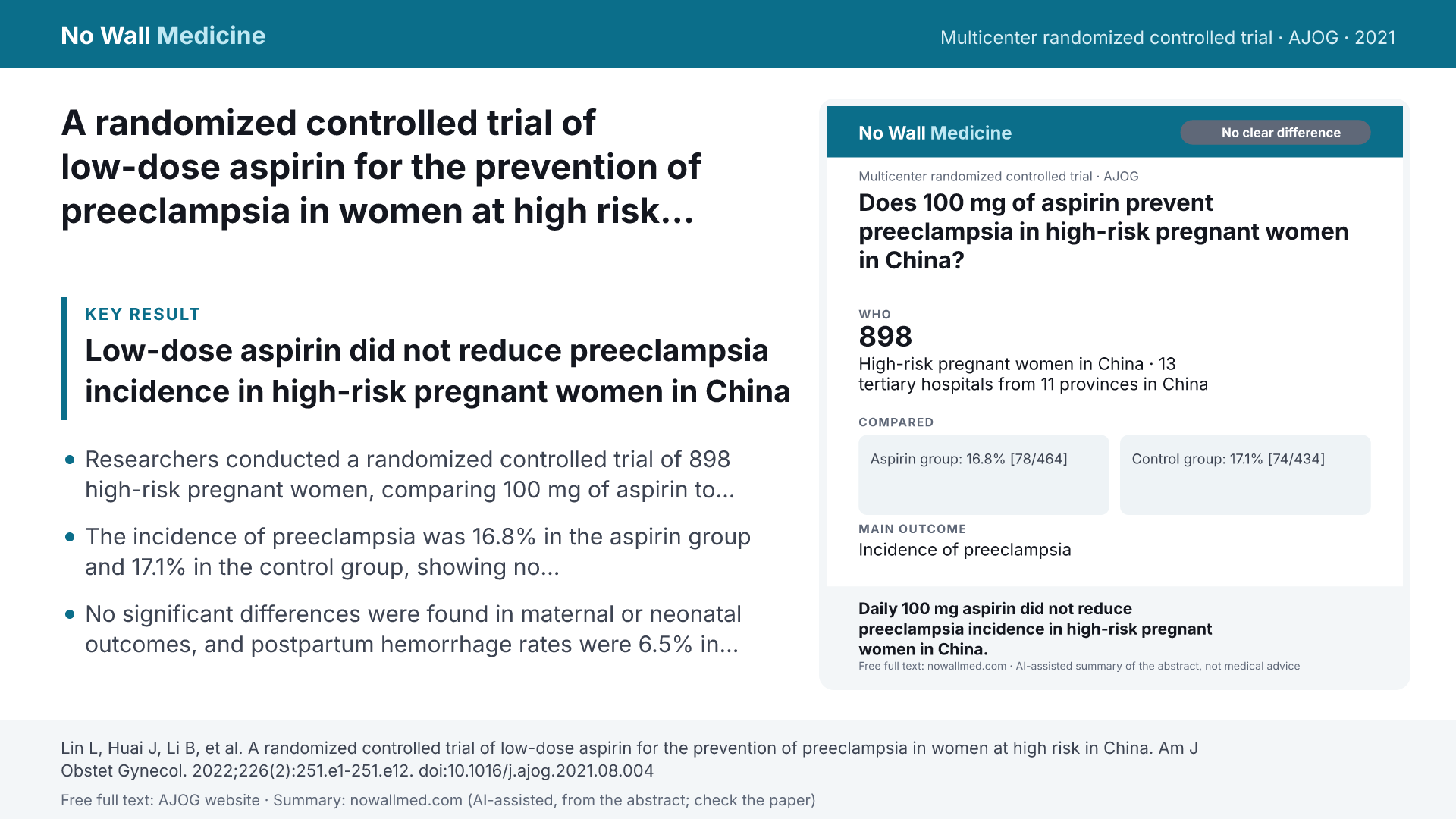
A randomized controlled trial of low-dose aspirin for the prevention of preeclampsia in women at high risk in China
Key result: Low-dose aspirin did not reduce preeclampsia incidence in high-risk pregnant women in China
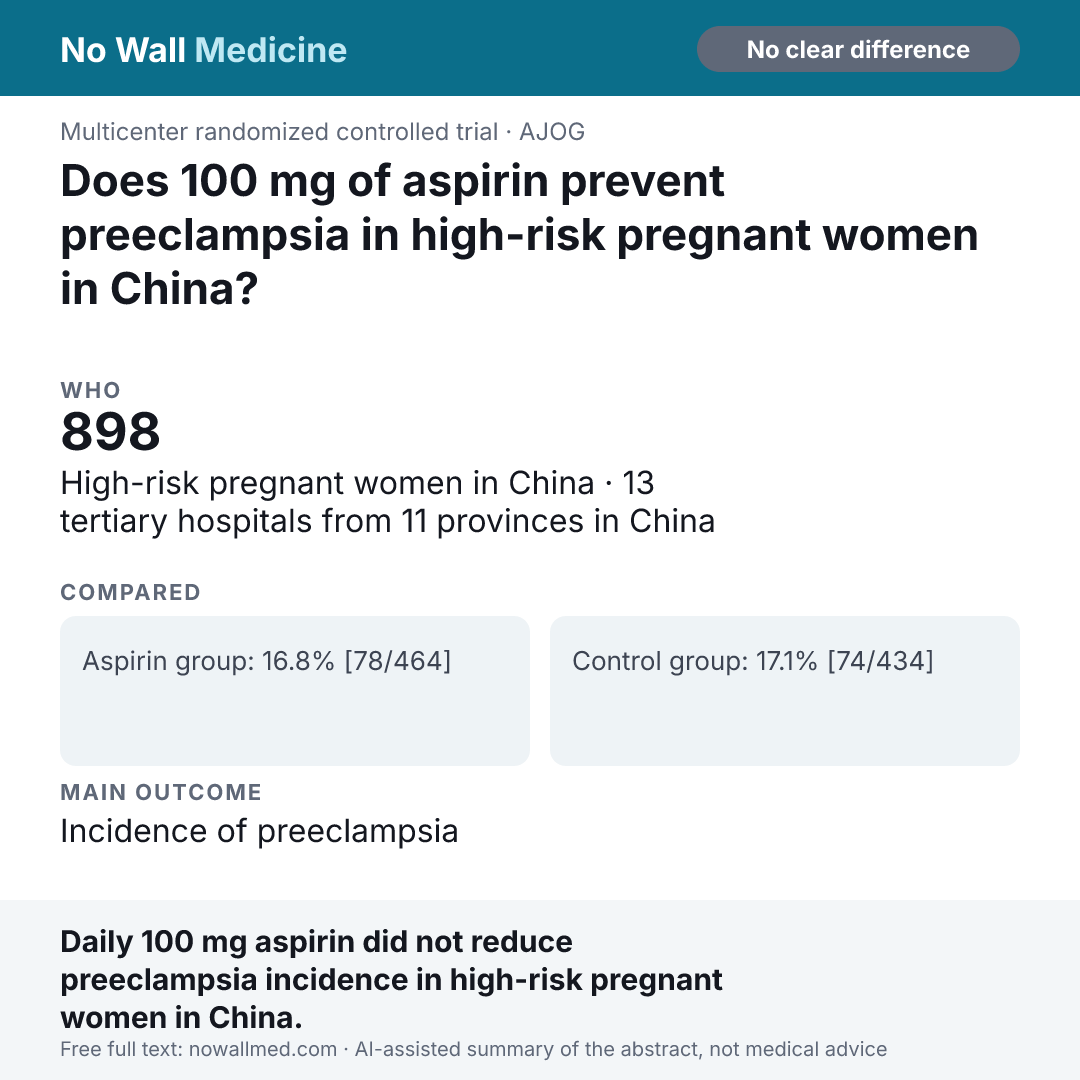
Multicenter randomized controlled trialNo clear difference
Does 100 mg of aspirin prevent preeclampsia in high-risk pregnant women in China?
Who
898
High-risk pregnant women in China · 13 tertiary hospitals from 11 provinces in China
Compared
Aspirin group: 16.8% [78/464]
Control group: 17.1% [74/434]
Main outcome
Incidence of preeclampsia
Result: relative risk 0.986; 95% confidence interval, 0.738-1.317
Bottom line: Daily 100 mg aspirin did not reduce preeclampsia incidence in high-risk pregnant women in China.
AJOG · 2021-08-10 · Save PNG
Key points
- Researchers conducted a randomized controlled trial of 898 high-risk pregnant women, comparing 100 mg of aspirin to a control group.
- The incidence of preeclampsia was 16.8% in the aspirin group and 17.1% in the control group, showing no significant difference.
- No significant differences were found in maternal or neonatal outcomes, and postpartum hemorrhage rates were 6.5% in the aspirin group and 5.3% in the control group.
Discussion prompts
- Would these patients look like yours? Who was left out?
- Is the main outcome one that matters to patients?
- Is the difference large enough to change what you do?
Cite: Lin L, Huai J, Li B, et al. A randomized controlled trial of low-dose aspirin for the prevention of preeclampsia in women at high risk in China. Am J Obstet Gynecol. 2022;226(2):251.e1-251.e12. doi:10.1016/j.ajog.2021.08.004
Free full text: AJOG website · Summary and visual abstract: nowallmed.com/a/a-randomized-controlled-trial-of-low-dose-aspirin-for-the-prevention-5t8k3f/ (AI-assisted from the abstract; check the paper before relying on it).