A randomized controlled trial of the effect of postoperative hand exercise training on arteriovenous fistula maturation in patients with chronic kidney disease
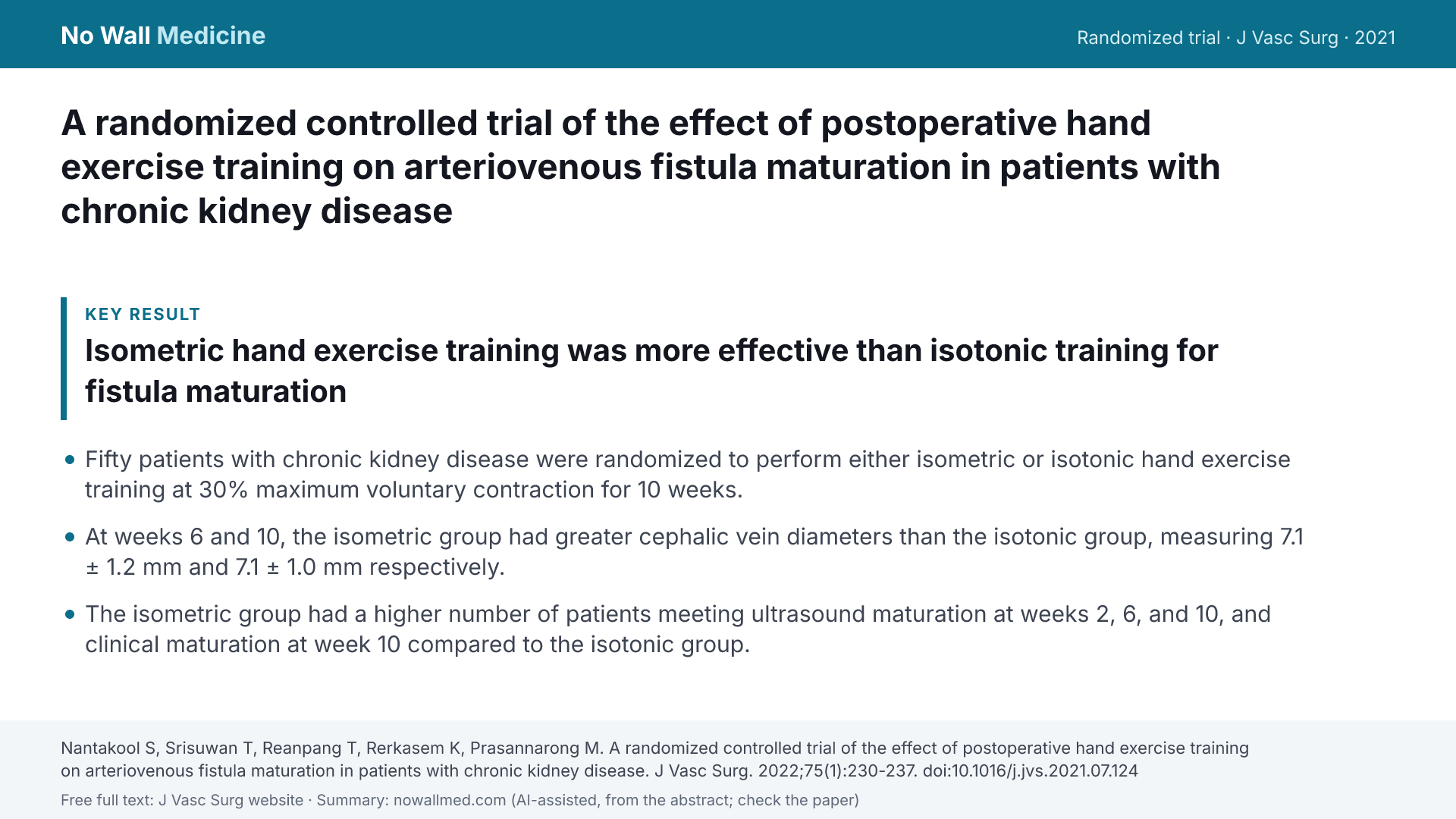
Key result: Isometric hand exercise training was more effective than isotonic training for fistula maturation
Key points
- Fifty patients with chronic kidney disease were randomized to perform either isometric or isotonic hand exercise training at 30% maximum voluntary contraction for 10 weeks.
- At weeks 6 and 10, the isometric group had greater cephalic vein diameters than the isotonic group, measuring 7.1 ± 1.2 mm and 7.1 ± 1.0 mm respectively.
- The isometric group had a higher number of patients meeting ultrasound maturation at weeks 2, 6, and 10, and clinical maturation at week 10 compared to the isotonic group.
Why it matters: It was unknown which type of hand exercise training is superior for the maturation of an arteriovenous fistula in patients with chronic kidney disease.
Discussion prompts
- Would these patients look like yours? Who was left out?
- Is the main outcome one that matters to patients?
- Is the difference large enough to change what you do?
Cite: Nantakool S, Srisuwan T, Reanpang T, Rerkasem K, Prasannarong M. A randomized controlled trial of the effect of postoperative hand exercise training on arteriovenous fistula maturation in patients with chronic kidney disease. J Vasc Surg. 2021. doi:10.1016/j.jvs.2021.07.124
Free full text: J Vasc Surg website · Summary and visual abstract: nowallmed.com/a/a-randomized-controlled-trial-of-the-effect-of-postoperative-hand-suznit/ (AI-assisted from the abstract; check the paper before relying on it).