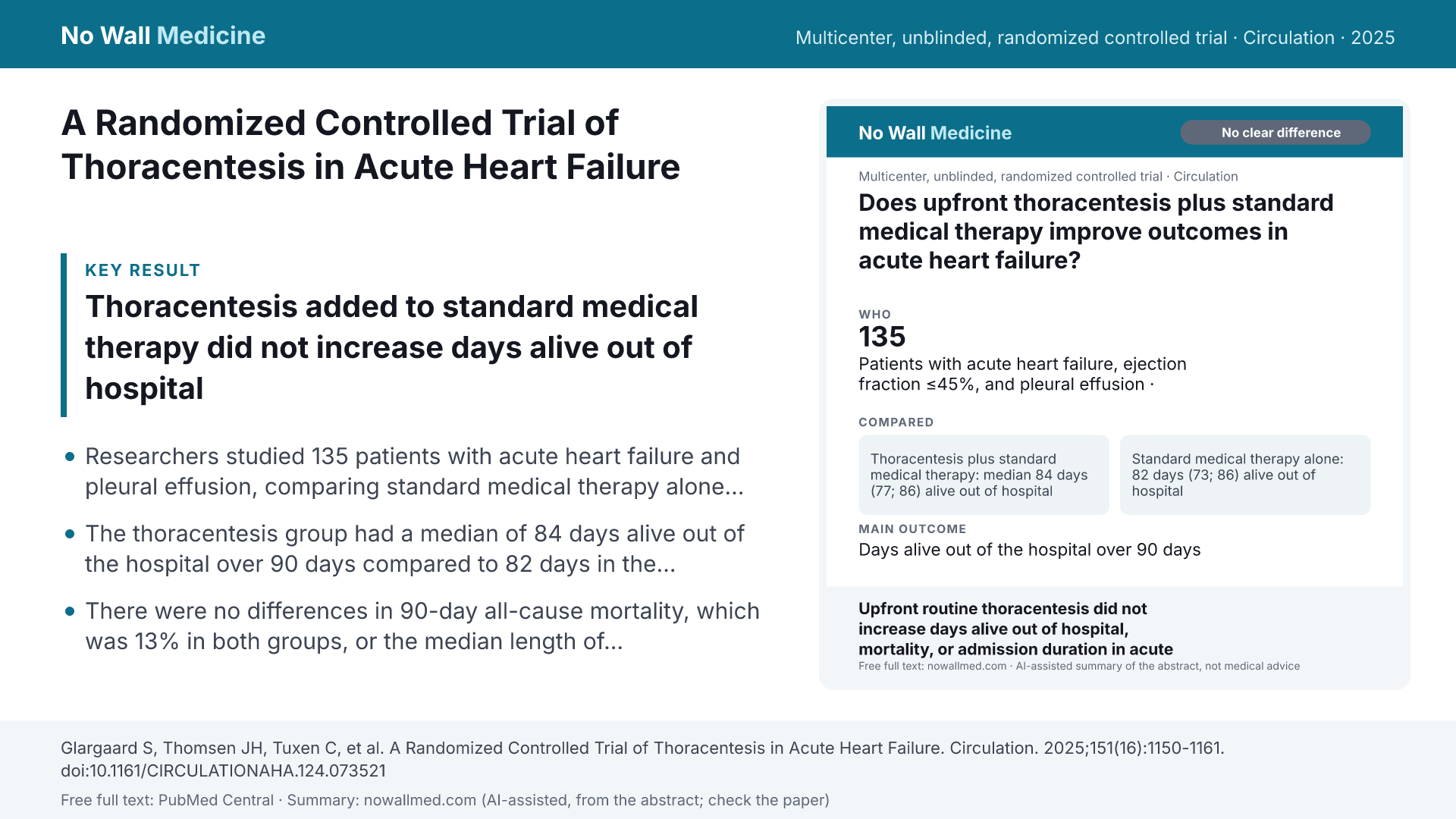
Thoracentesis added to standard medical therapy did not increase days alive out of hospital
A Randomized Controlled Trial of Thoracentesis in Acute Heart Failure
Multicenter, unblinded, randomized controlled trialNo clear difference
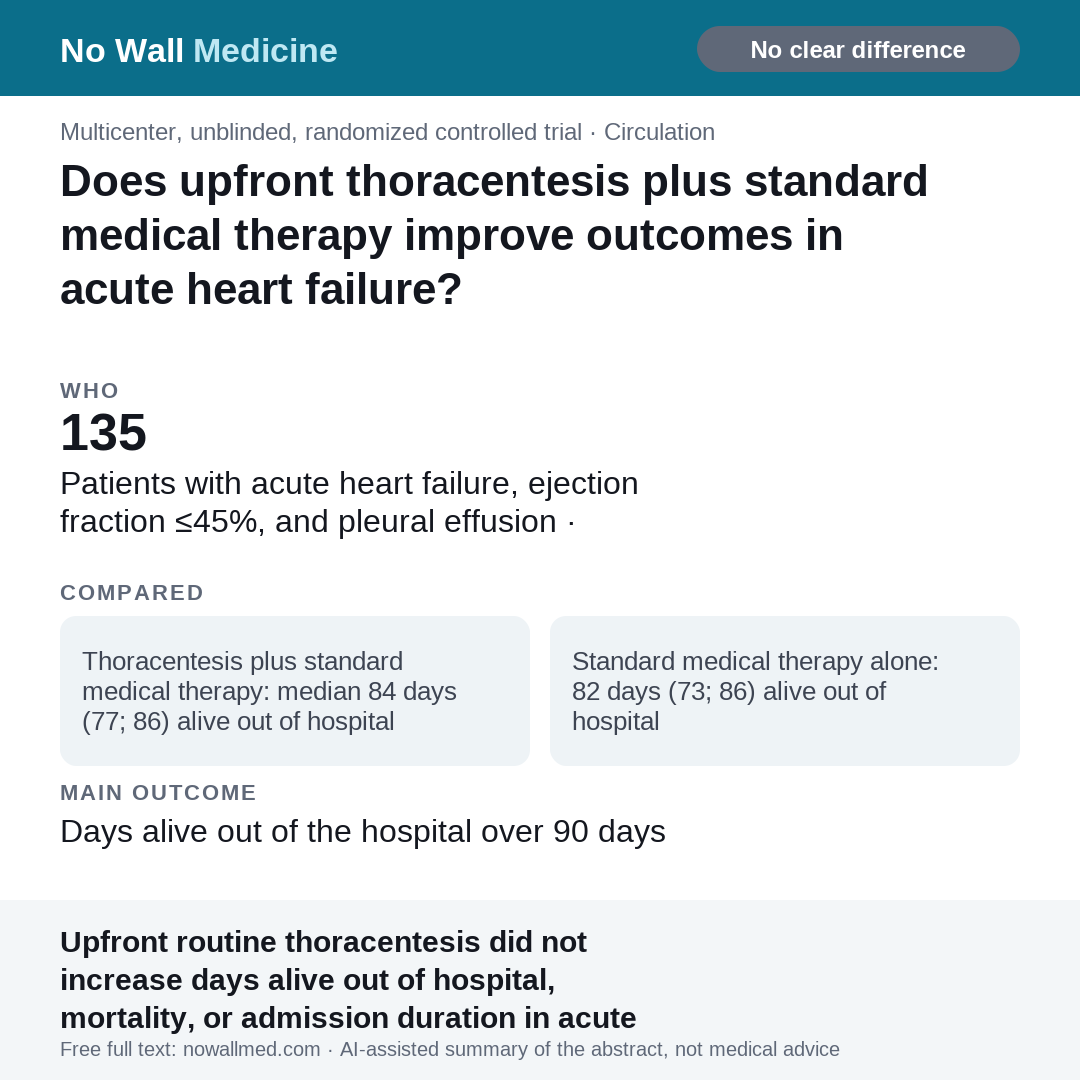
Does upfront thoracentesis plus standard medical therapy improve outcomes in acute heart failure?
Who
135
Patients with acute heart failure, ejection fraction ≤45%, and pleural effusion · Multicenter
Compared
Thoracentesis plus standard medical therapy: median 84 days (77; 86) alive out of hospital
Standard medical therapy alone: 82 days (73; 86) alive out of hospital
Main outcome
Days alive out of the hospital over 90 days
Bottom line: Upfront routine thoracentesis did not increase days alive out of hospital, mortality, or admission duration in acute heart failure.
Circulation · 2025-04-01Download image
Clinical question: Does upfront thoracentesis plus standard medical therapy improve outcomes in acute heart failure?
Why it matters: It is unknown if adding routine thoracentesis to standard medical therapy improves outcomes for patients with acute heart failure and pleural effusion.
Key points
- Researchers studied 135 patients with acute heart failure and pleural effusion, comparing standard medical therapy alone to therapy plus ultrasound-guided pigtail catheter thoracentesis, which is draining fluid with a small tube.
- The thoracentesis group had a median of 84 days alive out of the hospital over 90 days compared to 82 days in the control group (P=0.42).
- There were no differences in 90-day all-cause mortality, which was 13% in both groups, or the median length of hospital admission, which was 5 days for both groups (P=0.69).
Headline and key points written with AI from the paper’s abstract, with every number checked against it. Read the paper before relying on them.
Was this summary helpful?
Subject terms
Cite this article
Glargaard S, Thomsen JH, Tuxen C, Lindholm MG, Bang CA, Schou M. A Randomized Controlled Trial of Thoracentesis in Acute Heart Failure. Circulation. 2025. doi:10.1161/CIRCULATIONAHA.124.073521
Spotted a mistake? Suggest a correction
Top studies every Monday
The week’s key trials and guidelines in your specialties, plus any topics you follow. By email, free.
Get the weekly digest