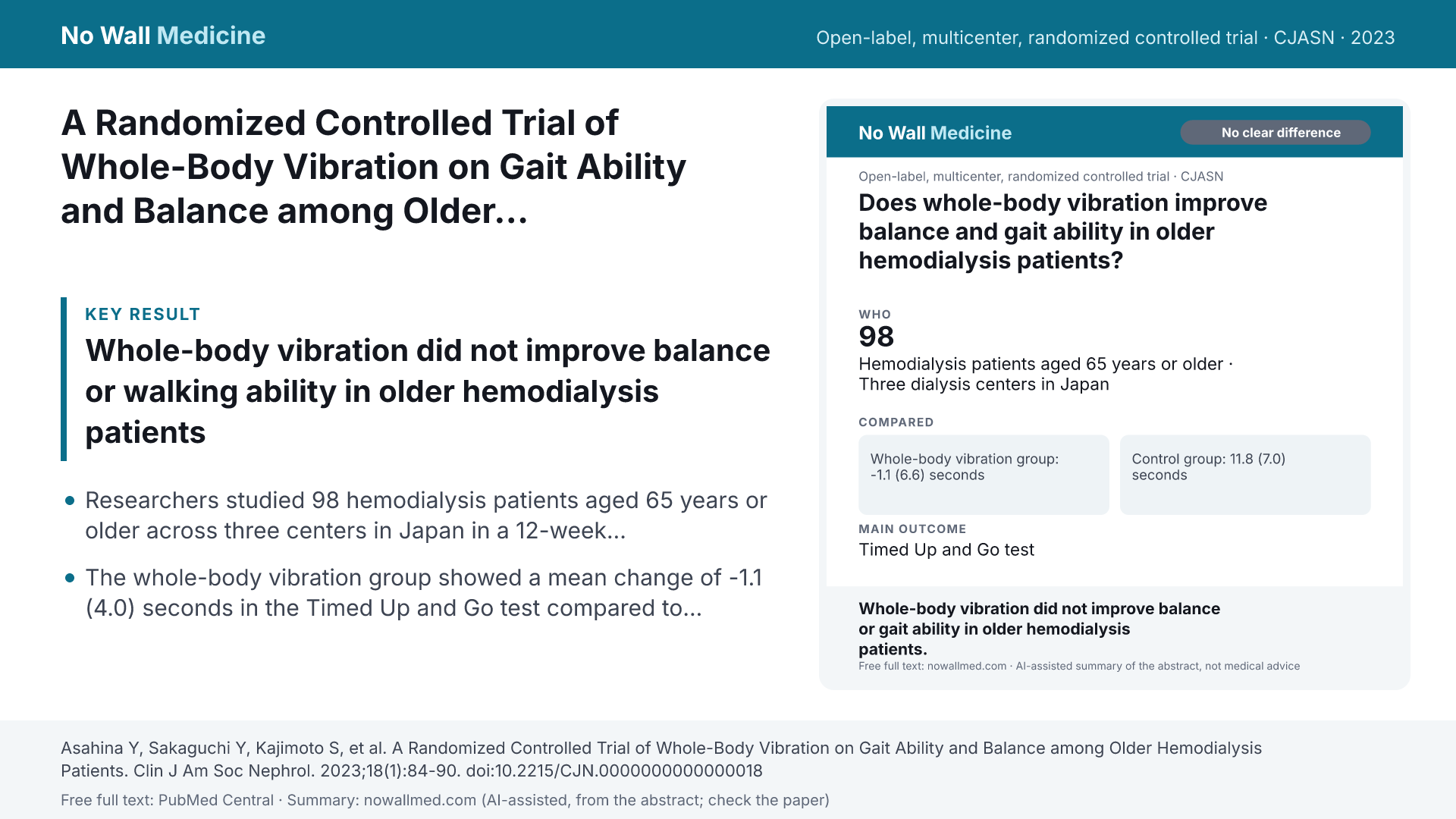
A Randomized Controlled Trial of Whole-Body Vibration on Gait Ability and Balance among Older Hemodialysis Patients
Key result: Whole-body vibration did not improve balance or walking ability in older hemodialysis patients
Open-label, multicenter, randomized controlled trialNo clear difference
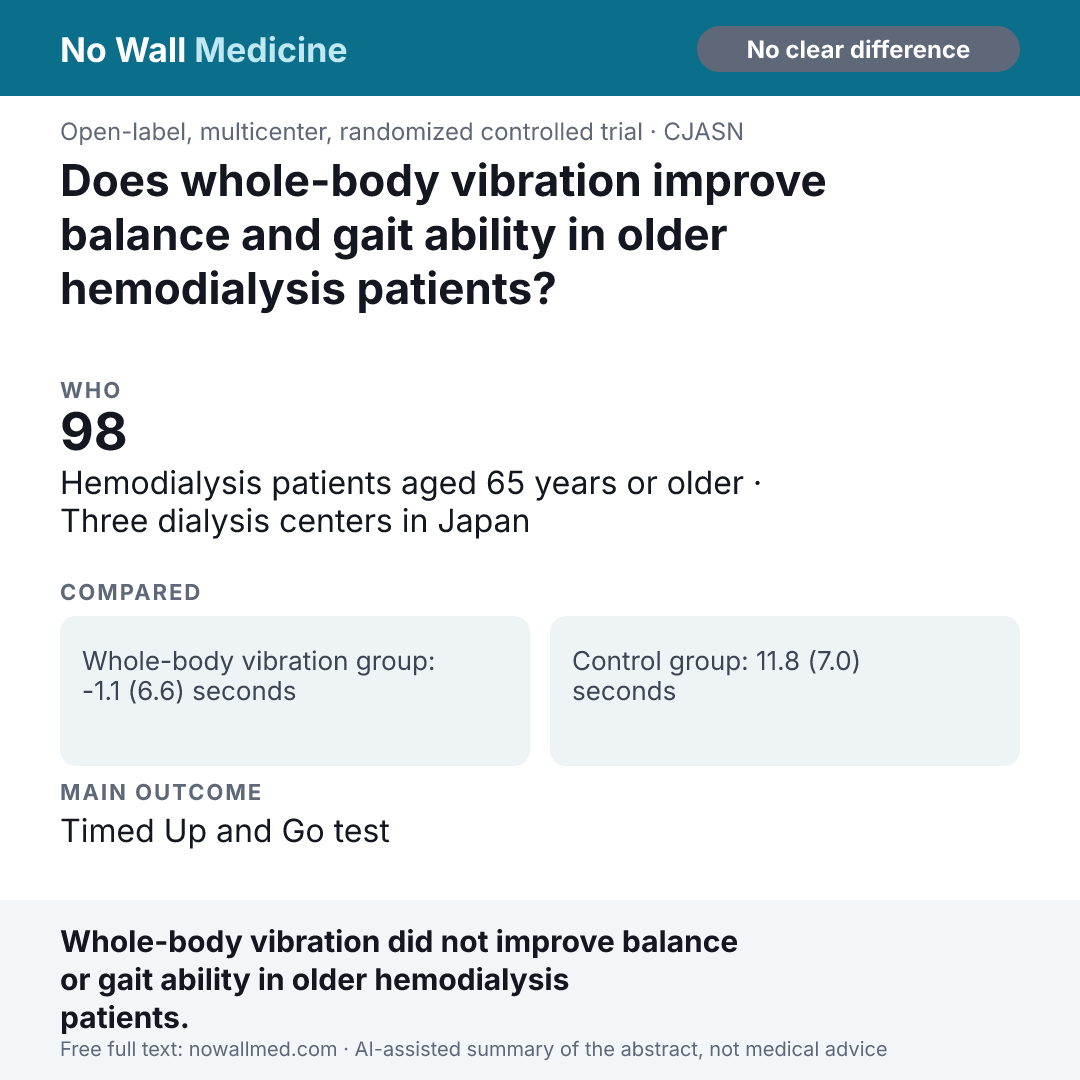
Does whole-body vibration improve balance and gait ability in older hemodialysis patients?
Who
98
Hemodialysis patients aged 65 years or older · Three dialysis centers in Japan
Compared
Whole-body vibration group: -1.1 (6.6) seconds
Control group: 11.8 (7.0) seconds
Main outcome
Timed Up and Go test
Result: change, 0.3 seconds in the whole-body vibration group; 95% confidence interval, -1.4 to 2.0; P=0.71
Bottom line: Whole-body vibration did not improve balance or gait ability in older hemodialysis patients.
CJASN · 2023-01-31 · Save PNG
Key points
- Researchers studied 98 hemodialysis patients aged 65 years or older across three centers in Japan in a 12-week randomized controlled trial.
- The whole-body vibration group showed a mean change of -1.1 (4.0) seconds in the Timed Up and Go test compared to -1.4 (4.4) seconds in the control group.
- No significant differences were found between groups for the single-leg stand test or the 30-second chair stand test, which measures leg strength.
Discussion prompts
- Would these patients look like yours? Who was left out?
- Is the main outcome one that matters to patients?
- Is the difference large enough to change what you do?
Cite: Asahina Y, Sakaguchi Y, Kajimoto S, et al. A Randomized Controlled Trial of Whole-Body Vibration on Gait Ability and Balance among Older Hemodialysis Patients. Clin J Am Soc Nephrol. 2023;18(1):84-90. doi:10.2215/CJN.0000000000000018
Free full text: PubMed Central · Summary and visual abstract: nowallmed.com/a/a-randomized-controlled-trial-of-whole-body-vibration-on-gait-ability-pile0h/ (AI-assisted from the abstract; check the paper before relying on it).