HMB and EPA supplementation did not increase muscle strength in mechanically ventilated patients
A randomized controlled trial to determine whether beta-hydroxy-beta-methylbutyrate and/or eicosapentaenoic acid improves diaphragm and quadriceps strength in critically Ill mechanically ventilated patients
Randomized controlled trialNo clear difference
Does HMB and/or EPA improve diaphragm and quadriceps strength in mechanically ventilated patients?
Who
83
Mechanically ventilated patients · Medical Intensive Care Units at the University of Kentucky
Compared
Placebo
HMB 3 gm/day
EPA 2 gm/day
HMB plus EPA
Main outcome
Diaphragm and quadriceps strength and thickness
Bottom line: A 10-day course of HMB and/or EPA does not improve skeletal muscle strength in critically ill mechanically ventilated patients.
Crit Care · 2021-08-26Download image
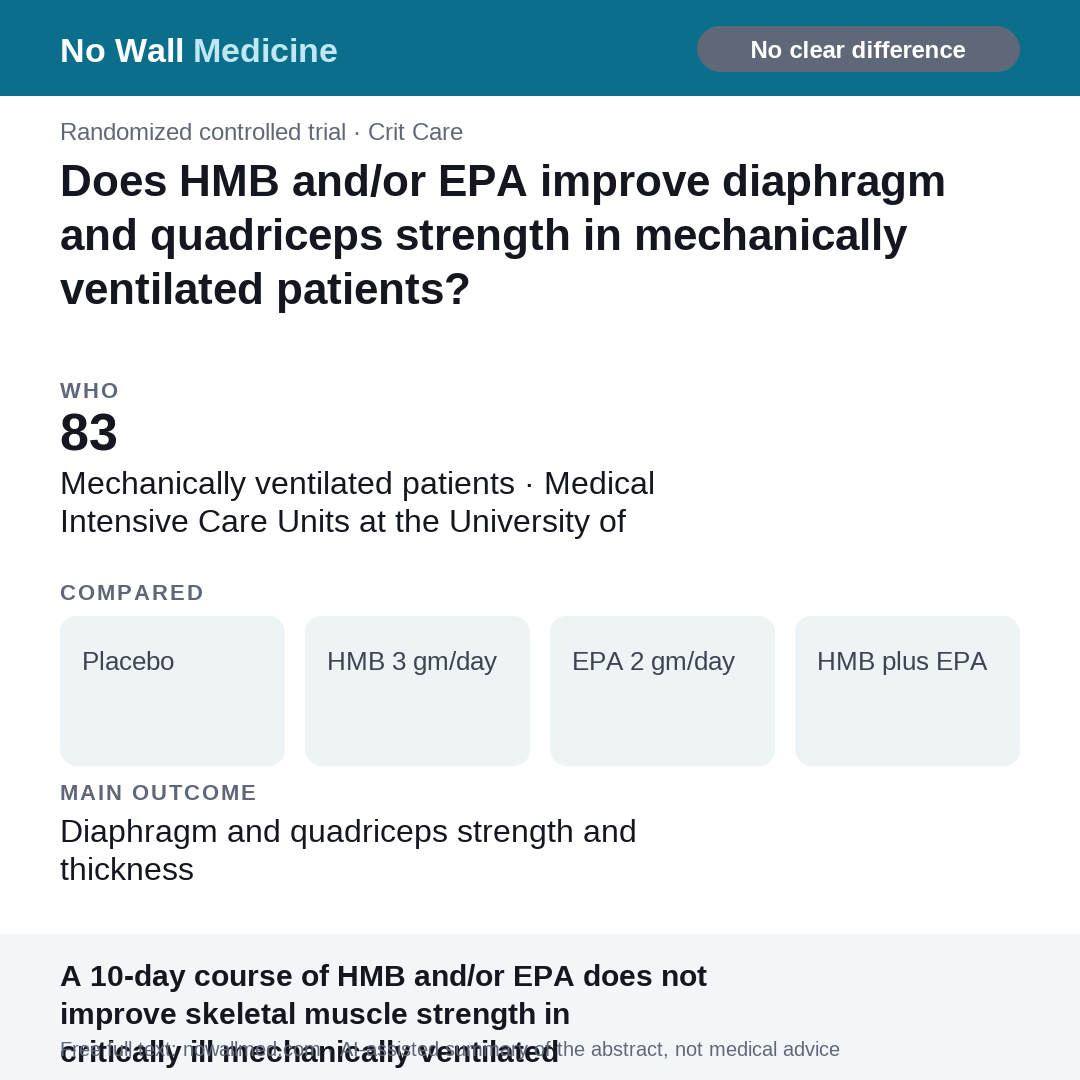
Clinical question: Does HMB and/or EPA improve diaphragm and quadriceps strength in mechanically ventilated patients?
Why it matters: There is currently no pharmacological therapy to address intensive care unit acquired weakness in critically ill patients.
Key points
- Researchers studied 83 mechanically ventilated patients randomized into four groups: placebo, 3 gm/day of beta-hydroxy-beta-methylbutyrate (HMB), 2 gm/day of eicosapentaenoic acid (EPA), or both.
- The treatments failed to increase the strength or thickness of the diaphragm or quadriceps compared to placebo after 11 days.
- The administration of HMB and/or EPA also failed to decrease the duration of mechanical ventilation.
Headline and key points written with AI from the paper’s abstract, with every number checked against it. Read the paper before relying on them.
Was this summary helpful?
Abstract
Background
Intensive care unit acquired weakness is a serious problem, contributing to respiratory failure and reductions in ambulation. Currently, there is no pharmacological therapy for this condition. Studies indicate, however, that both beta-hydroxy-beta-methylbutyrate (HMB) and eicosapentaenoic acid (EPA) increase muscle function in patients with cancer and in older adults. The purpose of this study was to determine whether HMB and/or EPA administration would increase diaphragm and quadriceps strength in mechanically ventilated patients. Methods
Studies were performed on 83 mechanically ventilated patients who were recruited from the Medical Intensive Care Units at the University of Kentucky. Diaphragm strength was assessed as the trans-diaphragmatic pressure generated by supramaximal magnetic phrenic nerve stimulation (PdiTw). Quadriceps strength was assessed as leg force generated by supramaximal magnetic femoral nerve stimulation (QuadTw). Diaphragm and quadriceps thickness were assessed by ultrasound. Baseline measurements of muscle strength and size were performed, and patients were then randomized to one of four treatment groups (placebo, HMB 3 gm/day, EPA 2 gm/day and HMB plus EPA). Strength and size measurements were repeated 11 days after study entry. ANCOVA statistical testing was used to compare variables across the four experimental groups. Results
Treatments failed to increase the strength and thickness of either the diaphragm or quadriceps when compared to placebo. In addition, treatments also failed to decrease the duration of mechanical ventilation after study entry. Conclusions
These results indicate that a 10-day course of HMB and/or EPA does not improve skeletal muscle strength in critically ill mechanically ventilated patients. These findings also confirm previous reports that diaphragm and leg strength in these patients are profoundly low. Additional studies will be needed to examine the effects of other anabolic agents and innovative forms of physical therapy. Trial registration
ClinicalTrials.gov, NCT01270516. Registered 5 January 2011, https://clinicaltrials.gov/ct2/show/NCT01270516?term=Supinski&draw=2&rank=4 .
Abstract reproduced under the article’s CC BY licence.
Subject terms
Cite this article
Supinski GS, Netzel PF, Westgate PM, Schroder EA, Wang L, Callahan LA. A randomized controlled trial to determine whether beta-hydroxy-beta-methylbutyrate and/or eicosapentaenoic acid improves diaphragm and quadriceps strength in critically Ill mechanically ventilated patients. Crit Care. 2021. doi:10.1186/s13054-021-03737-9
Spotted a mistake? Suggest a correction
Top studies every Monday
The week’s key trials and guidelines in your specialties, plus any topics you follow. By email, free.
Get the weekly digest