Artificial disc replacement shows short-term benefits for neck motion sequence compared to traditional surgery
A randomized controlled trial with extended long-term follow-up: Quality of cervical spine motion after anterior cervical discectomy (ACD) or anterior cervical discectomy with arthroplasty (ACDA)
Randomized controlled trialNo clear difference
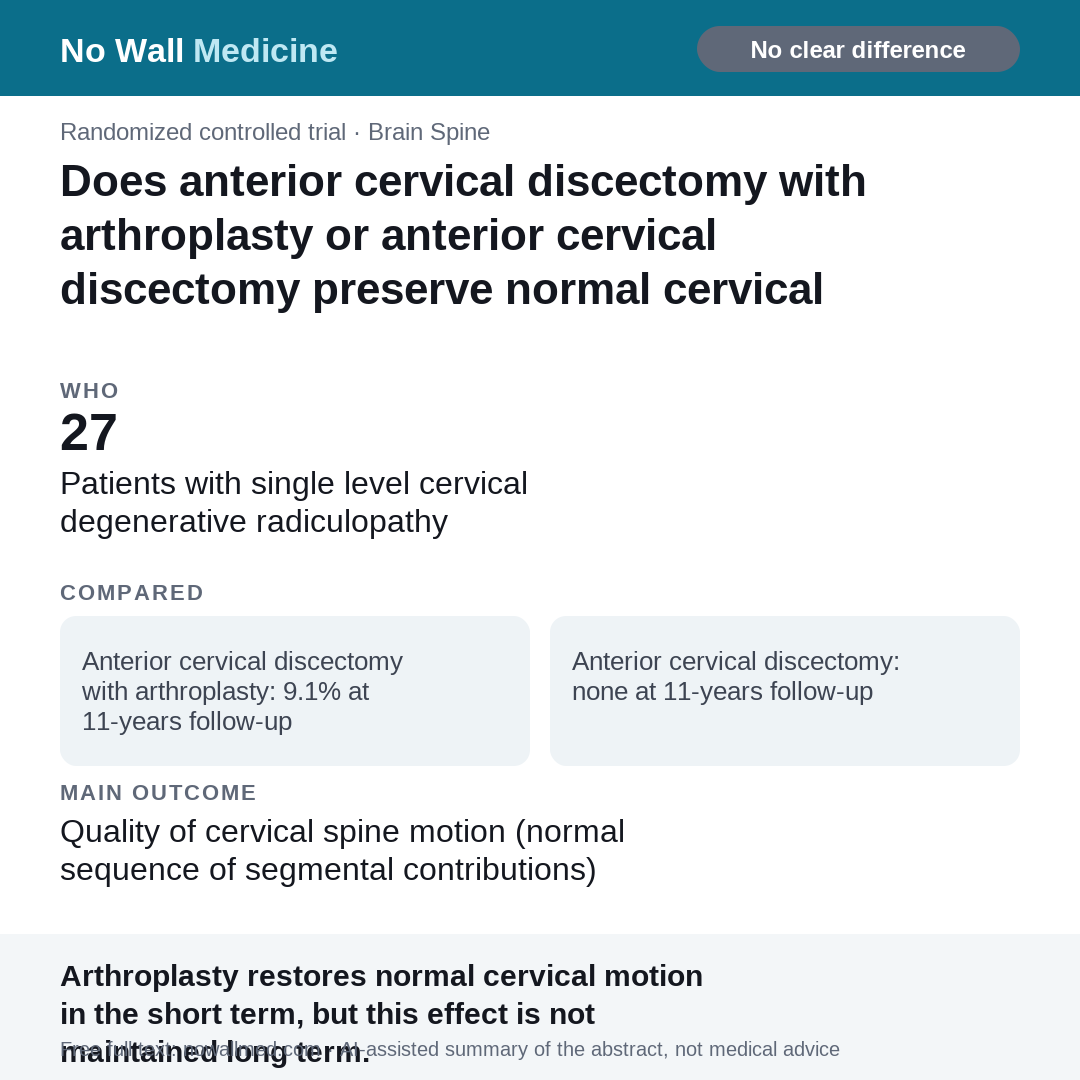
Does anterior cervical discectomy with arthroplasty or anterior cervical discectomy preserve normal cervical spine motion?
Who
27
Patients with single level cervical degenerative radiculopathy
Compared
Anterior cervical discectomy with arthroplasty: 9.1% at 11-years follow-up
Anterior cervical discectomy: none at 11-years follow-up
Main outcome
Quality of cervical spine motion (normal sequence of segmental contributions)
Bottom line: Arthroplasty restores normal cervical motion in the short term, but this effect is not maintained long term.
Brain Spine · 2023-12-14Download image
Clinical question: Does anterior cervical discectomy with arthroplasty or anterior cervical discectomy preserve normal cervical spine motion?
Why it matters: It was unknown if the normal sequence of motion segments observed in healthy people is present or maintained in patients after neck surgery.
Key points
- Researchers studied 27 patients with single-level cervical degenerative radiculopathy, comparing anterior cervical discectomy with arthroplasty (artificial disc replacement) to anterior cervical discectomy (removing the disc).
- At one year post-surgery, 66.7% of the artificial disc group showed a normal motion sequence compared to 30.0% in the traditional surgery group.
- After an average of 11-years follow-up, a normal motion sequence was observed in 9.1% of the artificial disc group and 0% in the traditional surgery group.
Headline and key points written with AI from the paper’s abstract, with every number checked against it. Read the paper before relying on them.
Was this summary helpful?
Cite this article
Schuermans VNE, Smeets AYJM, Curfs I, van Santbrink H, Boselie TFM. A randomized controlled trial with extended long-term follow-up: Quality of cervical spine motion after anterior cervical discectomy (ACD) or anterior cervical discectomy with arthroplasty (ACDA). Brain Spine. 2023. doi:10.1016/j.bas.2023.102726
Spotted a mistake? Suggest a correction
Top studies every Monday
The week’s key trials and guidelines in your specialties, plus any topics you follow. By email, free.
Get the weekly digest