Cultural dexterity training improved skills and beliefs among surgical residents in a randomized trial
A Randomized Crossover Trial Evaluating the Impact of Cultural Dexterity Training on Surgical Residents' Knowledge, Cross-Cultural Care, Skills, and Beliefs: The Provider Awareness and Cultural Dexterity Training for Surgeons (PACTS) Trial
Randomized crossover trialBenefit found
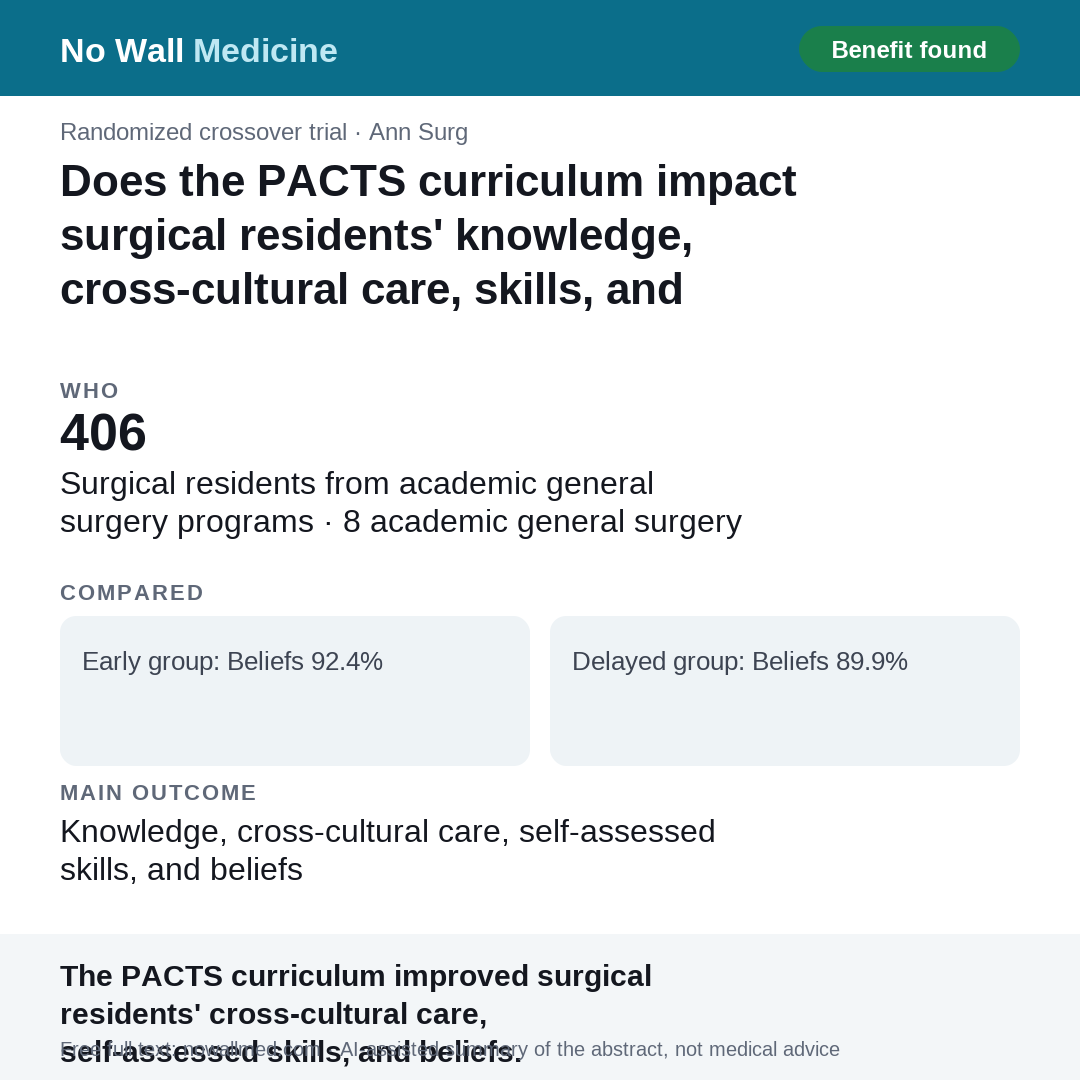
Does the PACTS curriculum impact surgical residents' knowledge, cross-cultural care, skills, and beliefs?
Who
406
Surgical residents from academic general surgery programs · 8 academic general surgery programs in the United States
Compared
Early group: Beliefs 92.4%
Delayed group: Beliefs 89.9%
Main outcome
Knowledge, cross-cultural care, self-assessed skills, and beliefs
Result: 92.4% vs 89.9%, P =0.0199
Bottom line: The PACTS curriculum improved surgical residents' cross-cultural care, self-assessed skills, and beliefs.
Ann Surg · 2024-06-26Download image
Clinical question: Does the PACTS curriculum impact surgical residents' knowledge, cross-cultural care, skills, and beliefs?
Why it matters: The effectiveness of cross-cultural training for surgical trainees in reducing healthcare outcome disparities is unknown.
Key points
- Researchers studied 406 surgical residents across 8 academic programs using a randomized crossover design to test a cultural dexterity curriculum.
- After the training, residents' cross-cultural care scores rose from 79.6% to 88.2%, self-assessed skills from 74.5% to 85.0%, and beliefs from 89.6% to 92.4%.
- Knowledge scores showed no significant change, moving from 71.3% to 74.3% with a P value of 0.0661.
Headline and key points written with AI from the paper’s abstract, with every number checked against it. Read the paper before relying on them.
Was this summary helpful?
Subject terms
Cite this article
Smink DS, Ortega G, Dacier BM, Petrusa ER, Chen YJ, Shaikh NQ. A Randomized Crossover Trial Evaluating the Impact of Cultural Dexterity Training on Surgical Residents' Knowledge, Cross-Cultural Care, Skills, and Beliefs: The Provider Awareness and Cultural Dexterity Training for Surgeons (PACTS) Trial. Ann Surg. 2024. doi:10.1097/SLA.0000000000006408
Spotted a mistake? Suggest a correction
Top studies every Monday
The week’s key trials and guidelines in your specialties, plus any topics you follow. By email, free.
Get the weekly digest