Mosunetuzumab plus polatuzumab vedotin showed higher response rates than rituximab plus polatuzumab vedotin in lymphoma patients
A Randomized Phase II Study of Subcutaneous Mosunetuzumab in Combination With Polatuzumab Vedotin Compared With Rituximab Plus Polatuzumab Vedotin in Patients With Relapsed or Refractory Large B-Cell Lymphoma
Randomized Phase II trialBenefit found
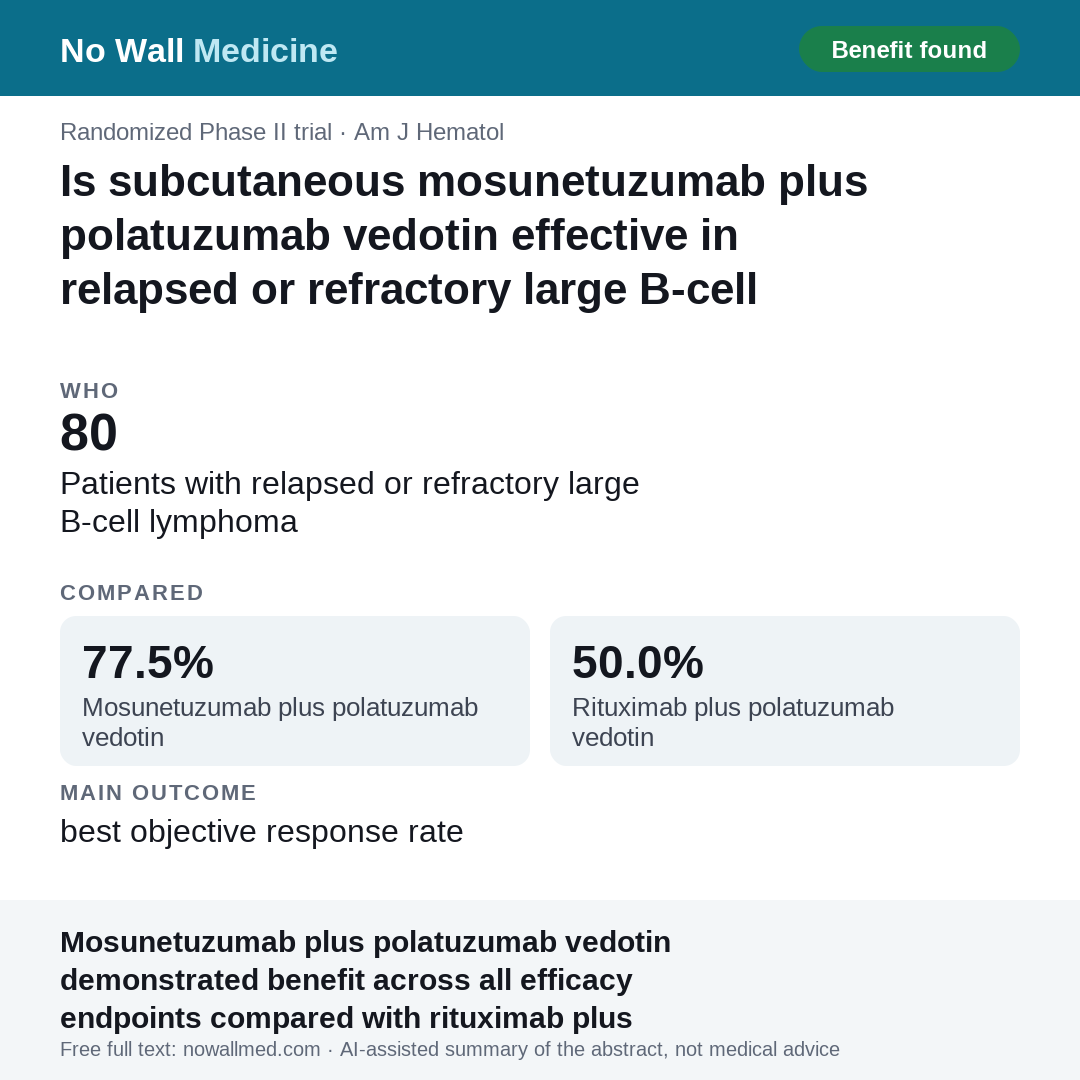
Is subcutaneous mosunetuzumab plus polatuzumab vedotin effective in relapsed or refractory large B-cell lymphoma?
Who
80
Patients with relapsed or refractory large B-cell lymphoma
Compared
77.5%Mosunetuzumab plus polatuzumab vedotin (95% CI 61.6-89.2)
50.0%Rituximab plus polatuzumab vedotin (95% CI: 33.8-66.2)
Main outcome
best objective response rate
Result: hazard ratio 0.47
Bottom line: Mosunetuzumab plus polatuzumab vedotin demonstrated benefit across all efficacy endpoints compared with rituximab plus polatuzumab vedotin.
Am J Hematol · 2026-06-12Download image
Clinical question: Is subcutaneous mosunetuzumab plus polatuzumab vedotin effective in relapsed or refractory large B-cell lymphoma?
Why it matters: Doctors needed to evaluate the efficacy of subcutaneous mosunetuzumab combined with polatuzumab vedotin for patients with relapsed or refractory large B-cell lymphoma.
Key points
- Researchers studied 80 patients with relapsed or refractory large B-cell lymphoma, comparing subcutaneous mosunetuzumab plus polatuzumab vedotin to rituximab plus polatuzumab vedotin.
- The best objective response rate was 77.5% for the mosunetuzumab group compared to 50.0% for the rituximab group.
- Median progression-free survival was 25.4 months for the mosunetuzumab group and 6.4 months for the rituximab group.
Headline and key points written with AI from the paper’s abstract, with every number checked against it. Read the paper before relying on them.
Topics
Cite this article
Chavez JC, Bastos-Oreiro M, Diefenbach C, Lossos IS, Shah N, Assouline S. A Randomized Phase II Study of Subcutaneous Mosunetuzumab in Combination With Polatuzumab Vedotin Compared With Rituximab Plus Polatuzumab Vedotin in Patients With Relapsed or Refractory Large B-Cell Lymphoma. Am J Hematol. 2026. doi:10.1002/ajh.70403
Spotted a mistake? Suggest a correction