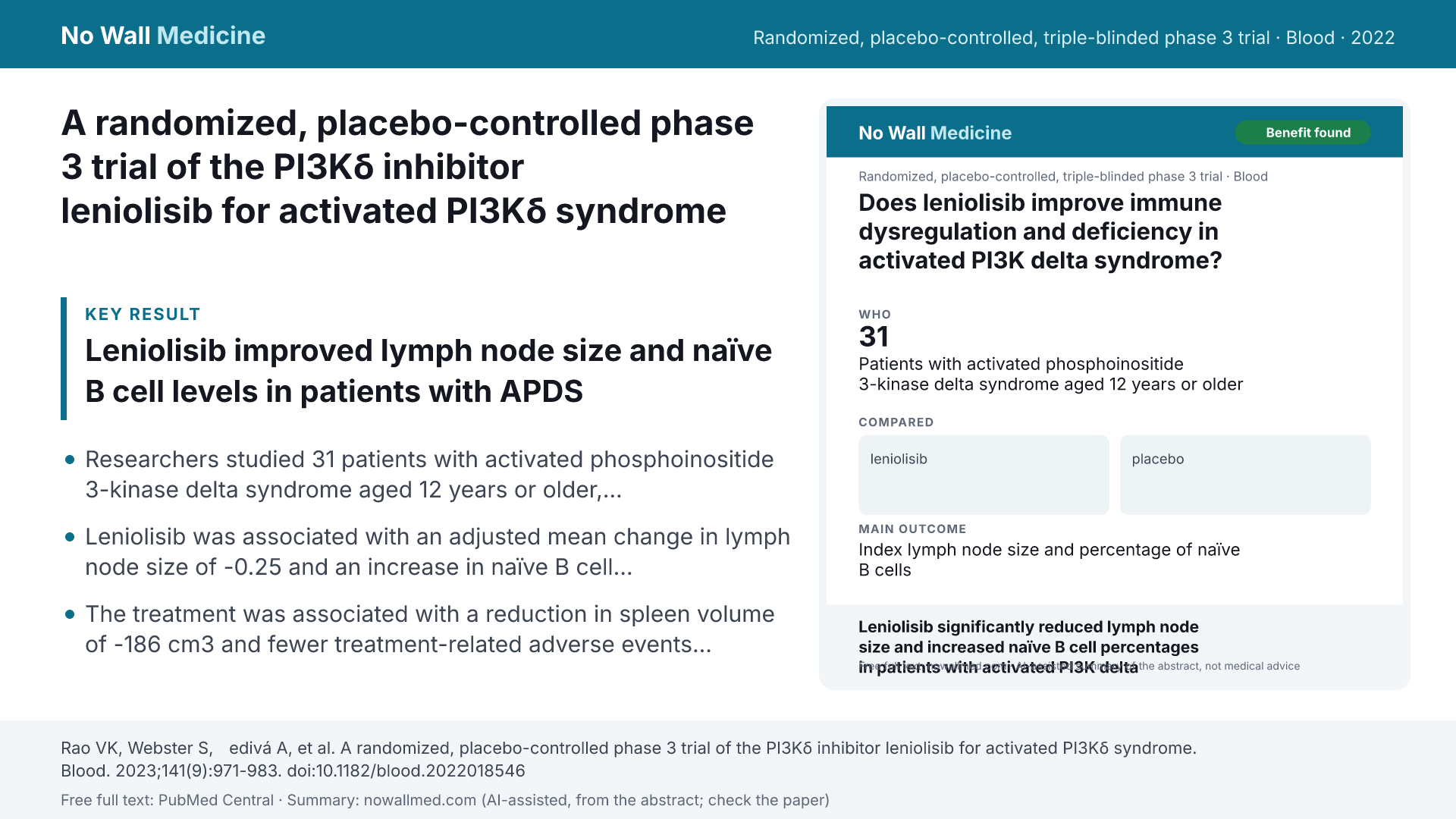
Leniolisib improved lymph node size and naïve B cell levels in patients with APDS
A randomized, placebo-controlled phase 3 trial of the PI3Kδ inhibitor leniolisib for activated PI3Kδ syndrome
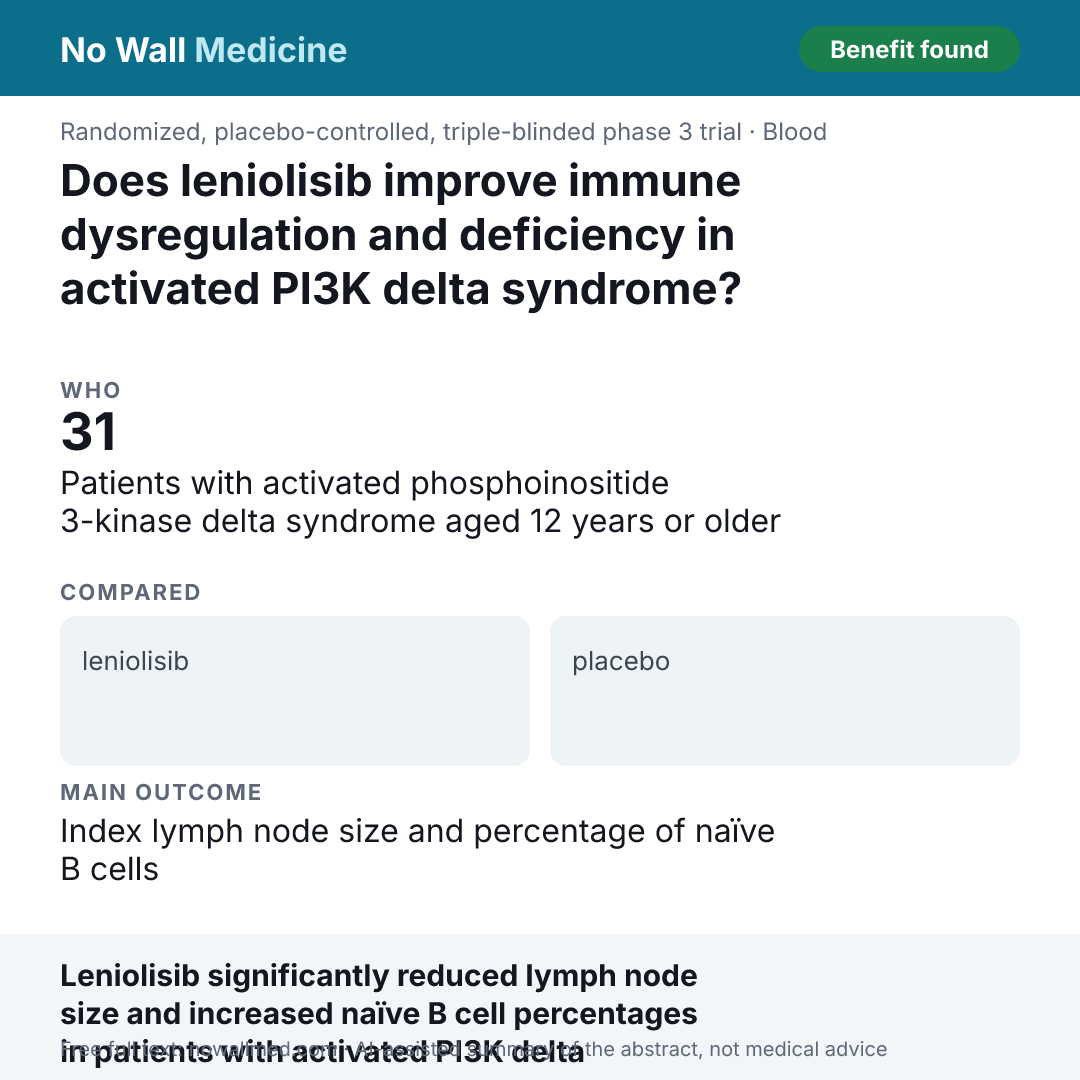
Randomized, placebo-controlled, triple-blinded phase 3 trialBenefit found
Does leniolisib improve immune dysregulation and deficiency in activated PI3K delta syndrome?
Who
31
Patients with activated phosphoinositide 3-kinase delta syndrome aged 12 years or older · Global
Compared
leniolisib
placebo
Main outcome
Index lymph node size and percentage of naïve B cells
Result: difference in adjusted mean change for lymph node size -0.25 (95% CI -0.38, -0.12); difference for naïve B cells 37.30 (95% CI 24.06, 50.54)
Bottom line: Leniolisib significantly reduced lymph node size and increased naïve B cell percentages in patients with activated PI3K delta syndrome.
Blood · 2022-11-19 · Save PNG
Clinical question: Does leniolisib improve immune dysregulation and deficiency in activated PI3K delta syndrome?
Key points
- Researchers studied 31 patients with activated phosphoinositide 3-kinase delta syndrome aged 12 years or older, comparing leniolisib to a placebo over 12 weeks.
- Leniolisib was associated with an adjusted mean change in lymph node size of -0.25 and an increase in naïve B cell percentage of 37.30 compared to placebo.
- The treatment was associated with a reduction in spleen volume of -186 cm3 and fewer treatment-related adverse events than placebo at 23.8% versus 30.0%.
Headline and key points written with AI from the paper’s abstract, with every number checked against it. Read the paper before relying on them.
Was this summary helpful?
Abstract
Activated phosphoinositide 3-kinase delta (PI3Kδ) syndrome (APDS) is an inborn error of immunity with clinical manifestations including infections, lymphoproliferation, autoimmunity, enteropathy, bronchiectasis, increased risk of lymphoma, and early mortality. Hyperactive PI3Kδ signaling causes APDS and is selectively targeted with leniolisib, an oral, small molecule inhibitor of PI3Kδ. Here, 31 patients with APDS aged ≥12 years were enrolled in a global, phase 3, triple-blinded trial and randomized 2:1 to receive 70 mg leniolisib or placebo twice daily for 12 weeks. Coprimary outcomes were differences from baseline in the index lymph node size and the percentage of naïve B cells in peripheral blood, assessed as proxies for immune dysregulation and deficiency. Both primary outcomes were met: the difference in the adjusted mean change (95% confidence interval [CI]) between leniolisib and placebo for lymph node size was -0.25 (-0.38, -0.12; P = .0006; N = 26) and for percentage of naïve B cells, was 37.30 (24.06, 50.54; P = .0002; N = 13). Leniolisib reduced spleen volume compared with placebo (adjusted mean difference in 3-dimensional volume [cm3], -186; 95% CI, -297 to -76.2; P = .0020) and improved key immune cell subsets. Fewer patients receiving leniolisib reported study treatment-related adverse events (AEs; mostly grades 1-2) than those receiving placebo (23.8% vs 30.0%). Overall, leniolisib was well tolerated and significant improvement over placebo was notable in the coprimary endpoints, reducing lymphadenopathy and increasing the percentage of naïve B cells, reflecting a favorable impact on the immune dysregulation and deficiency seen in patients with APDS. This trial was registered at www.clinicaltrials.gov as #NCT02435173.
Abstract reproduced under the article’s CC BY NC ND licence.
Subject terms
Headline, design, result, key points, caveat and citation as plain text.
Cite this article
Rao VK, Webster S, Šedivá A, et al. A randomized, placebo-controlled phase 3 trial of the PI3Kδ inhibitor leniolisib for activated PI3Kδ syndrome. Blood. 2023;141(9):971-983. doi:10.1182/blood.2022018546
Spotted a mistake? Suggest a correction