A randomized, placebo-controlled study of chitosan gel for the treatment of chronic diabetic foot ulcers (the CHITOWOUND study)
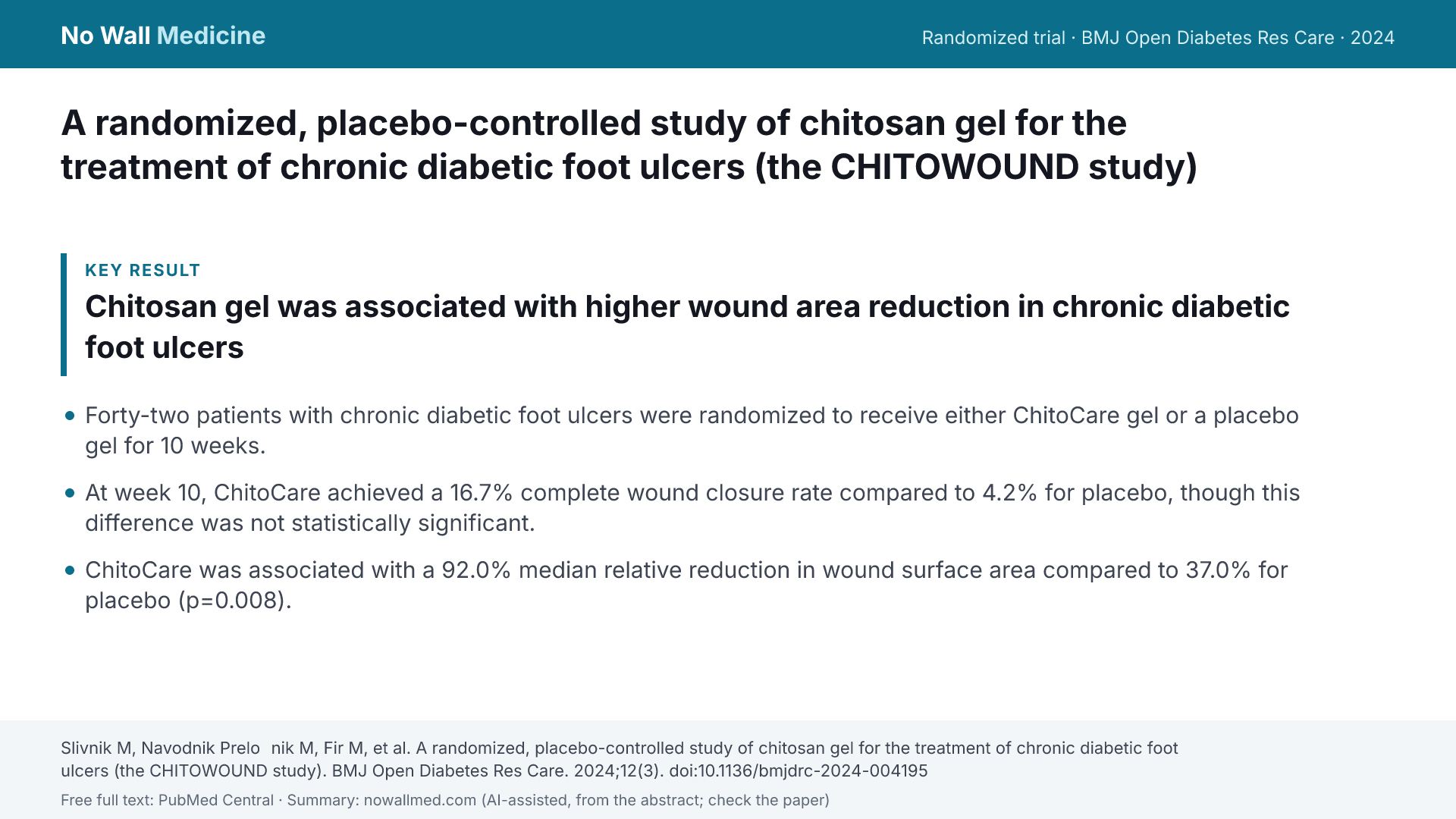
Key result: Chitosan gel was associated with higher wound area reduction in chronic diabetic foot ulcers
Key points
- Forty-two patients with chronic diabetic foot ulcers were randomized to receive either ChitoCare gel or a placebo gel for 10 weeks.
- At week 10, ChitoCare achieved a 16.7% complete wound closure rate compared to 4.2% for placebo, though this difference was not statistically significant.
- ChitoCare was associated with a 92.0% median relative reduction in wound surface area compared to 37.0% for placebo (p=0.008).
Discussion prompts
- Would these patients look like yours? Who was left out?
- Is the main outcome one that matters to patients?
- Is the difference large enough to change what you do?
Cite: Slivnik M, Navodnik Preložnik M, Fir M, et al. A randomized, placebo-controlled study of chitosan gel for the treatment of chronic diabetic foot ulcers (the CHITOWOUND study). BMJ Open Diabetes Res Care. 2024;12(3). doi:10.1136/bmjdrc-2024-004195
Free full text: PubMed Central · Summary and visual abstract: nowallmed.com/a/a-randomized-placebo-controlled-study-of-chitosan-gel-for-the-12keqgd/ (AI-assisted from the abstract; check the paper before relying on it).