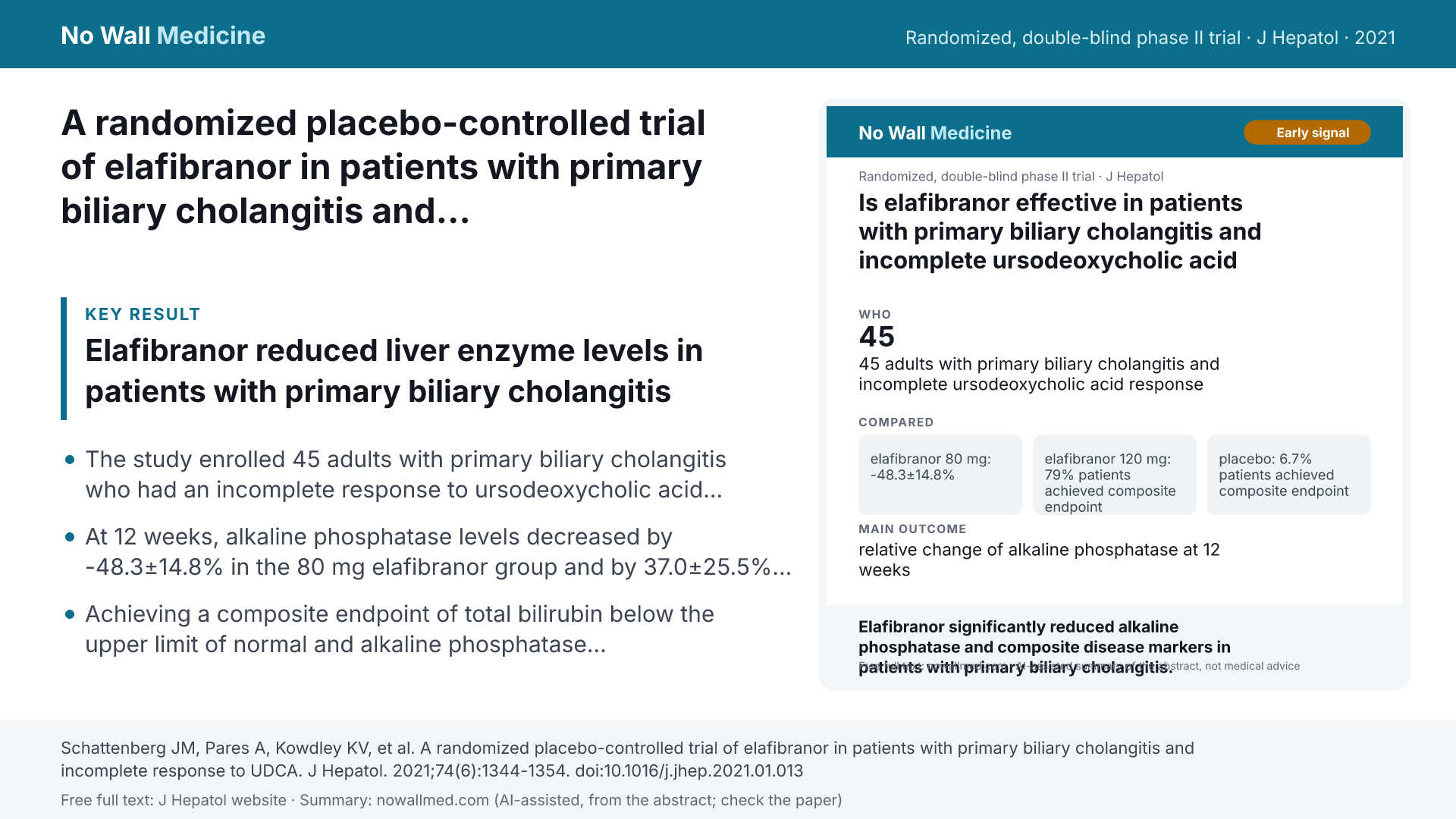
Elafibranor reduced liver enzyme levels in patients with primary biliary cholangitis
A randomized placebo-controlled trial of elafibranor in patients with primary biliary cholangitis and incomplete response to UDCA
Randomized, double-blind phase II trialEarly signal
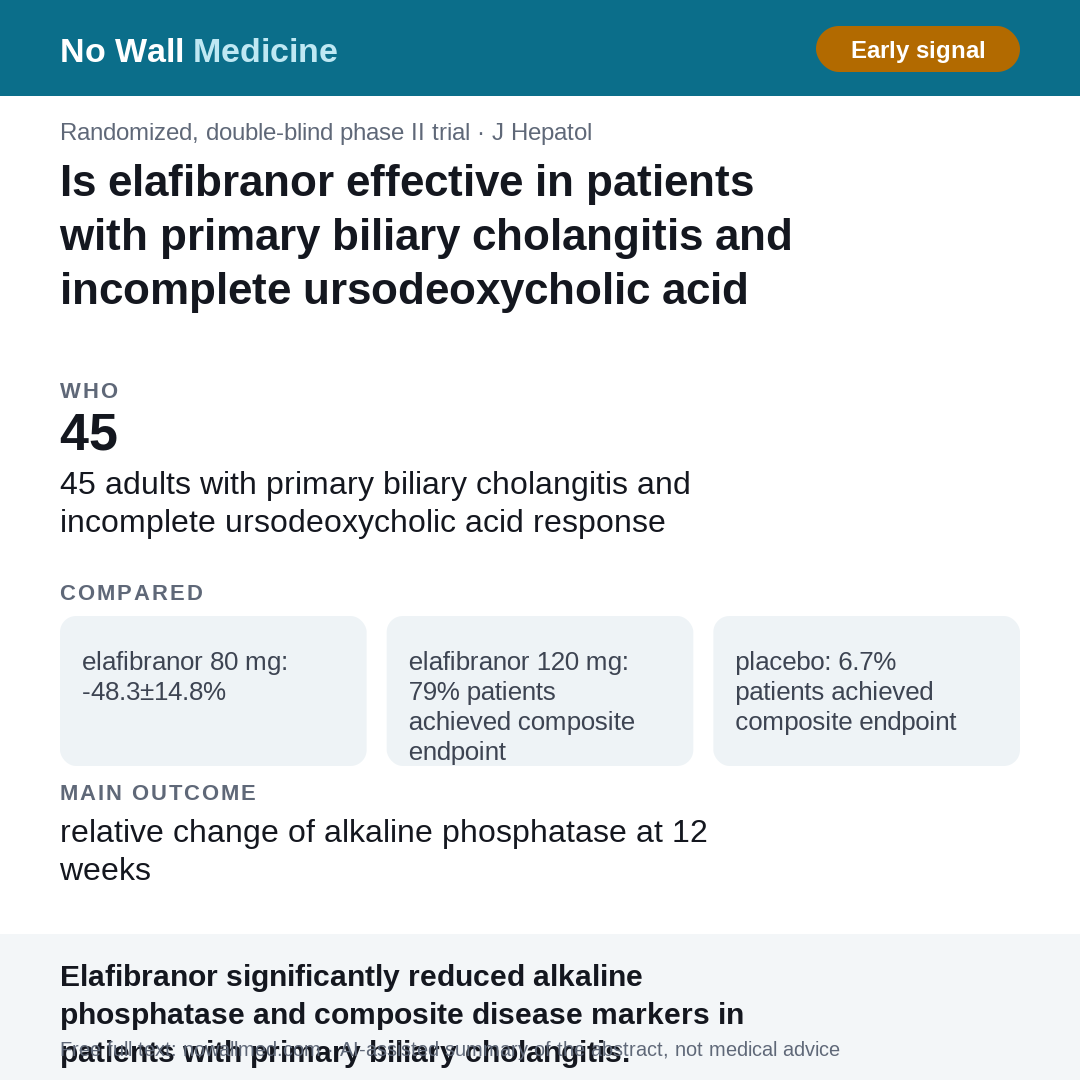
Is elafibranor effective in patients with primary biliary cholangitis and incomplete ursodeoxycholic acid response?
Who
45
45 adults with primary biliary cholangitis and incomplete ursodeoxycholic acid response
Compared
elafibranor 80 mg: -48.3±14.8%
elafibranor 120 mg: 79% patients achieved composite endpoint
placebo: 6.7% patients achieved composite endpoint
Main outcome
relative change of alkaline phosphatase at 12 weeks
Bottom line: Elafibranor significantly reduced alkaline phosphatase and composite disease markers in patients with primary biliary cholangitis.
J Hepatol · 2021-01-21Download image
Clinical question: Is elafibranor effective in patients with primary biliary cholangitis and incomplete ursodeoxycholic acid response?
Why it matters: Patients with primary biliary cholangitis who do not respond fully to ursodeoxycholic acid remain at risk of disease progression.
Key points
- The study enrolled 45 adults with primary biliary cholangitis who had an incomplete response to ursodeoxycholic acid and compared elafibranor doses to a placebo.
- At 12 weeks, alkaline phosphatase levels decreased by -48.3±14.8% in the 80 mg elafibranor group and by 37.0±25.5% in the gamma-glutamyltransferase levels for that same group.
- Achieving a composite endpoint of total bilirubin below the upper limit of normal and alkaline phosphatase reduction occurred in 67% of the 80 mg group and 79% of the 120 mg group.
Headline and key points written with AI from the paper’s abstract, with every number checked against it. Read the paper before relying on them.
Was this summary helpful?
Abstract
Background & aims
Patients with primary biliary cholangitis (PBC) who have an incomplete response to ursodeoxycholic acid remain at risk of disease progression. We investigated the safety and efficacy of elafibranor, a dual PPARα/δ agonist, in patients with PBC.Methods
This 12-week, double-blind phase II trial enrolled 45 adults with PBC who had incomplete response to ursodeoxycholic acid (alkaline phosphatase levels ≥1.67-fold the upper limit of normal (ULN). Patients were randomly assigned to elafibranor 80 mg, elafibranor 120 mg or placebo. The primary endpoint was the relative change of ALP at 12 weeks (NCT03124108).Results
At 12 weeks, ALP was reduced by -48.3±14.8% in the elafibranor 80 mg group (p 15% and total bilirubin below the ULN was achieved in 67% patients in the elafibranor 80 mg group and 79% patients in the elafibranor 120 mg group, vs. 6.7% patients in the placebo group. Levels of gamma-glutamyltransferase decreased by 37.0±25.5% in the elafibranor 80 mg group (p Conclusion
In this randomized phase II trial, elafibranor was generally safe and well tolerated and significantly reduced levels of ALP, composite endpoints of bilirubin and ALP, as well as other markers of disease activity in patients with PBC and an incomplete response to ursodeoxycholic acid.Lay summary
Patients with primary biliary cholangitis (a rare chronic liver disease) that do not respond to standard therapy remain at risk of disease progression toward cirrhosis and impaired quality of life. Elafibranor is a nuclear receptor agonist that we tested in a randomized clinical trial over 12 weeks. It successfully decreased levels of disease activity markers, including alkaline phosphatase. Thus, this study is the foundation for a larger prospective study that will determine the efficacy and safety of this drug as a second-line therapy.Clinical trial registration number
Clinical Trials.gov NCT03124108.
Abstract reproduced under the article’s CC BY licence.
Subject terms
Cite this article
Schattenberg JM, Pares A, Kowdley KV, et al. A randomized placebo-controlled trial of elafibranor in patients with primary biliary cholangitis and incomplete response to UDCA. J Hepatol. 2021. doi:10.1016/j.jhep.2021.01.013
Spotted a mistake? Suggest a correction