Adding breast density and polygenic risk scores reclassifies risk for 33% of women
A randomized study of 2 risk assessment models for individualized breast cancer risk estimation
Randomized intervention studyNo clear difference
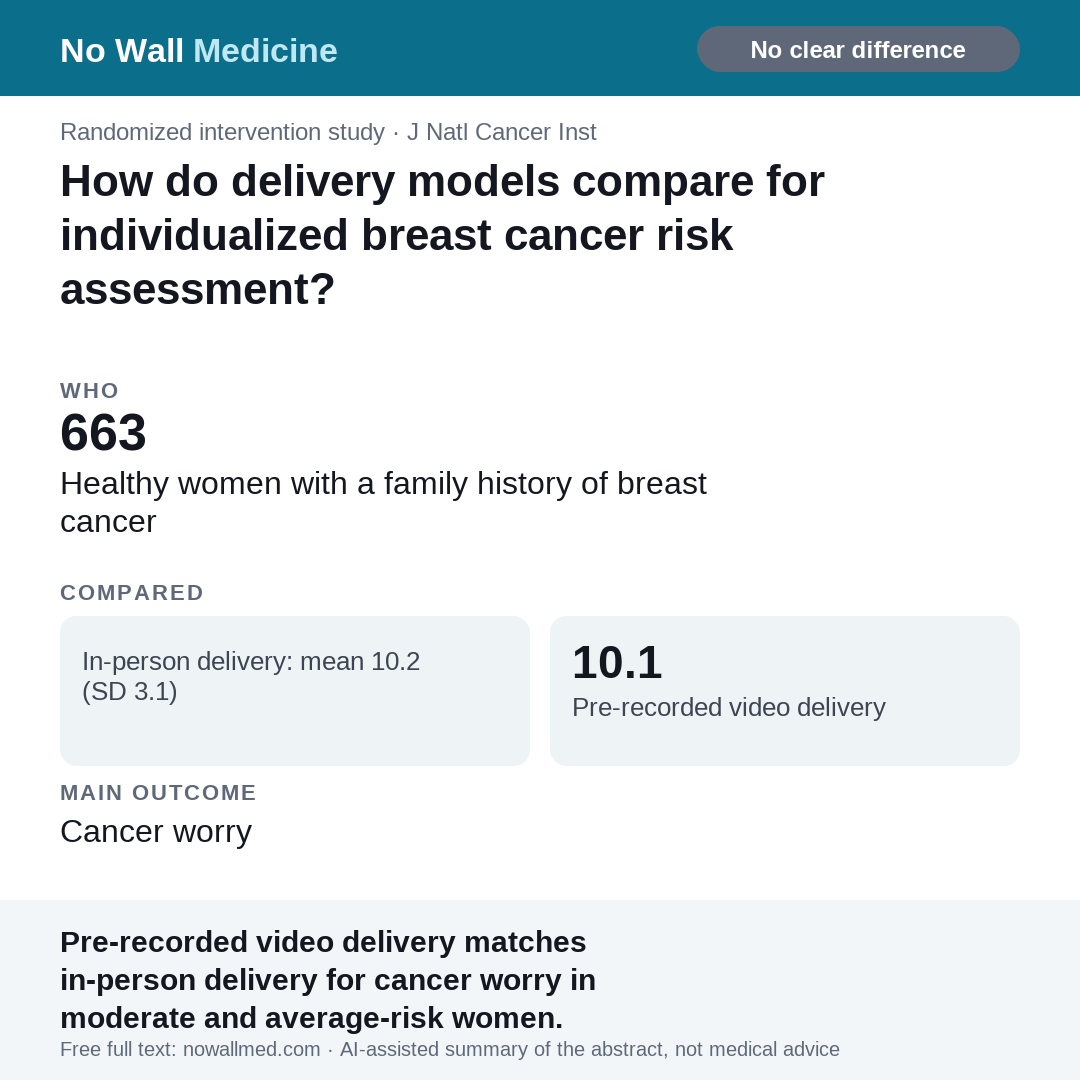
How do delivery models compare for individualized breast cancer risk assessment?
Who
663
Healthy women with a family history of breast cancer
Compared
In-person delivery: mean 10.2 (SD 3.1)
10.1Pre-recorded video delivery (2.7)
Main outcome
Cancer worry
Bottom line: Pre-recorded video delivery matches in-person delivery for cancer worry in moderate and average-risk women.
J Natl Cancer Inst · 2025-04-02Download image
Clinical question: How do delivery models compare for individualized breast cancer risk assessment?
Why it matters: Clinicians need to know if adding breast density and polygenic risk scores improves risk estimation and how different delivery methods affect patient perception and worry.
Key points
- Researchers studied 663 healthy women with a family history of breast cancer to see how adding breast density and polygenic risk scores—a measure of many small genetic variations—changed risk estimates.
- The addition of these factors reclassified 33% of participants, though only 5% were reclassified as high-risk.
- Comparing delivery methods, a pre-recorded video was associated with similar levels of cancer worry compared to in-person delivery, with mean scores of 10.1 versus 10.2.
Headline and key points written with AI from the paper’s abstract, with every number checked against it. Read the paper before relying on them.
Was this summary helpful?
Subject terms
Cite this article
López-Fernández A, Duran-Lozano L, Villacampa G, Pardo M, Pérez E, Darder E. A randomized study of 2 risk assessment models for individualized breast cancer risk estimation. J Natl Cancer Inst. 2025. doi:10.1093/jnci/djaf067
Spotted a mistake? Suggest a correction
Top studies every Monday
The week’s key trials and guidelines in your specialties, plus any topics you follow. By email, free.
Get the weekly digest