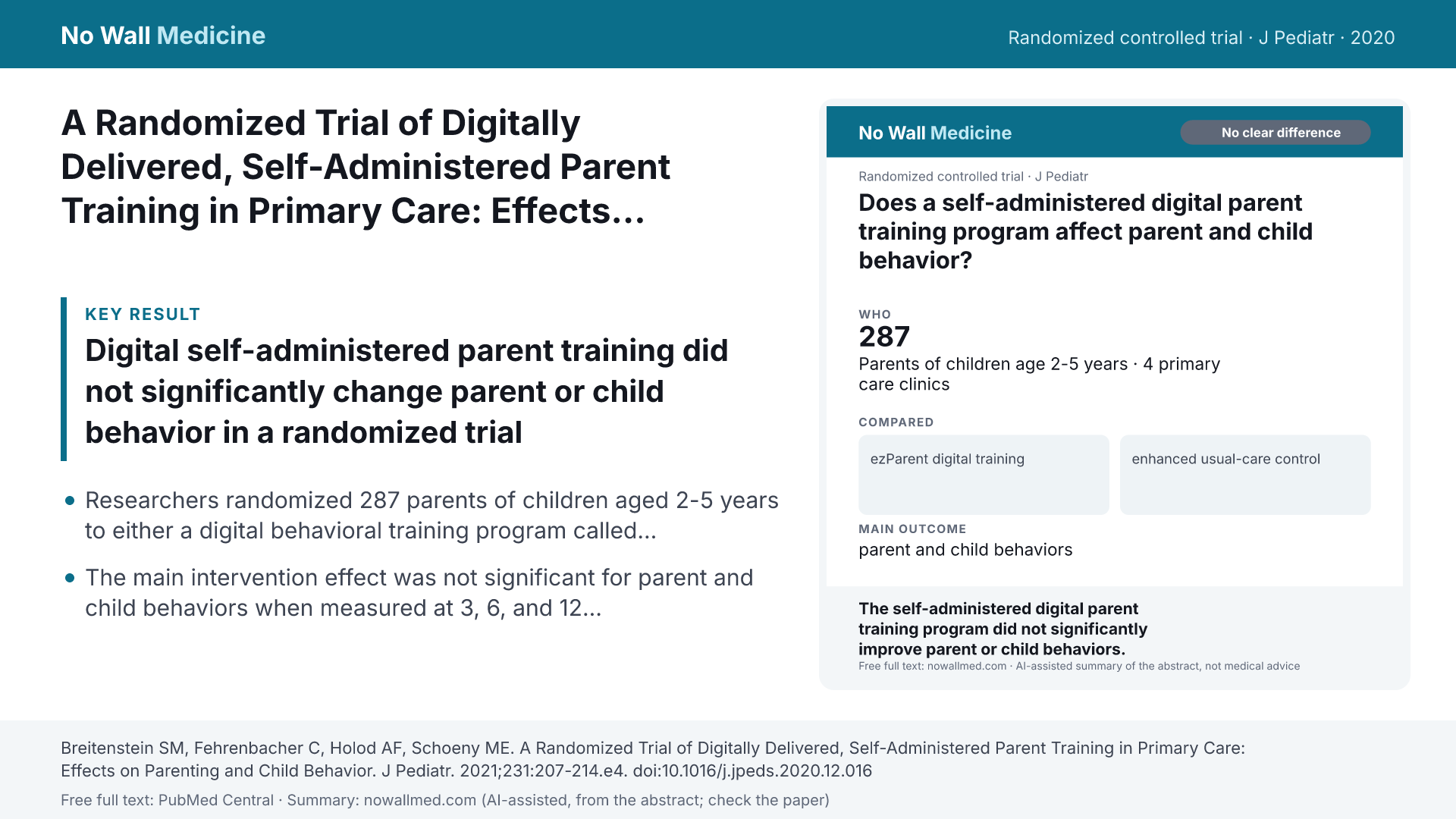
A Randomized Trial of Digitally Delivered, Self-Administered Parent Training in Primary Care: Effects on Parenting and Child Behavior
Key result: Digital self-administered parent training did not significantly change parent or child behavior in a randomized trial
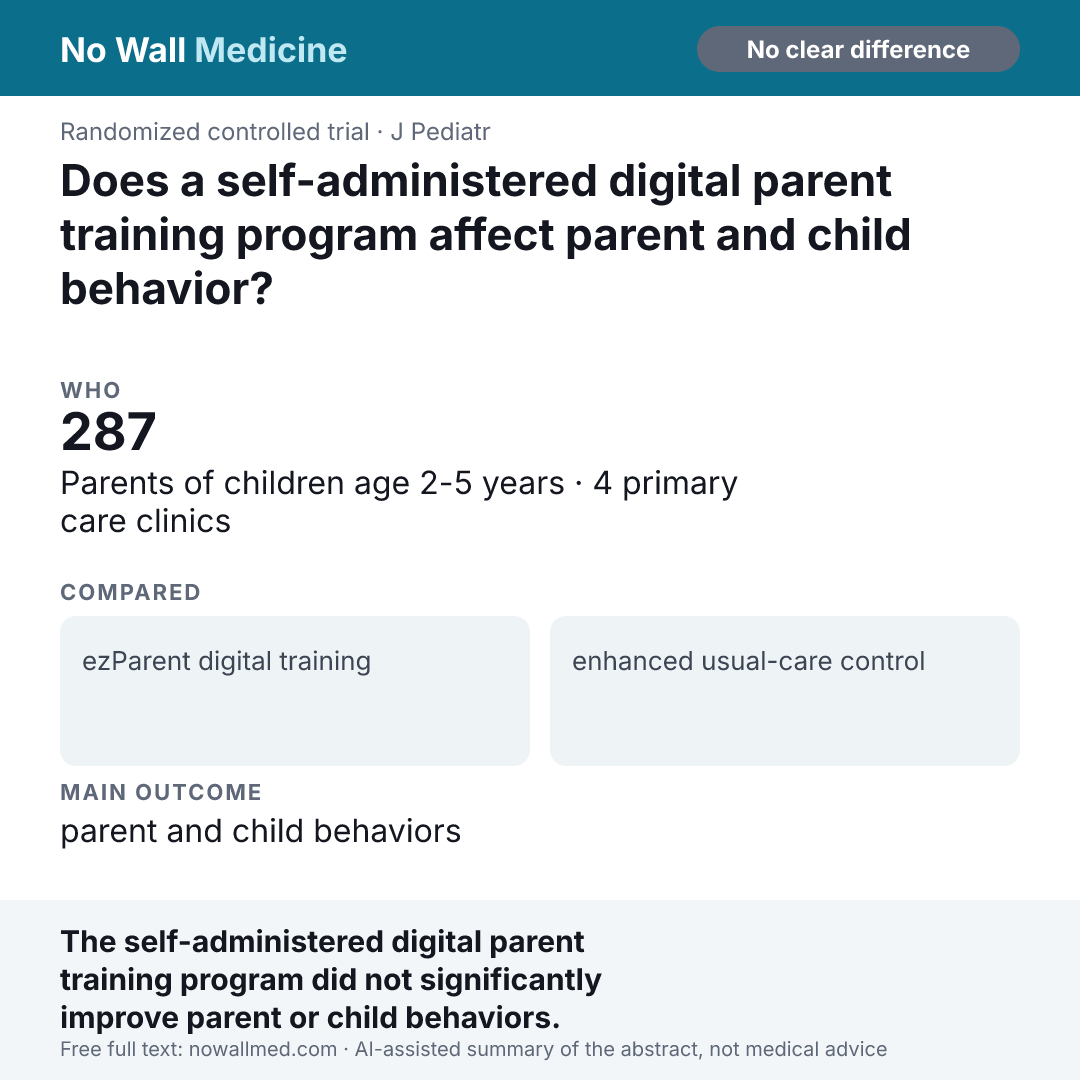
Randomized controlled trialNo clear difference
Does a self-administered digital parent training program affect parent and child behavior?
Who
287
Parents of children age 2-5 years · 4 primary care clinics
Compared
ezParent digital training
enhanced usual-care control
Main outcome
parent and child behaviors
Bottom line: The self-administered digital parent training program did not significantly improve parent or child behaviors.
J Pediatr · 2020-12-16 · Save PNG
Key points
- Researchers randomized 287 parents of children aged 2-5 years to either a digital behavioral training program called ezParent or an enhanced usual-care control group.
- The main intervention effect was not significant for parent and child behaviors when measured at 3, 6, and 12 months postbaseline.
- In exploratory analysis, parents with higher baseline stress or child behavior problems reported greater improvements in parental warmth, setting limits, and proactive parenting.
Discussion prompts
- Would these patients look like yours? Who was left out?
- Is the main outcome one that matters to patients?
- Is the difference large enough to change what you do?
Cite: Breitenstein SM, Fehrenbacher C, Holod AF, Schoeny ME. A Randomized Trial of Digitally Delivered, Self-Administered Parent Training in Primary Care: Effects on Parenting and Child Behavior. J Pediatr. 2021;231:207-214.e4. doi:10.1016/j.jpeds.2020.12.016
Free full text: PubMed Central · Summary and visual abstract: nowallmed.com/a/a-randomized-trial-of-digitally-delivered-self-administered-parent-ubwkwx/ (AI-assisted from the abstract; check the paper before relying on it).