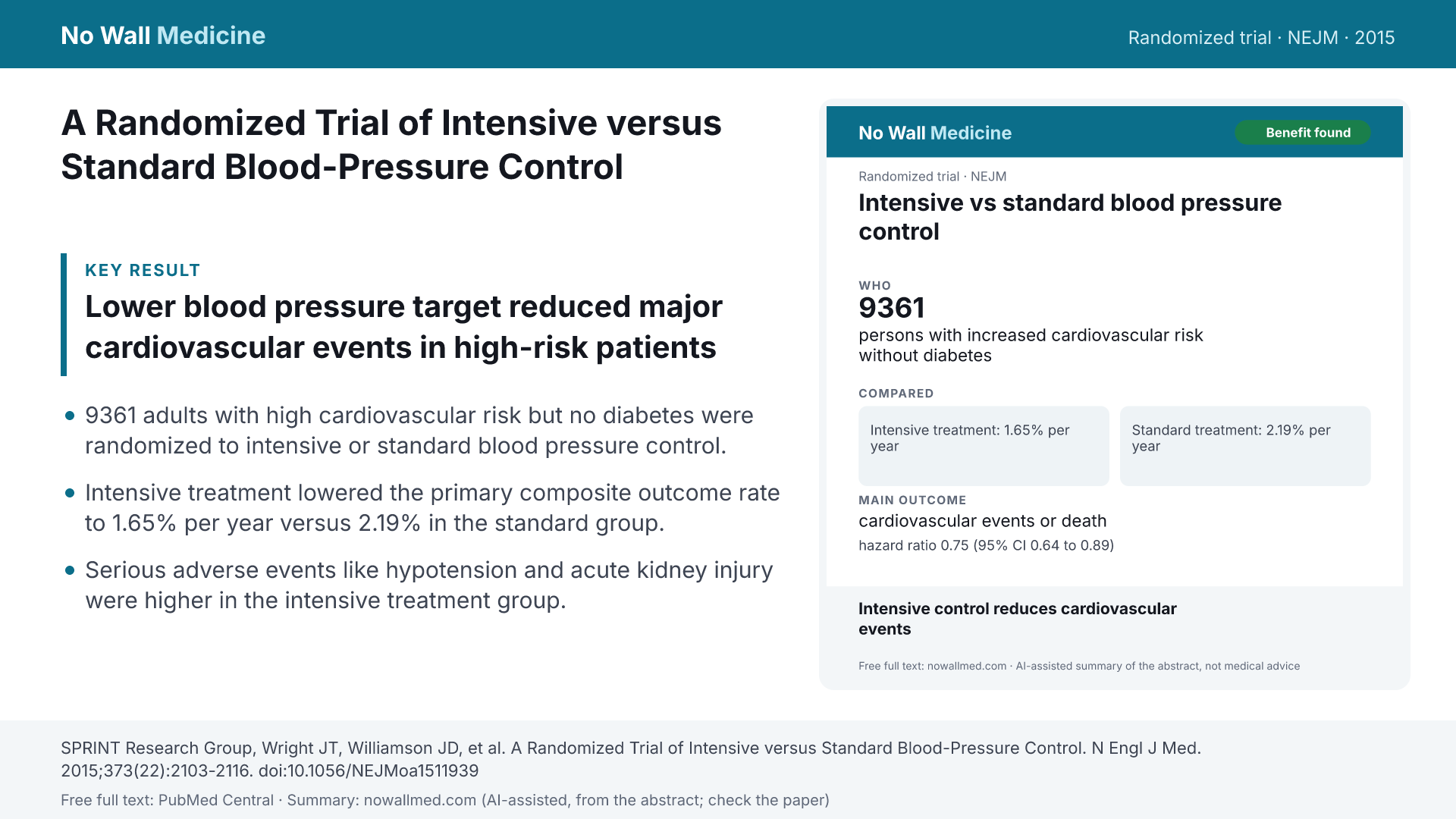
Lower blood pressure target reduced major cardiovascular events in high-risk patients
A Randomized Trial of Intensive versus Standard Blood-Pressure Control
Why it matters: Showed that aiming for a systolic blood pressure below 120 mm Hg, rather than below 140, lowered cardiovascular events and deaths in high-risk adults without diabetes. People with diabetes were excluded; the ACCORD blood-pressure trial had tested a similar target in diabetes without a significant reduction in its primary outcome.
Related landmark trials: ACCORD
Context written by the No Wall Medicine team.
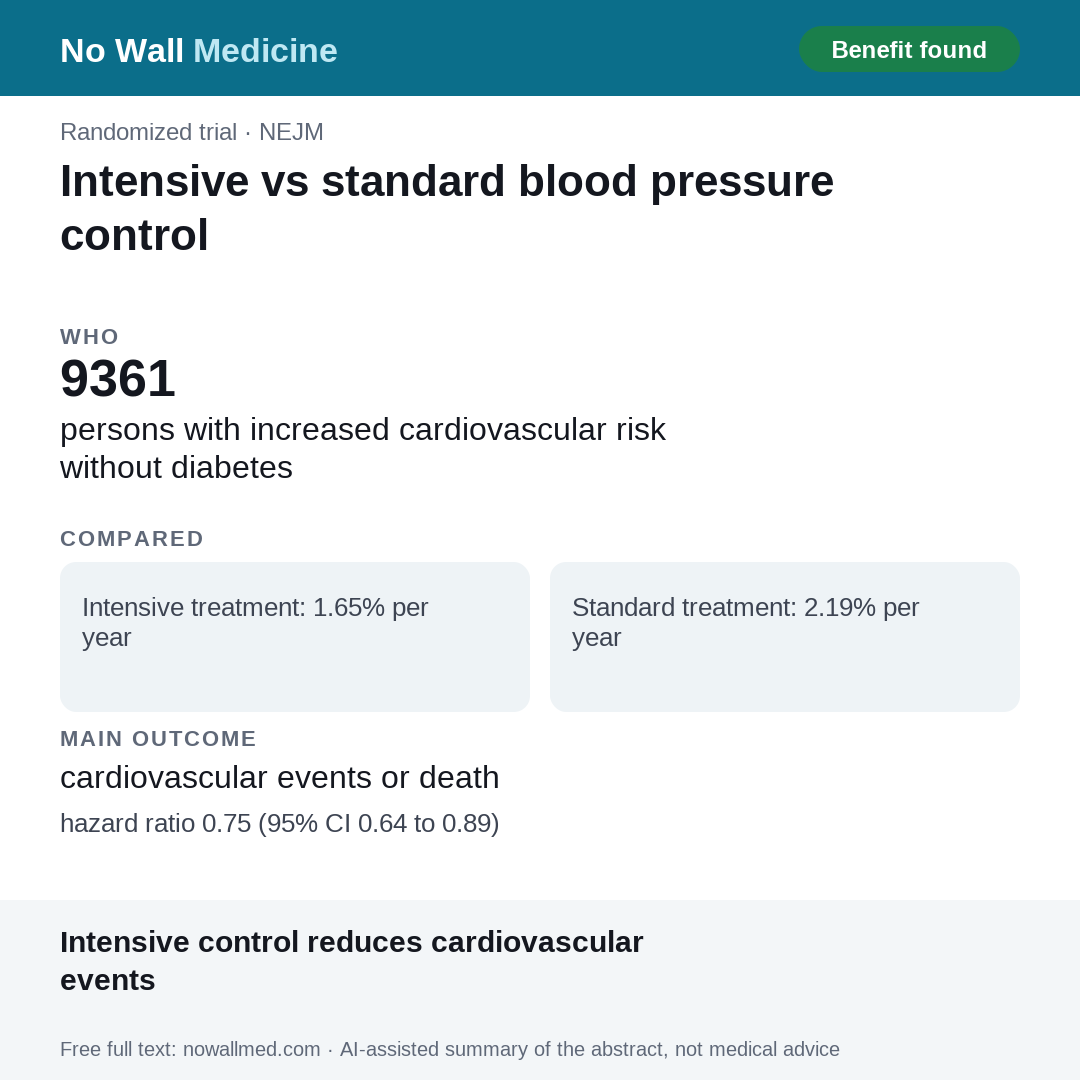
Randomized trialBenefit found
Intensive vs standard blood pressure control
Who
9361
persons with increased cardiovascular risk without diabetes
Compared
Intensive treatment: 1.65% per year
Standard treatment: 2.19% per year
Main outcome
cardiovascular events or death
Result: hazard ratio 0.75 (95% CI 0.64 to 0.89)
Bottom line: Intensive control reduces cardiovascular events
Funded by: National Institutes of Health
NEJM · 2015-11-09Download image
Trial at a glance
Bottom line: Intensive treatment lowered rates of fatal and nonfatal major cardiovascular events and death from any cause.
Clinical question
Does intensive blood-pressure control reduce cardiovascular events?
Design
Randomized, controlled, open-label trial. United States, 102 clinical sites, 2010-2013
Who was studied
9361 persons with increased cardiovascular risk, without diabetes
Key inclusion criteria
- age of at least 50 years
- systolic blood pressure of 130 to 180 mm Hg
- increased risk of cardiovascular events
Key exclusion criteria
- diabetes mellitus
- prior stroke
Interventions
- intensive-treatment: systolic blood-pressure target of less than 120 mm Hg
- standard-treatment: target of less than 140 mm Hg
Primary outcome
myocardial infarction, other acute coronary syndromes, stroke, heart failure, or death from cardiovascular causes. 1.65% per year vs. 2.19% per year; hazard ratio with intensive treatment, 0.75
Secondary outcomes
- all-cause mortality: hazard ratio, 0.73; 95% CI, 0.60 to 0.90; P = 0.003
Harms
higher rates of hypotension, syncope, electrolyte abnormalities, and acute kidney injury or failure
Limitations reported by the authors
- lack of generalizability to populations not included in the study
Funding
National Institutes of Health
Written with AI from the full paper; every number was checked against it. Read the paper before relying on it.
Key points
- 9361 adults with high cardiovascular risk but no diabetes were randomized to intensive or standard blood pressure control.
- Intensive treatment lowered the primary composite outcome rate to 1.65% per year versus 2.19% in the standard group.
- Serious adverse events like hypotension and acute kidney injury were higher in the intensive treatment group.
Headline and key points written with AI from the paper’s abstract, with every number checked against it. Read the paper before relying on them.
Was this summary helpful?
Subject terms
Cite this article
SPRINT Research Group, Wright JT, Williamson JD, et al. A Randomized Trial of Intensive versus Standard Blood-Pressure Control. NEJM. 2015. doi:10.1056/NEJMoa1511939
Spotted a mistake? Suggest a correction