Protocol-based care did not improve septic shock outcomes in emergency departments
A randomized trial of protocol-based care for early septic shock
Why it matters: Found no mortality benefit of protocol-based resuscitation over usual care in early septic shock, challenging the Rivers EGDT approach.
Related landmark trials: Rivers EGDT
Context written by the No Wall Medicine team.
Randomized trialNo clear difference
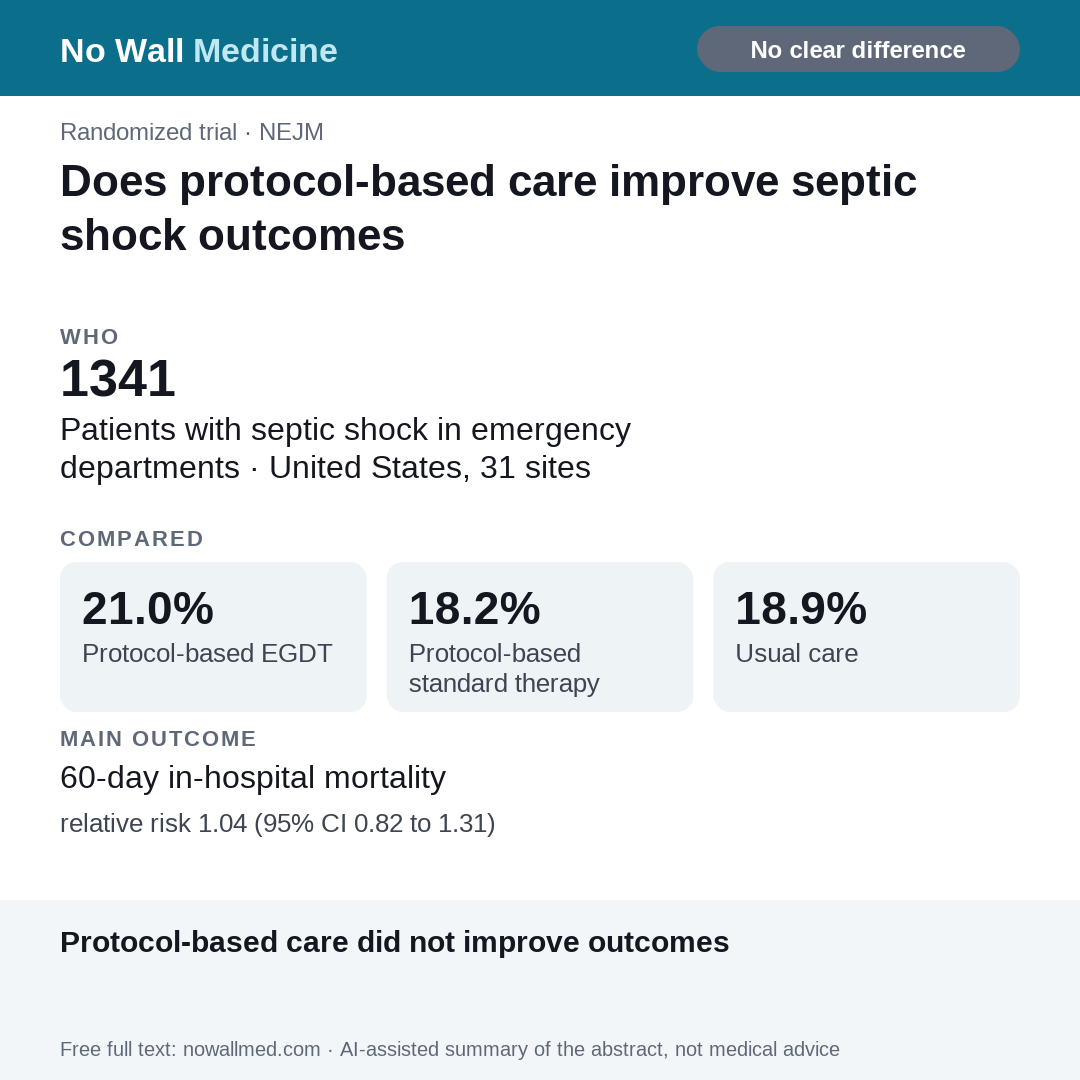
Does protocol-based care improve septic shock outcomes
Who
1341
Patients with septic shock in emergency departments · United States, 31 sites
Compared
21.0%Protocol-based EGDT (92/439)
18.2%Protocol-based standard therapy (81/446)
18.9%Usual care (86/456)
Main outcome
60-day in-hospital mortality
Result: relative risk 1.04 (95% CI 0.82 to 1.31)
Bottom line: Protocol-based care did not improve outcomes
Funded by: National Institute of General Medical Sciences
NEJM · 2014-03-18Download image
Trial at a glance
Bottom line: Protocol-based resuscitation did not improve outcomes in septic shock patients.
Clinical question
Does protocol-based care improve outcomes in septic shock?
Design
Multicentre, randomized trial. 31 United States emergency departments, 2008-2013
Who was studied
1341 patients with septic shock
Key inclusion criteria
- at least 18 years of age
- suspected sepsis
- two or more systemic inflammatory response syndrome criteria
- refractory hypotension or serum lactate level of 4 mmol per liter or higher
Interventions
- protocol-based Early Goal-Directed Therapy (EGDT): intravenous fluids, vasopressors, inotropes, and blood transfusions
- protocol-based standard therapy: no central venous catheter, inotropes, or blood transfusions
- usual care: standard care
Primary outcome
60-day in-hospital mortality. 21.0% in EGDT, 18.2% in standard therapy, 18.9% in usual care
Secondary outcomes
- 90-day mortality: no significant differences
- 1-year mortality: no significant differences
- need for organ support: no significant differences
Harms
higher incidence of acute renal failure in standard-therapy group
Limitations reported by the authors
- important limitations to our study
- no routine resuscitation protocols for septic shock
- no adjustment for multiple testing
Funding
National Institute of General Medical Sciences
Written with AI from the full paper; every number was checked against it. Read the paper before relying on it.
Key points
- Researchers studied 1341 patients with septic shock in 31 US emergency departments.
- 21.0% of protocol-based EGDT patients and 18.9% of usual-care patients died within 60 days.
- No significant differences were found in 90-day or 1-year mortality rates.
Limitation the authors note: The study was conducted in a tertiary care setting, which may not be generalizable to other settings
Headline and key points written with AI from the paper’s abstract, with every number checked against it. Read the paper before relying on them.
Topics
Spotted a mistake? Suggest a correction