A Randomized Trial of Shunting for Idiopathic Normal-Pressure Hydrocephalus
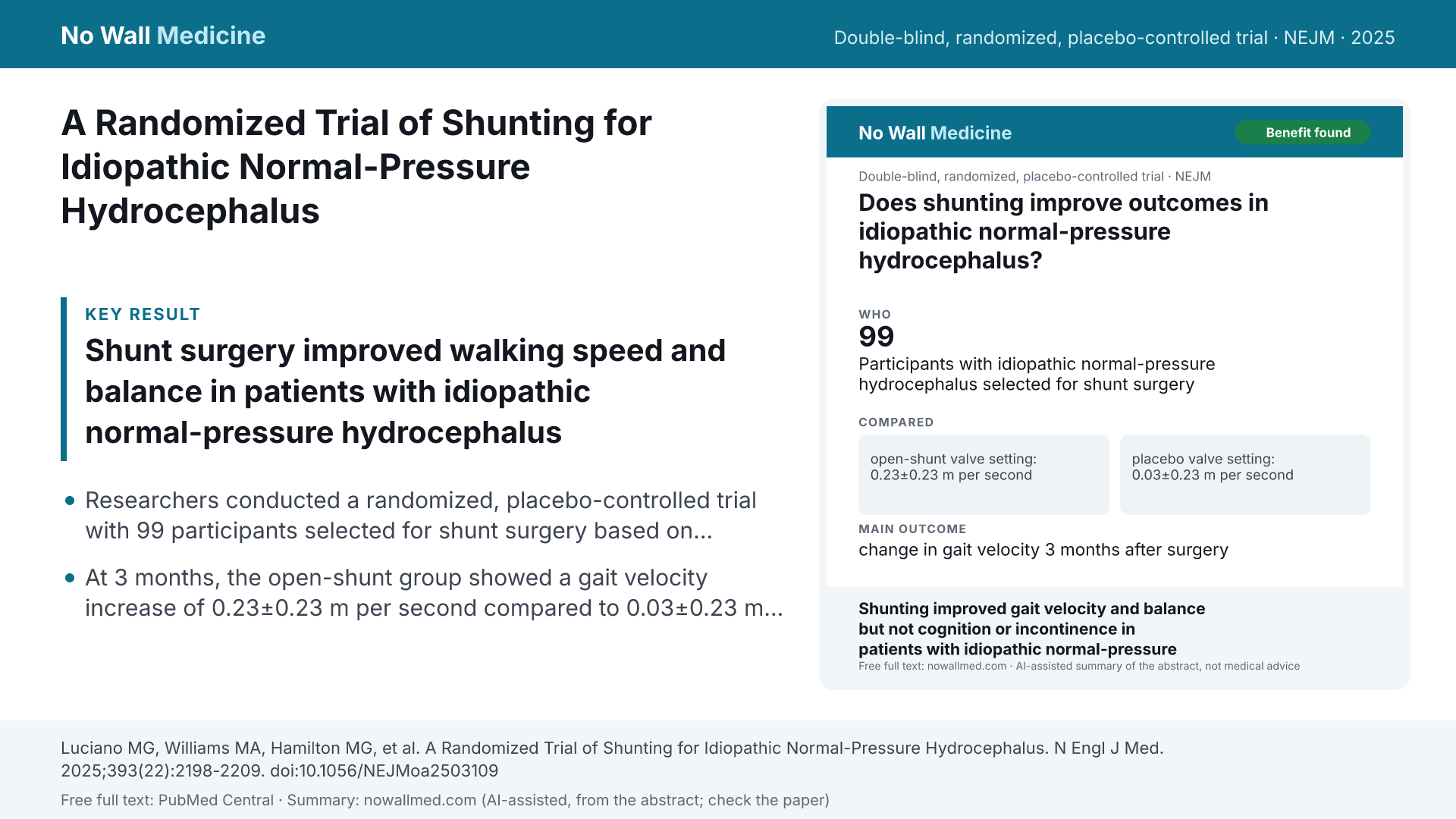
Key result: Shunt surgery improved walking speed and balance in patients with idiopathic normal-pressure hydrocephalus
Double-blind, randomized, placebo-controlled trialBenefit found
Does shunting improve outcomes in idiopathic normal-pressure hydrocephalus?
Who
99
Participants with idiopathic normal-pressure hydrocephalus selected for shunt surgery
Compared
open-shunt valve setting: 0.23±0.23 m per second
placebo valve setting: 0.03±0.23 m per second
Main outcome
change in gait velocity 3 months after surgery
Result: treatment difference of 0.21 m per second (95% confidence interval, 0.12 to 0.31)
Bottom line: Shunting improved gait velocity and balance but not cognition or incontinence in patients with idiopathic normal-pressure hydrocephalus.
NEJM · 2025-09-16 · Funded by National Institute of Neurological Disorders and Stroke and Trial Innovation Network
Key points
- Researchers conducted a randomized, placebo-controlled trial with 99 participants selected for shunt surgery based on their response to cerebrospinal fluid drainage.
- At 3 months, the open-shunt group showed a gait velocity increase of 0.23±0.23 m per second compared to 0.03±0.23 m per second in the placebo group.
- The open-shunt group had higher rates of positional headaches at 59% compared to 28% in the placebo group, while subdural bleeding occurred in 12% versus 2%.
Discussion prompts
- Would these patients look like yours? Who was left out?
- Is the main outcome one that matters to patients?
- Is the difference large enough to change what you do?
Cite: Luciano MG, Williams MA, Hamilton MG, et al. A Randomized Trial of Shunting for Idiopathic Normal-Pressure Hydrocephalus. N Engl J Med. 2025;393(22):2198-2209. doi:10.1056/NEJMoa2503109
Free full text: PubMed Central · Summary and visual abstract: nowallmed.com/a/a-randomized-trial-of-shunting-for-idiopathic-normal-pressure-83dj1n/ (AI-assisted from the abstract; check the paper before relying on it).