A randomized trial of stereotactic versus conventional radiotherapy in young patients with low-grade brain tumors: occupational therapy-based neurocognitive data
Randomized trialBenefit found
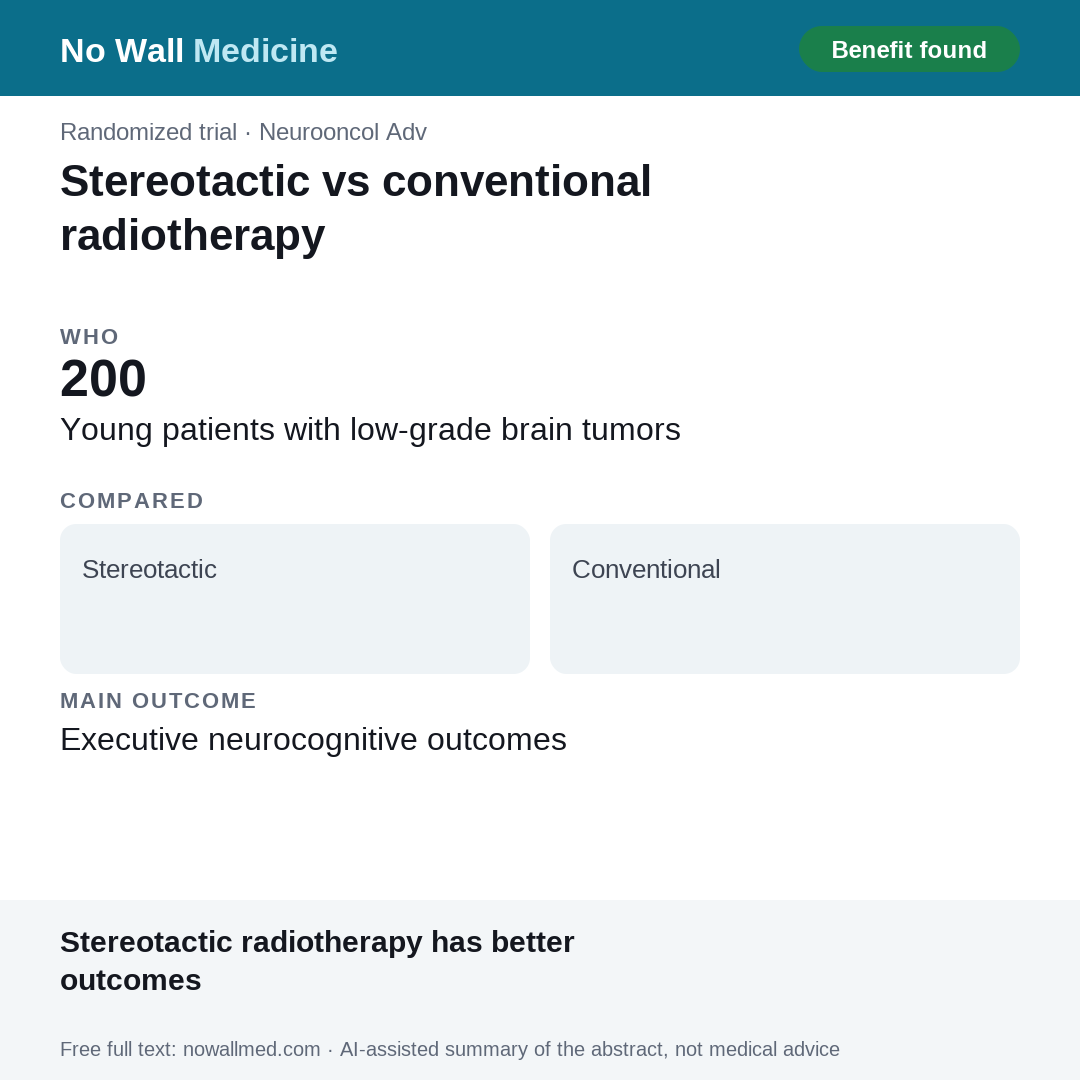
Stereotactic vs conventional radiotherapy
Who
200
Young patients with low-grade brain tumors
Compared
Stereotactic
Conventional
Main outcome
Executive neurocognitive outcomes
Bottom line: Stereotactic radiotherapy has better outcomes
Neurooncol Adv · 2020-10-01Download image
Abstract
Background
Radiotherapy for brain tumors in young patients is not only associated with improved survival but also long-term neurocognitive sequelae. We aimed to compare group differences in the executive neurocognitive outcomes in young patients with low-grade brain tumors treated with stereotactic conformal radiotherapy (SCRT) and conventional RT (ConvRT) techniques. Methods
This a phase 3 randomized trial that enrolled 200 young patients with benign brain tumors and low-grade gliomas. Patients were randomly allocated (1:1) to either SCRT or ConvRT arms and treated to a dose of 54 Gy in 30 fractions over 6 weeks. Lowenstein Occupational Therapy Cognitive Assessment battery was performed at preradiotherapy baseline, 6 months, and annually thereafter until 5 years. Executive functions measures included orientation, visual perception, spatial perception, motor praxis, visuomotor organization, thinking operations, and attention and concentration. The trajectory of these parameters was compared between the treatment arms over 5 years. Results
Two hundred patients were enrolled in the study (SCRT: 104 and ConvRT: 96). The median age was 13 years (interquartile range: 9-17); mean total neurocognitive scores over 5 years were significantly superior in SCRT arm as compared to ConvRT (difference in slope: 2.27, P = .024). Outcomes improved in the SCRT arm vis-à-vis ConvRT for the subdomain of visuomotor organization (difference in slope: 0.66, P < .001). Visuomotor organization scores significantly improved in majority of the substratification groups. Spatial perception improved in craniopharyngioma patients with SCRT technique as opposed to ConvRT. Conclusions
SCRT achieved superior outcomes compared to ConvRT in certain executive neurocognitive functional domains. We provide high level of evidence in favor of SCRT. Trial Registration. ClinicalTrials.gov Identifier: NCT00517959.
Cite this article
Chatterjee A, Goda JS, Gupta T, Kamble R, Mokal S, Krishnatry R. A randomized trial of stereotactic versus conventional radiotherapy in young patients with low-grade brain tumors: occupational therapy-based neurocognitive data. Neurooncol Adv. 2020. doi:10.1093/noajnl/vdaa130
Spotted a mistake? Suggest a correction
Top studies every Monday
The week’s key trials and guidelines in your specialties, plus any topics you follow. By email, free.
Get the weekly digest