Different types of online advertisements failed to produce a meaningful number of organ donor registrations
A Randomized Trial of Theory-Informed Appeals for Organ Donor Registration Using Internet Advertisements
Randomized trialNo clear difference
Do different theory-informed internet advertisements increase organ donor registration?
Who
People viewing internet banner advertisements · Diverse online sites via Google AdWords
Compared
Control and reciprocity messages: 0.51% click-through rate
Reciprocity message: 18 organ donor registrations
Main outcome
Clicks, page visits, and organ donor registrations
Bottom line: Internet banner advertisements generated clicks but did not lead to a meaningful number of organ donor registrations.
Kidney Int Rep · 2020-09-12 · Save PNG
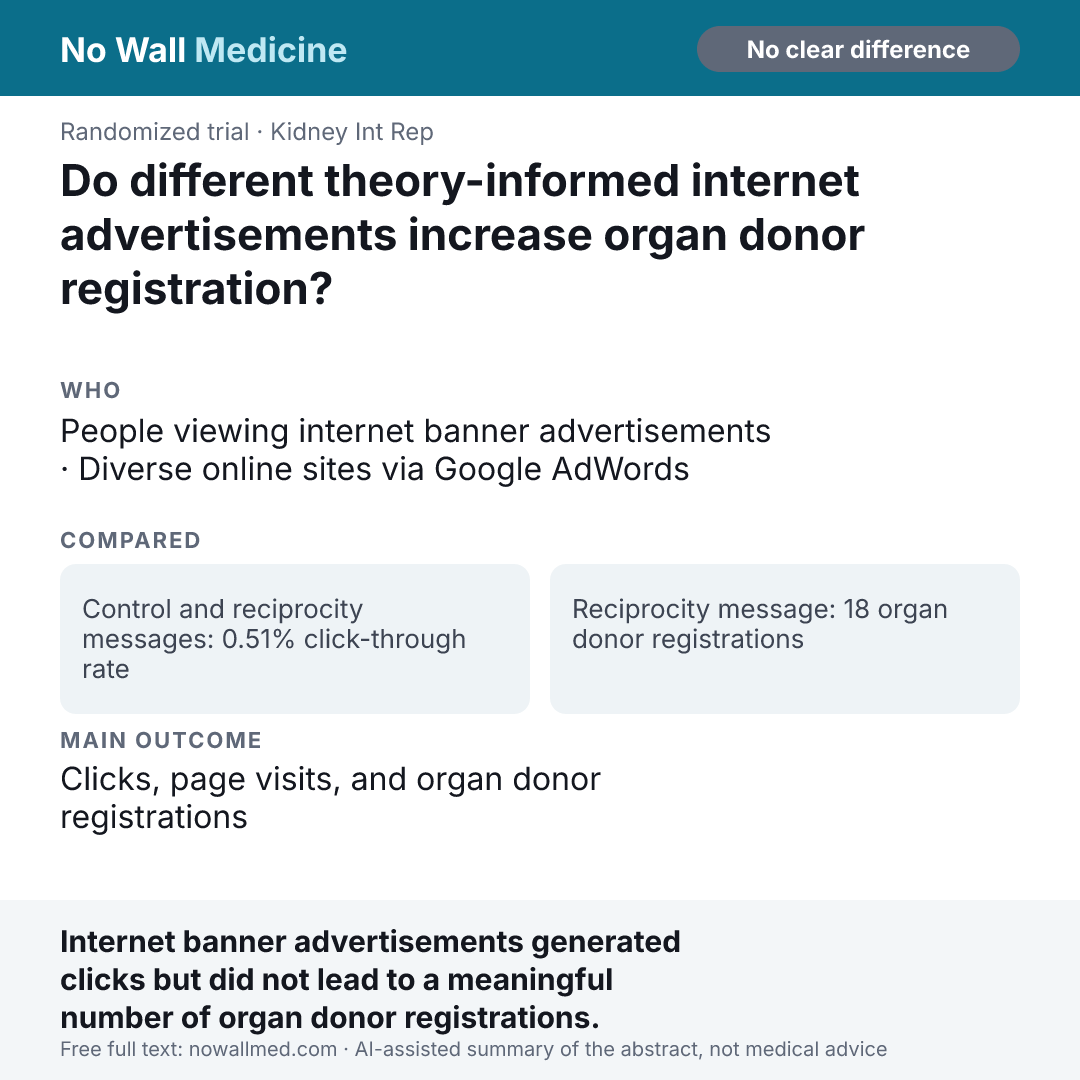
Clinical question: Do different theory-informed internet advertisements increase organ donor registration?
Key points
- Researchers used Google AdWords to randomly show five different types of theory-based organ donation messages to 5,156,048 people online.
- The messages achieved a click-through rate of 0.49% with 25,001 total clicks, but only 52 total organ donor registration events occurred.
- The message offering a free wristband, known as the reciprocity message, resulted in 18 organ donor registrations.
Headline and key points written with AI from the paper’s abstract, with every number checked against it. Read the paper before relying on them.
Was this summary helpful?
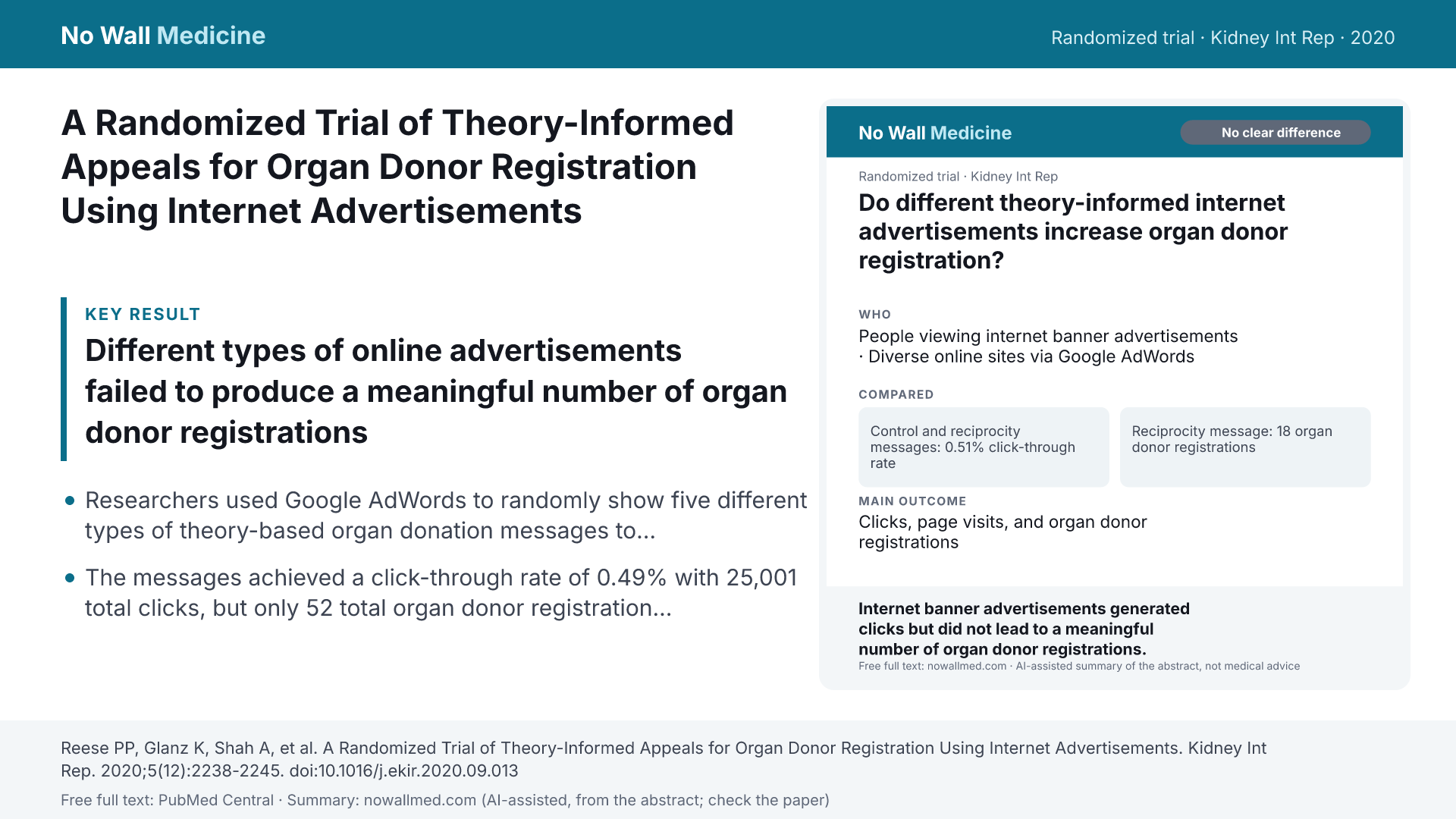
Headline, design, result, key points, caveat and citation as plain text.
Cite this article
Reese PP, Glanz K, Shah A, et al. A Randomized Trial of Theory-Informed Appeals for Organ Donor Registration Using Internet Advertisements. Kidney Int Rep. 2020. doi:10.1016/j.ekir.2020.09.013
Spotted a mistake? Suggest a correction