Fertility-tracking app use was not associated with higher chances of conception in a randomized trial
A randomized trial of web-based fertility-tracking software and fecundability
Parallel non-blinded randomized controlled trialNo clear difference
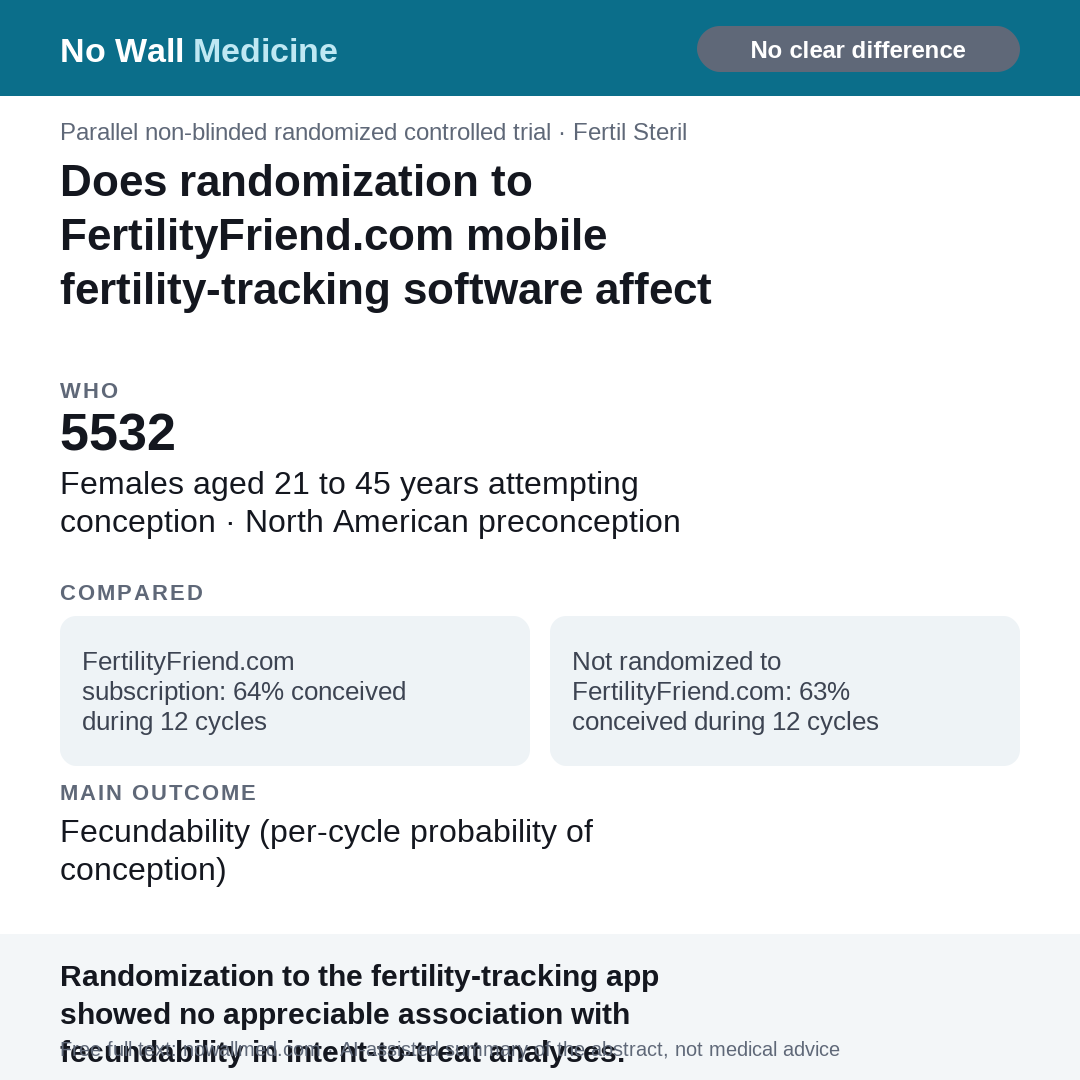
Does randomization to FertilityFriend.com mobile fertility-tracking software affect fecundability?
Who
5532
Females aged 21 to 45 years attempting conception · North American preconception cohort
Compared
FertilityFriend.com subscription: 64% conceived during 12 cycles
Not randomized to FertilityFriend.com: 63% conceived during 12 cycles
Main outcome
Fecundability (per-cycle probability of conception)
Result: fecundability ratio 0.97 (95% CI, 0.90-1.04)
Bottom line: Randomization to the fertility-tracking app showed no appreciable association with fecundability in intent-to-treat analyses.
Limitation: Per-protocol results are susceptible to unmeasured confounding.
Fertil Steril · 2023-02-10Download image
Clinical question: Does randomization to FertilityFriend.com mobile fertility-tracking software affect fecundability?
Why it matters: It was unknown whether using a mobile fertility-tracking application could increase the probability of conception per cycle for women attempting to become pregnant.
Key points
- Researchers studied 5532 women aged 21 to 45 years who were attempting to conceive for 6 menstrual cycles or fewer.
- In the main analysis, 64% of those assigned to the fertility app conceived within 12 cycles compared to 63% of those not assigned to the app.
- The intent-to-treat analysis showed no appreciable association between the app and fecundability, which is the probability of conception per cycle.
Limitation the authors note: The per-protocol analyses, which accounted for how strictly participants used the app, are susceptible to unmeasured confounding.
Headline and key points written with AI from the paper’s abstract, with every number checked against it. Read the paper before relying on them.
Was this summary helpful?
Subject terms
Cite this article
Wise LA, Wang TR, Stanford JB, Wesselink AK, Ncube CN, Rothman KJ. A randomized trial of web-based fertility-tracking software and fecundability. Fertil Steril. 2023. doi:10.1016/j.fertnstert.2023.02.005
Spotted a mistake? Suggest a correction
Top studies every Monday
The week’s key trials and guidelines in your specialties, plus any topics you follow. By email, free.
Get the weekly digest