Dolutegravir combinations showed higher rates of virus suppression than darunavir plus two nucleoside reverse transcriptase inhibitors
A Randomized Trial to Compare Dolutegravir Plus Boosted Darunavir Versus Recommended Standard of Care Antiretroviral Regimens in People With HIV-1, Whose First-line Non-nucleoside Reverse Transcriptase Inhibitor Therapy Has Failed: Final 96-week Results of the D2EFT Study
Randomized trialBenefit found
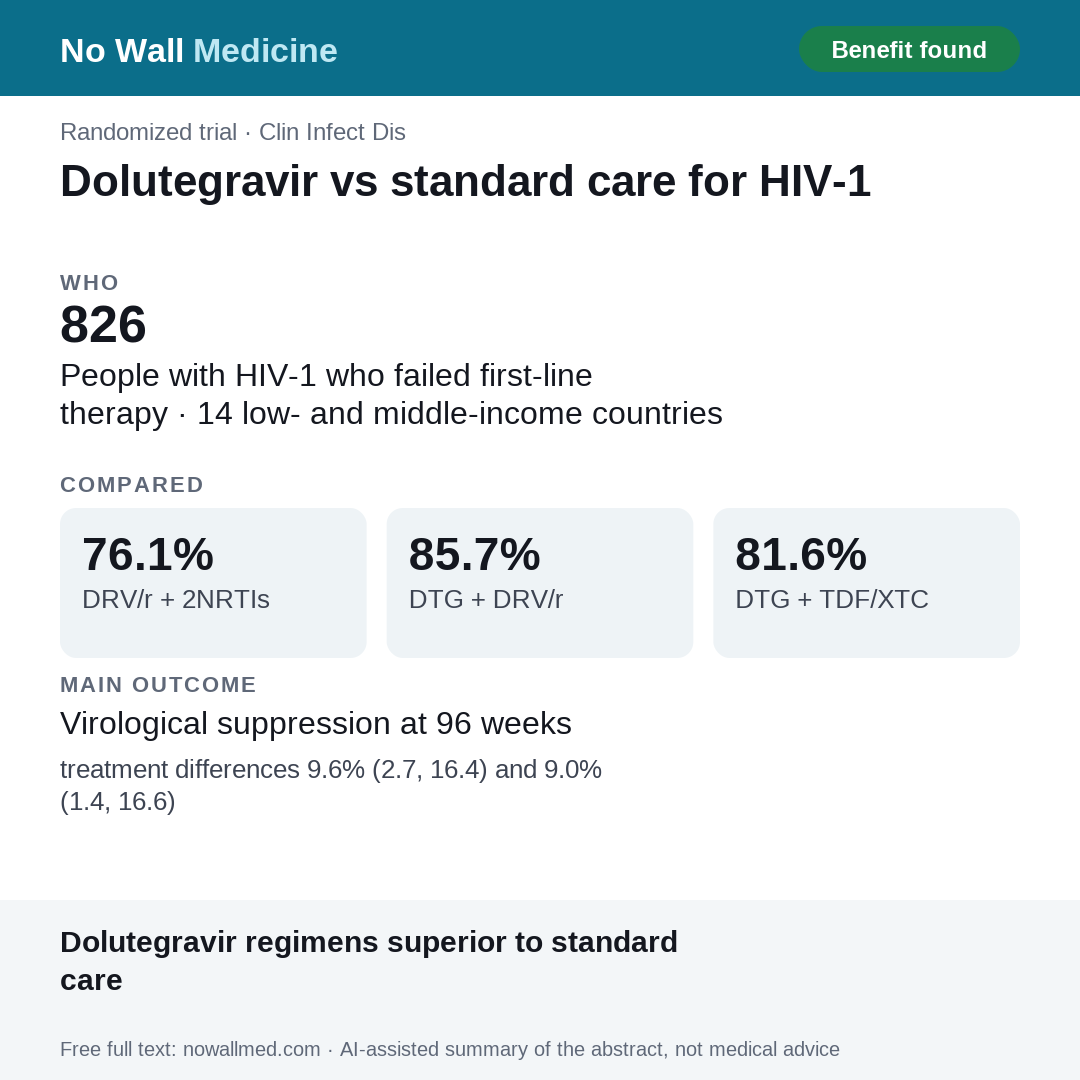
Dolutegravir vs standard care for HIV-1
Who
826
People with HIV-1 who failed first-line therapy · 14 low- and middle-income countries
Compared
76.1%DRV/r + 2NRTIs (191/251)
85.7%DTG + DRV/r (215/251)
81.6%DTG + TDF/XTC (231/283)
Main outcome
Virological suppression at 96 weeks
Result: treatment differences 9.6% (2.7, 16.4) and 9.0% (1.4, 16.6)
Bottom line: Dolutegravir regimens superior to standard care
Limitation: Emerging dolutegravir resistance
Clin Infect Dis · 2025-06-27Download image
Why it matters: Longer-term outcome data for second-line antiretroviral therapy is limited in resource-limited settings where genotypic resistance testing is often inaccessible.
Key points
- The study randomized 826 people with HIV-1 who failed first-line therapy to receive one of three different antiretroviral regimens.
- At 96 weeks, 85.7% of the dolutegravir plus boosted darunavir group and 81.6% of the dolutegravir plus tenofovir plus lamivudine or emtricitabine group achieved virological suppression.
- Intermediate or high-level dolutegravir resistance was identified in 13% of virological failures in the dolutegravir plus tenofovir group, but not in the dolutegravir plus boosted darunavir group.
Headline and key points written with AI from the paper’s abstract, with every number checked against it. Read the paper before relying on them.
Topics
Cite this article
Nyein PP, Borok M, Eriobu N, Kaplan R, Kumarasamy N, Avihingsanon A. A Randomized Trial to Compare Dolutegravir Plus Boosted Darunavir Versus Recommended Standard of Care Antiretroviral Regimens in People With HIV-1, Whose First-line Non-nucleoside Reverse Transcriptase Inhibitor Therapy Has Failed: Final 96-week Results of the D2EFT Study. Clin Infect Dis. 2025. doi:10.1093/cid/ciaf346
Spotted a mistake? Suggest a correction