Theory-based digital mental health intervention associated with fewer depressive symptoms and higher well-being
A scalable mental health intervention for depressive symptoms: evidence from a randomized controlled trial and large-scale real-world studies
Why it matters: Few digital mental health interventions are grounded in theory or tested using large-scale samples to address the global threat of depressive symptoms.
Key points
- Researchers studied 187 participants in a randomized controlled trial and two large real-world groups of 11,554 and 44,018 adults in China.
- The real-world studies showed a 35-36% decrease in depressive symptoms and a 14-16% increase in well-being over 21 days.
- The intervention is based on the Extended Process Model of Emotion Regulation, which is a theoretical framework for how people manage their emotions.
Headline and key points written with AI from the paper’s abstract, with every number checked against it. Read the paper before relying on them.
Was this summary helpful?
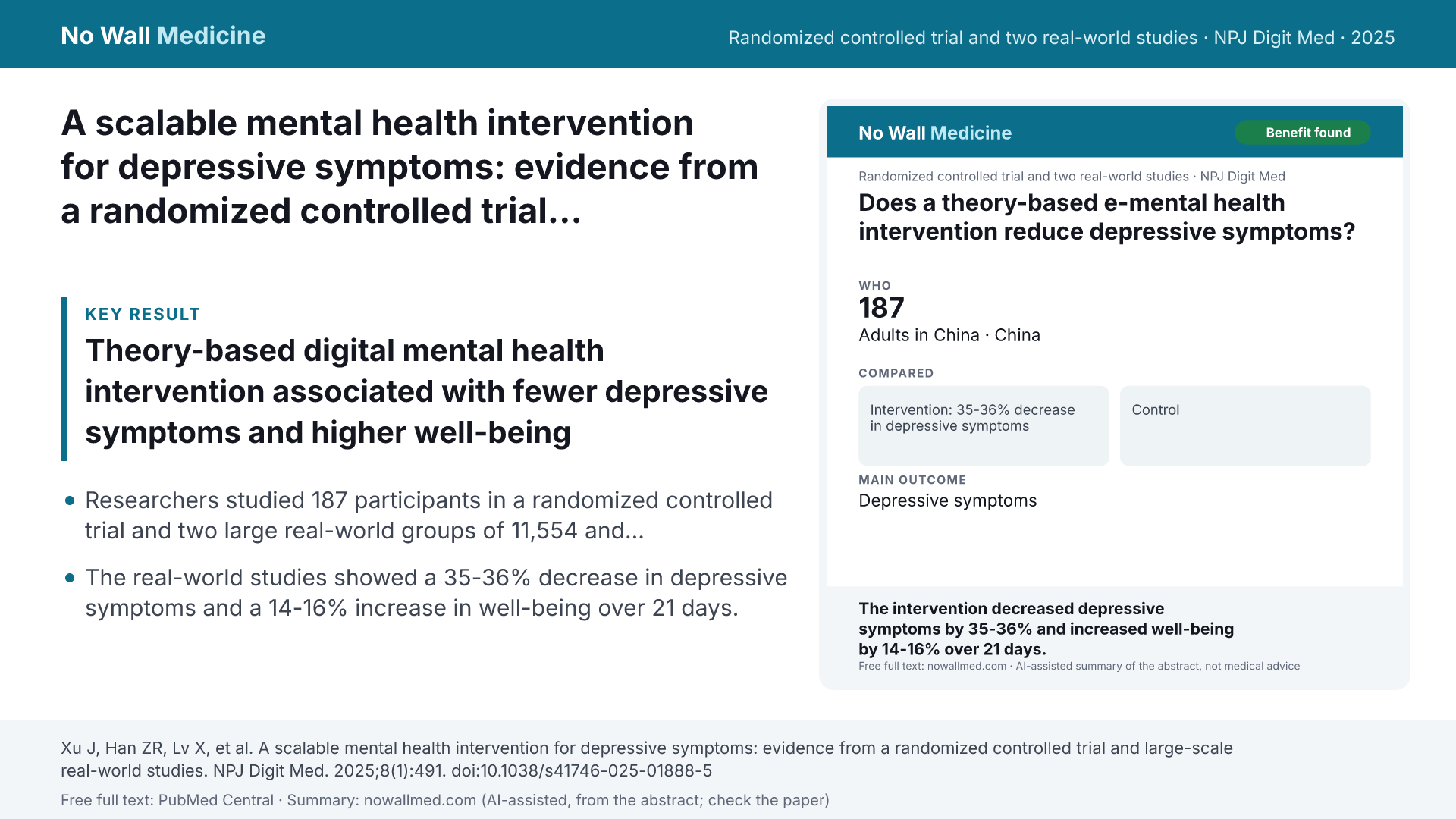
Headline, design, result, key points, caveat and citation as plain text.
Cite this article
Xu J, Han ZR, Lv X, et al. A scalable mental health intervention for depressive symptoms: evidence from a randomized controlled trial and large-scale real-world studies. NPJ Digit Med. 2025. doi:10.1038/s41746-025-01888-5
Spotted a mistake? Suggest a correction