Increasing secukinumab dose to 300 mg did not improve disease inactivity in ankylosing spondylitis
A secukinumab dose-escalation study in patients with ankylosing spondylitis not achieving inactive disease after 16 weeks of treatment
Randomized, double-blind trialNo clear difference
Secukinumab dose effect in ankylosing spondylitis
Who
322
Patients with ankylosing spondylitis · Multicentre
Compared
8.8%Secukinumab 300mg
6.7%Secukinumab 150mg
Main outcome
ASDAS less than 1.3
Bottom line: Dose escalation showed no difference
Rheumatology · 2024-08-12Download image
Why it matters: It was unknown if increasing the dose of secukinumab from 150 mg to 300 mg would help patients with ankylosing spondylitis who did not reach inactive disease levels.
Key points
- The study compared 101 patients receiving 300 mg of secukinumab to 105 patients receiving 150 mg after an inadequate response to 150 mg for 16 weeks.
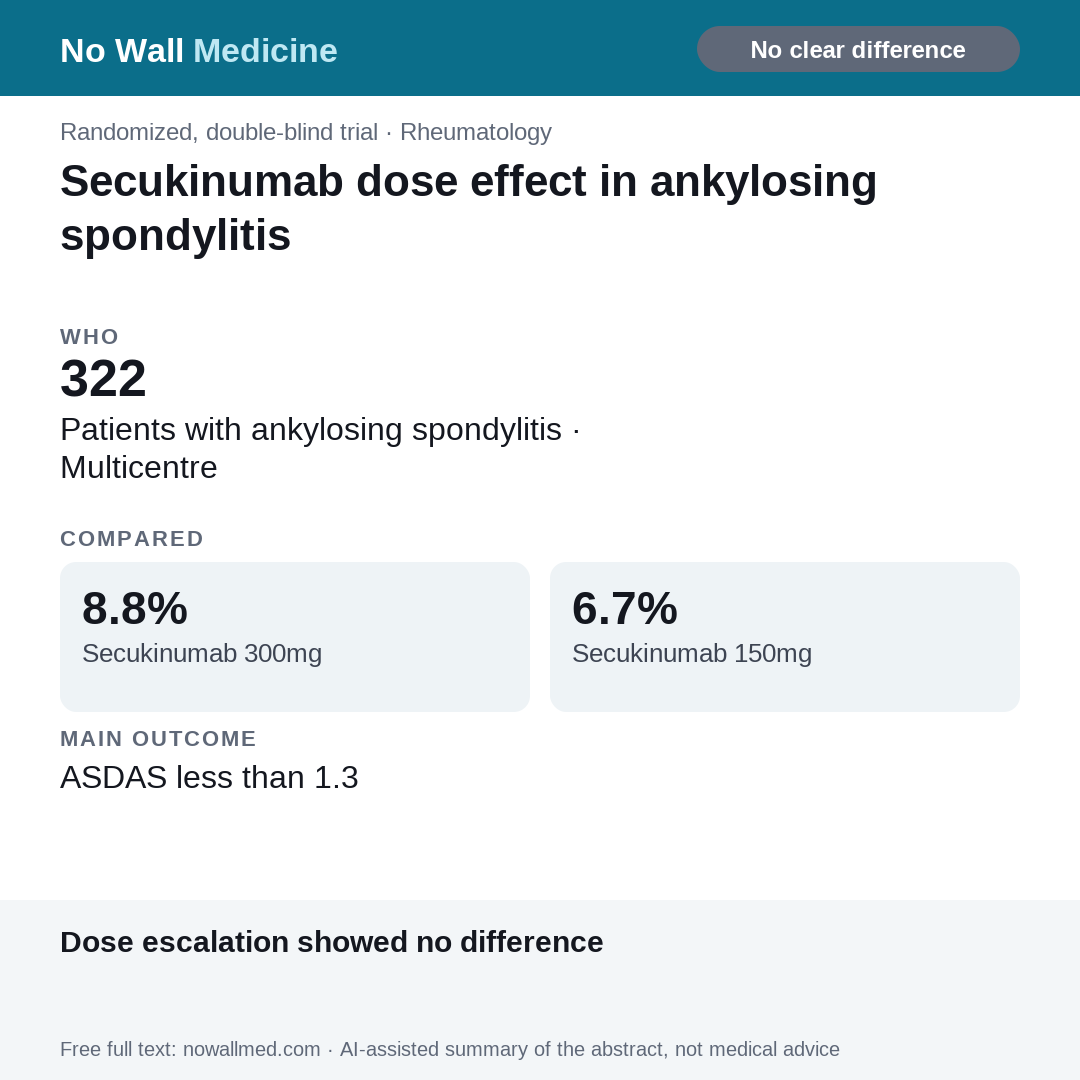
- At week 52, 8.8% of patients in the 300 mg group and 6.7% in the 150 mg group achieved an AS Disease Activity Score of less than 1.3.
- The incidence of treatment-emergent adverse events, or unexpected side effects occurring during treatment, was similar between both dose groups through week 52.
Headline and key points written with AI from the paper’s abstract, with every number checked against it. Read the paper before relying on them.
Was this summary helpful?
Subject terms
Cite this article
Deodhar A, Kivitz AJ, Magrey M, Walsh JA, Mease PJ, Greenwald M. A secukinumab dose-escalation study in patients with ankylosing spondylitis not achieving inactive disease after 16 weeks of treatment. Rheumatology. 2024. doi:10.1093/rheumatology/keae432
Spotted a mistake? Suggest a correction
Top studies every Monday
The week’s key trials and guidelines in your specialties, plus any topics you follow. By email, free.
Get the weekly digest